
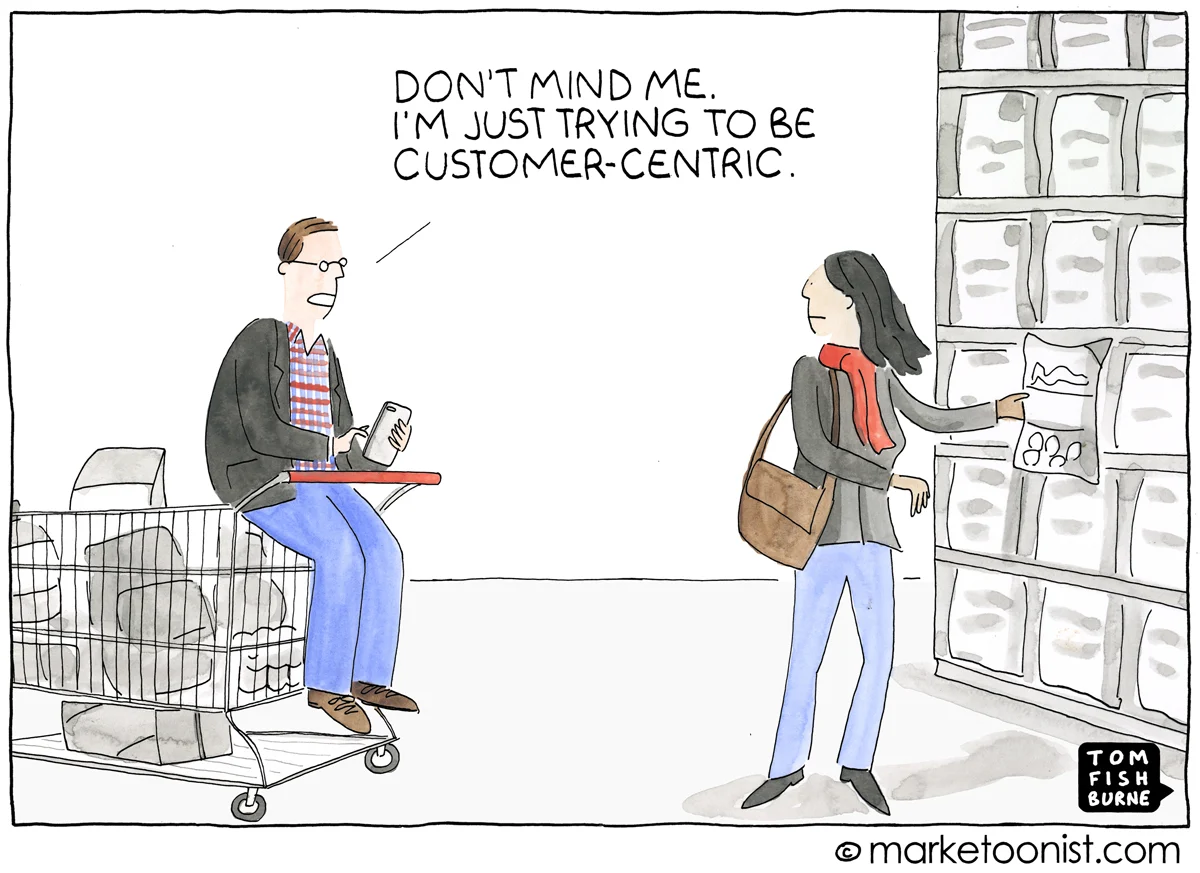

I don’t find “we’re customer-centric” very convincing. I want to know what happens when serving a customer gets in the way of hitting a target. That’s where I would look for the truth about a business.
Imagine you run a support team. You want customers to spend less time on the phone, so you start measuring call length. That sounds reasonable. Then you reward shorter calls. A representative who fixes a difficult problem in twelve minutes looks worse than one who ends an unresolved call in four.
The second customer calls back tomorrow. Your team handles another short call. On the report, people work faster. In the customer’s life, you’ve made the problem more annoying. Nobody had to announce that customers no longer matter. You changed what counted as success, and the people doing the work responded.
That’s the failure I’m interested in: a company starts protecting its internal version of success at the expense of the reason people choose it.
I don’t think this explains every struggling business. But Nike’s channel decisions, Starbucks’ operating trade-offs and IBM’s internal divisions give us concrete reasons to take the pattern seriously.
The reason people pay you
When I ask why a company exists, I’m not asking for the founder’s biography or the sentence above the fold. I’m asking what becomes possible for someone because the business exists.
Can they do something they couldn’t do before? Does a difficult job become easier? Can they stop worrying about a problem? Do they feel more capable, more welcome or better equipped for whatever they’re trying to do?
Those are different benefits. We need to find out which ones matter to the customers we’re serving, rather than choose the most flattering explanation.
Picture a founder who sees an unnecessary frustration. They believe people would choose something different if someone built it properly. They build a product, set standards, and decide what they won’t compromise. Customers respond, and the founder learns which parts of the idea actually work.
That understanding has to travel as the business grows. New people need to know more than what to produce. They need to understand why particular decisions matter. A procedure might say to spend time helping someone choose. The underlying reason might be that a confident purchase produces fewer mistakes and a better relationship.
If I preserve the procedure but lose the reason, I might eventually classify that time as waste. I can then improve an internal efficiency measure by removing something that helped earn the sale.
That’s what I mean by forgetting. The company might remember every detail of its history while losing track of what its decisions do for customers.
Nike put the channel ahead of the shopper
Nike gives me a particularly clear example because I don’t have to guess what management was trying to do.
On its March 21, 2024 earnings call, CFO Matt Friend acknowledged that, over the preceding year or so, Nike had focused more on achieving its marketplace-mix targets than on “serving consumer demand where the consumer is shopping.”
Nike had become too focused on where it wanted the transaction to happen. Its compensation documents make that priority tangible. For fiscal 2023, Nike’s annual executive cash incentive gave equal weight to adjusted revenue, adjusted digital revenue and adjusted earnings before interest and taxes. Digital revenue was included in the business’s revenue and also served as a separately rewarded objective.
I can understand the attraction of direct selling. A company may gain control over its presentation, improve its relationship with buyers and keep more of the selling price. Those benefits are worth weighing against the costs.
But customers don’t have to organize their shopping around your preferred channel. Consider someone who wants to try several brands, compare fit and get help from a store employee. For that person, the retailer does useful work. Moving the transaction onto your website doesn’t automatically preserve that help.
I read Nike’s admission as a warning about confusing a means with an end. The channel should help the company serve demand profitably. Once the channel becomes the destination, customer behaviour can start looking like an obstacle to the plan.
Nike reported revenue of $46.3 billion in fiscal 2025, down from $51.4 billion in fiscal 2024. That decline doesn’t tell us how much damage came from channel decisions rather than products, competition or other factors.
I don’t need to assign every lost dollar to one bonus measure to recognize the problem. The incentive design documents a priority. The CFO’s admission documents a conflict between that priority and serving shoppers.
What interests me is the decision rule underneath: would we rather make it easier for someone to buy, or have the purchase happen in the place that makes our internal report look right?
Imagine a business earns $40 online out of every $100 in sales. It wants online to represent half its revenue. It could reach that percentage by growing online sales. It could also reach it by keeping online sales at $40 while the rest fall to $40. The target improves while total sales shrink.
I’m not saying Nike deliberately made that calculation. I’m showing why a mix target cannot tell me, on its own, whether a business has become more useful or more successful. A percentage describes a relationship between numbers. It doesn’t tell me whether either number deserves celebration.
Starbucks improved the parts and questioned the result
Starbucks offers a different version of the same tension. In February 2007, Howard Schultz wrote an internal memo about the weakening of the Starbucks experience. He described automated espresso machines that improved speed but blocked customers’ view of drink preparation. He discussed packaging that supported fresh coffee at scale but reduced the aroma and preparation rituals in stores. Standardized design improved store economics while, in his view, making the stores less welcoming.
These weren’t obviously ridiculous decisions. Each addressed a real operating problem. That’s why I find the memo useful. I can picture the separate business cases. Faster service. Easier distribution. A cheaper store to build. Each proposal might look sensible on its own.
But the customer experiences the result of all those decisions together. They don’t encounter separate departments. They walk into a café. Schultz also wrote, “We have all been part of these decisions. I take full responsibility myself.”
That sentence stops me from turning this into a story about an innocent visionary and managers who ruined everything. The people who built a business can help make the choices that weaken it.
Nor would I claim that lost aroma explains Starbucks’ downturn. Prices, household finances and expansion complicate that account. The evidence doesn’t isolate how much particular experience changes affected visits. The useful lesson is more specific: an operating improvement can remove a benefit unless somebody evaluates both.
The subsequent machine choice illustrates a better response. Starbucks introduced the lower-profile Mastrena in 2008, keeping automation while aiming to improve contact between baristas and customers. The company said it had worked on the machine for more than five years.
I don’t read that as a demand to go backward. I read it as a reason to ask a better design question: can we retain the useful efficiency without sacrificing the experience?
People can care and still make the problem worse
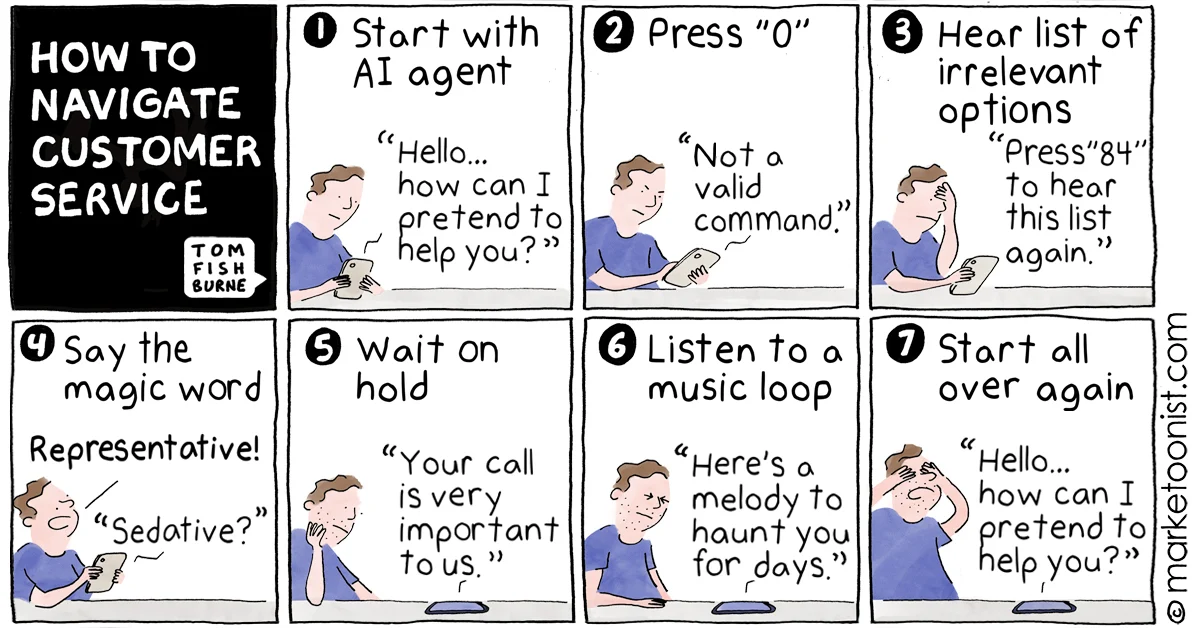
I think we lose something when we explain this behaviour by saying employees stopped caring. Sometimes a person understands the customer problem perfectly. They also understand what will happen to their performance review if they spend time fixing it.
Steven Kerr described the mismatch in his 1975 paper, On the Folly of Rewarding A, While Hoping for B. He examined reward systems that encouraged behaviour at odds with the outcomes people said they wanted.
I would apply that test beyond bonuses. Look at who gets promoted, whose work earns praise and who gets questioned when a number falls. Imagine a sales team paid for signed contracts, with little consequence when customers discover the product doesn’t fit. The salesperson can hit the target while creating a problem that another team inherits.
Or imagine a product leader who earns recognition for launching features. Making an existing task easier might matter more to customers, but it produces a less impressive announcement.
These are examples of how I would inspect a reward system, not arguments that sales commissions or product targets are inherently wrong. The trouble deepens when a target acquires a sponsor, a budget and a public commitment. Questioning it can mean questioning a senior person’s judgment. Now the organization has two problems: the original mistake and the cost of admitting it.
Argyris’s work describes how people can protect themselves from embarrassment or threat in ways that also prevent them from examining their own contribution to a problem. I would worry less about whether the company has politics and more about what those politics prevent people from changing.
Can an employee bring evidence that the plan harms customers? Can that evidence reach someone with authority? And can that person change the plan without first making the employee defend their loyalty?
Argyris explained why working harder isn’t enough
Chris Argyris gives me a useful distinction between improving how we pursue a goal and questioning the goal itself.
He called these single-loop and double-loop learning. Single-loop learning corrects problems within the existing objectives and rules. Double-loop learning also makes those objectives and rules open to examination.
Go back to the support team.
Single-loop learning asks how to shorten the calls. We might improve training, simplify the script or give representatives faster access to information. Some of those changes could help everyone.
Double-loop learning asks whether call length deserves to govern performance in the first place. Are shorter calls evidence of better service, or have we started ending conversations before resolving problems?
We need both kinds of learning. I wouldn’t want a company that debates its purpose every time someone processes an order. But I wouldn’t want one that treats the target as untouchable, either.
Argyris described an unnamed company’s troubled Product X. People close to production and marketing recognized serious problems long before management abandoned it. Warnings weakened as they travelled upward, senior enthusiasm persisted, and people below eventually communicated less.
The detail that stays with me is that the information already existed inside the business. Hiring another researcher wouldn’t necessarily have solved it. Neither would another presentation reminding everyone to listen to customers. The organization needed a way for uncomfortable knowledge to change an authorized decision.
That is more demanding than inviting feedback.
Suppose I tell my team to challenge assumptions, then respond to the first challenge by explaining why the person doesn’t understand the strategy. What have I taught them?
I’ve made my response more informative than my invitation.
Argyris also distinguished what people say guides them from the rules their conduct appears to follow. I don’t need to call someone dishonest to examine that gap. I need to compare their stated principles with repeated choices.
“We put customers first” may be sincere. But if I repeatedly protect a delivery date over resolving a known customer problem, my decisions deserve scrutiny.
The customer shouldn’t have to manage your departments
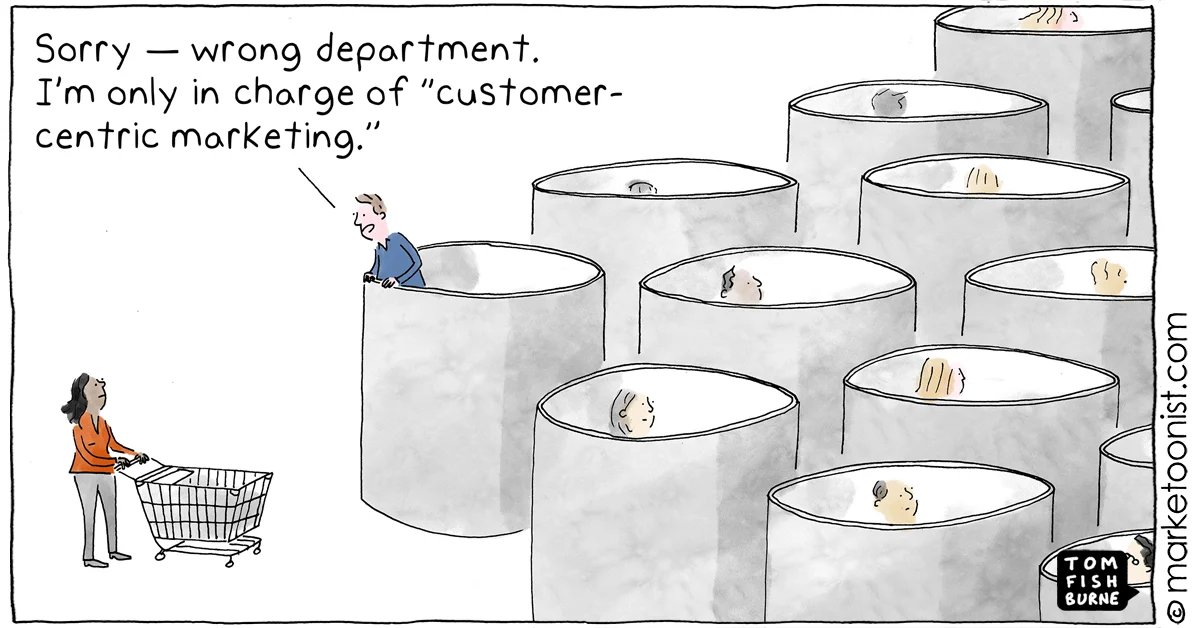
IBM helps me think about another form of inward focus: making customers navigate the way the company organizes itself. In the 1990s, IBM worked to keep the company together, improve coordination and put more emphasis on companywide results. Customer accounts from that period describe the value of bringing different kinds of expertise together.
One buyer put it plainly. Gillette’s chief information officer told Fortune: “I often don’t know if I need hardware or software or services, and I don’t care.” He expected IBM to find the appropriate expertise.
I hear a customer asking the supplier to take responsibility for the problem, rather than sell whatever sits inside a particular department.
Lou Gerstner joined IBM as an outsider in 1993. In IBM’s later account, he recognized that customers wanted integrated help while the company’s separate businesses pursued their own paths.
This gives me a useful test: when two departments make individually defensible choices, who checks whether the combined result works for the buyer?
Brian Chesky raised a similar issue in his 2024 Decoder interview about Airbnb. He described groups with different incentives and incompatible approaches, where a sensible local decision could make the overall company work worse. That’s his diagnosis; it doesn’t independently prove what caused Airbnb’s subsequent performance.
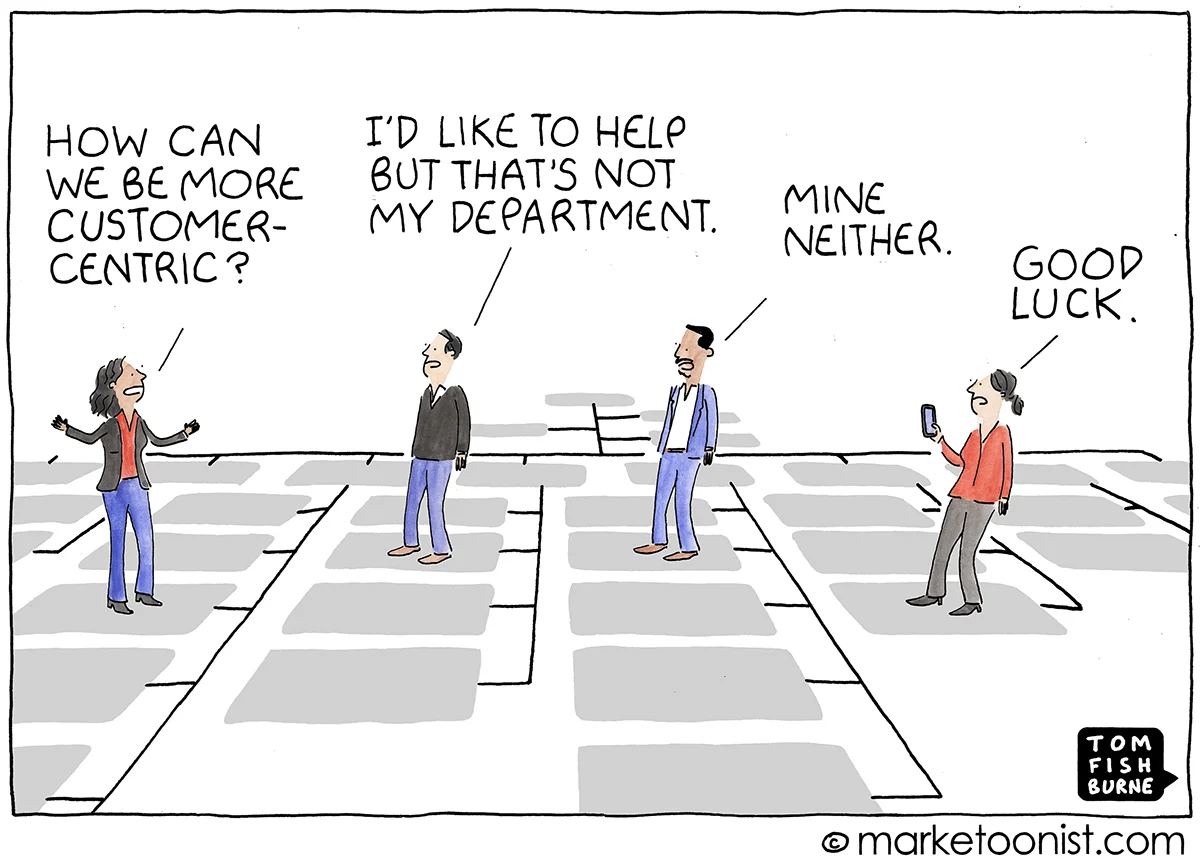
I don’t take these examples as an instruction to centralize everything. I take them as a reason to give someone responsibility for the complete customer experience.
Customer focus still requires commercial judgment
I don’t want this argument to become an excuse for bad economics. A company needs enough money to pay people, maintain its product and invest in what comes next. Serving customers at a cost the business can’t sustain doesn’t solve that problem.
IBM didn’t abandon financial discipline during its correction. Its 1995 proxy says that executives’ actual 1994 incentive awards depended primarily on pretax earnings and cash flow. Customer satisfaction and other individual contributions carried less weight.
That matters because the choice isn’t customers or numbers. I want the numbers to tell me whether the way I serve customers still works. I also don’t confuse customer focus with agreeing to every request. Customers can want different things. A request from one large account might make the product worse for everyone else. A popular feature might cost more to maintain than the business can support.
My responsibility is to understand those trade-offs and choose deliberately. I’d make another distinction: saving work and moving work aren’t the same.
Suppose I replace a service employee with a form. The company spends less, but now the customer must find documents, enter information we already hold and work out which category their problem belongs in. I may have improved the process. Or I may have handed the work to someone whose time doesn’t appear in my accounts.
I would check before celebrating the savings.
The same goes for a cost that looks unnecessary. Training, maintenance or a useful conversation can be hard to connect to a single sale. That doesn’t make the spending automatically valuable. But difficulty measuring its contribution isn’t evidence that its contribution is zero.
I would also resist protecting an old practice simply because the founder liked it. What matters is whether it still helps deliver something people value. A new method can preserve that benefit better than the original one.
This is where I draw a line between conviction and stubbornness. I can care deeply about making something possible while revising my assumptions about how to do it. And I can remove unnecessary work without assuming every activity whose value is hard to measure must be unnecessary.
What I would change
I wouldn’t begin with a customer-centricity workshop. I’d put a few actual decisions on the table. I’d choose a target that affects pay or promotion and ask the people working under it how they could meet it while making the customer experience worse.
I would make clear that I’m inspecting the target, not asking them to confess misconduct. The support example shows why: a well-intended measure can reward a result nobody originally wanted.
Then I’d trace one customer’s experience across the whole company. Not an average customer in a slide. A specific purchase, implementation or unresolved complaint.
Where did we make them repeat information? Which handoff delayed the result? Did we solve their problem, or did each department complete its assigned step?
Next, I’d follow the warning. Who first noticed the issue? What happened when they raised it? Did anyone have permission to change the requirement, or could everyone only apologize and work around it?
I’d also inspect the measurement itself. Fewer support contacts could mean a better product. They could mean people can’t reach support. More usage could mean greater value, or more effort to complete the same job.
I would pair the internal number with evidence of what changed for the customer. For support, that might include whether the issue stayed resolved, repeat contacts and total time spent getting help. None of those measures is perfect, so I’d keep reading the underlying cases.
Then I would change something consequential. Adjust the incentive. Give someone authority over the broken handoff. Remove an approval that adds no useful protection, or restore a capability we cut without understanding.
I would state what I expect the change to do, set a review date and check whether customers actually experience the improvement. If the evidence contradicts me, I’d revise the decision rather than search for a more flattering number.
Your decisions answer before your messaging does
This is why I treat positioning as a business question. A promise of simplicity has operating consequences. If I keep adding steps that make my company easier to manage and my customer’s job harder to complete, a clearer homepage won’t remove those steps.
Communication can explain a useful change. It cannot substitute for making one.
When I say a company has forgotten why it exists, I don’t mean it needs a better origin story. I mean its internal rules may no longer protect the benefit that earns the customer’s choice.
I want to know which rule we’d change when those two things conflict.
Take the target your team most wants to hit this quarter. Could they hit it while making life worse for the people buying from you?
If they showed you that happening, would you change the target?
Or would you congratulate them?
Leave a Reply
You must be logged in to post a comment.