
♛
23.06.2026
Words speak louder than words
Read Time: 8 Minutes
Hello
Before you dive into this week’s Digest, here are three other articles I published last week worth exploring.
Surveys are slop
Belief to position
Build with AI
Enjoy the words below.
The difference between the sentence you can sell and the decisions that move a market.
Words speak louder than words.
Read that again, because someone is selling it to you and hasn’t noticed it says nothing. The old saying had a second half that did all the work. Actions. Somewhere along the way, as it got turned into a service, the second half quietly got swapped for the first. What’s left is a pitch that better words beat worse words. That’s the whole product. Get clearer. Sharpen the message. Own one idea. Stop trying to do so many things at once, say the one thing crisply, and the market will finally get you.
The product is clarity. The promise is that your problem is a matter of wording.
I want to take that apart slowly because it’s twisted and almost everyone has it backwards. The people buying it and the people selling it alike.
Let me say where I’m standing first. I’ve spent years reading companies from outside the building. The words their customers use. Their filings. Who they hire. What they ship and what they kill. What they fund and what they walk away from. No inside access, no NDAs, no sitting in the room. The pattern I’m about to describe is one I keep finding from the outside, which turns out to be part of the point. (See the Gravity reports below.)
And I’ll give the other side its due up front, because my case is stronger if I do. The people who sell clarity are mostly not frauds. Saying things clearly is a real skill, and most companies are bad at it. A muddled sentence loses readers. A sharp one wins them. None of that is in question. The mistake is one word wide. They take the job of saying a company clearly and call it the job of changing where the company sits in a customer’s head. Those are two different jobs. One is cheap and done by Friday. The other is expensive and stays invisible for years. Selling the first while calling it the second is the whole trick. And the buyer never feels the swap happen, because they can’t name their own position any better than the seller can.
I. Why a clearer sentence can’t move you
Strip away the frameworks and ask the question beneath it all. Why would a customer believe anything you say about yourself?
They wouldn’t, and they don’t. People are built to tune out self-promotion. Tell someone you’re the premium choice and you wake up the part of their brain that asks, “Says who?” The claim and the doubt show up in the same breath. You’ve spent money to make a person doubt you at the worst possible moment, right before they were going to choose.
So the clearer you make the sentence, the cleaner you trip the reflex. Polishing the claim doesn’t lower their guard. It sharpens the very thing their guard is up against. A vague brag slips by. A crisp, well-built brag gets read for exactly what it is: a company telling you what to think about it, and the reader leans away. The wording pitch assumes the problem is that people don’t understand you, that they’d choose you if only they got it. The real problem is that they don’t believe you. And belief doesn’t run on how well you said it. It runs on whether saying it cost you anything.
II. The reality, and the four fields that agree on it
Here’s the part the wording pitch has to ignore, because the science runs right through it. Four fields, built by people who weren’t talking to each other. Developmental psychology, evolutionary biology, behavioural economics, and neuroscience. On this one question they all say the same thing. The mind tunes out cheap, unproven claims and trusts costly, proven behaviour. We learn it before we can read. It’s older than language. We never grow out of it.
Before I lean on any of this, let me say plainly what I’m not leaning on, because overreaching here would weaken the case, not help it. I’m not going to tell you that 93% of communication is body language. That stat is a misreading of one study and doesn’t mean what people think it does. I’m not going to tell you newborns copy faces using some mirror system they’re born with, because the famous study behind that claim failed to be replicated in a large follow-up a decade ago. And I’m not going to tell you one brain circuit reads other people’s intentions. The flashy versions of these ideas are the first thing a critic reaches for, and the argument doesn’t need them. It only needs the parts that hold up, and those are more than enough.
Start with kids, because they run the rule before they have words for it. In studies from the early 1970s, children got tokens to keep or give away. They watched an adult who either preached generosity or selfishness, and who then either gave or kept their own tokens. What the kids did tracked what the adult did. The preaching barely moved them. When the adult preached generosity and then pocketed the tokens, the kids pocketed theirs too. Weeks later, the kids still giving were the ones who had simply watched a generous adult say nothing at all. The lecture wore off. The example stuck. This is the whole reason “do as I say, not as I do” sounds hollow to everyone, including the kid it’s aimed at. We show up watching, not listening.
There’s also a good case that this bias isn’t only learned but built in, though I’ll treat that as a theory, not a fact. Two researchers, Cosmides and Tooby, argued the mind evolved a special knack for catching cheats, people who take the benefit without paying the cost. In a world that runs on trading favours, a group of trusting people is wide open to anyone willing to lie about their end. The evidence is oddly specific. Give people a logic puzzle in the abstract, and they flunk it. Rewrite the exact same puzzle as a social deal, “if you take the benefit you have to pay the cost,” and they nail it. They didn’t get smarter at logic. They got smarter at catching cheats. The same test, run on a non-literate people deep in the Amazon, comes back at Harvard-student level. And one patient with a specific kind of brain damage kept his general reasoning but lost the knack for spotting social cheating. The reading of all this is debated. The findings themselves are striking, and they point the same way as everything else. A claim that you’re trustworthy doesn’t plant a belief. It walks into someone already on the lookout for that exact move.
Evolutionary biology says why that lookout is worth keeping. When two animals signal each other and their interests don’t fully line up, the sender has a reason to lie, and a system of free signals falls apart, because the liar can send the same signal as the honest one at the same cost of nothing. Zahavi’s answer, back in 1975, was that the signals that survive are the ones too expensive to fake. The peacock’s tail is the classic case. It slows the bird down and draws predators, which is exactly why it’s trusted. Only a strong, healthy male can carry that thing and live. The cost is the proof. A signal is believed to the degree it would hurt to fake.
Behavioural economics got to the same spot from the other side. Michael Spence won a Nobel for showing what makes a degree a believable sign of ability. The cost, not the claim. A weak candidate can’t pay the time and effort a strong one can, so the price tag sorts the two when the words “I’m capable” never could. Samuelson set the frame even earlier, in 1938: if you want to know what people prefer, watch what they pick. Don’t ask. The gap between what people say they’ll do and what they actually do is one of the most frequently reported findings in the field. One review of 29 studies found that people talk up their preferences by about 3 times as much as they actually do. Another, across 77 studies and more than 45,000 people, found the same gap, leaning the same way, again and again. People mean it when they say it. They do something else when it counts.
Neuroscience points the same way, and here the careful version is the smaller one. The brain files what you’re told and what you live through in separate places. What you live through, built up by repetition, settles in below your awareness and shrugs off arguments. What you’re told sits on the surface and gets thrown out the second a louder claim shows up. There’s a known study where people with damage to one brain region stopped showing the usual brand effect, the one where seeing the label changes which cola they say they like. Real result, nice colour. But you don’t need the brain scan to know that earned beliefs stick and claimed ones bounce off. The behaviour already told you. Keep the brain science as seasoning. Don’t build the meal on it.
Put all four together, and it’s not subtle. A claim is the cheapest thing a company can send. Anyone can send it, for free, which is exactly why the mind files it as the least trustworthy thing in the room. So the thing the industry is selling, a clean sentence about yourself, is by the science’s own measure the weakest form of positioning there is. They’re handing you the bottom rung and charging you for the top.
III. Where a position actually lives
If the sentence can’t do the job, what can?
Costly decisions, made early, repeated for years. Who you hired and who you turned away. What you funded and what you starved. What you built yourself when buying would’ve been cheaper. And loudest of all, what you flat-out refused to do. These are the things that put you in a specific place in a customer’s head, because they stay true about you whether or not anyone’s watching.
The reason they work and the sentence doesn’t comes down to one thing. A tagline is copied in a day. The way you run the company can’t be copied at all. It can only be torn down and rebuilt, which means turning into a different company. Change your messaging, and you’ve changed something a rival answers by the afternoon. Change what you refuse to ship and you’ve changed something a rival can’t match without taking itself apart.
In-N-Out won’t franchise and won’t freeze a patty. That refusal has cost it billions in growth it chose not to take. Delete every word of its marketing and the refusal still says “fresh,” because there are no freezers in the building, and that’s a fact a customer can stand inside, not a claim. A rival copies the menu by Friday. It can’t copy twenty years of saying no to growth. Patagonia ran a Black Friday ad telling people not to buy its jacket, and later the founder gave the whole company away so its profits would fund environmental work for good. That move turns down real money, which is the only thing that makes it a signal and not a slogan. The same company also runs ads about caring for the planet, and those are cheap talk, nothing at risk but the ad budget. The given-away profits are the costly version of the exact same sentence. Same words, opposite meaning, and the difference is the cost behind them. Patek Philippe killed off its hottest watch in 2021 while buyers were paying multiples over retail to get one. Walking away from your bestseller is not a move a company chasing this quarter’s number can make. The decision is the proof, and the proof is the position.
The clearest version came straight from a Ford CEO, in a rare display of honesty about his own company’s weakness. Jim Farley explained why a legacy carmaker struggles with software. Ford handed the parts out to suppliers so it could pit them against each other on price. The result, in his words, is roughly 150 little computers running the car, written by 150 different companies that “don’t talk to each other,” a “loose confederation of software providers.” The code in something as basic as a seat belongs to the supplier, so Ford has to ask permission to change it. Then the tell. Ford decided to bring it all in-house and write the car’s software itself, in his phrase, “for the first time ever.” Tesla’s position, the car that gets better after you buy it, isn’t a line in a deck. It’s a decision made years earlier to own the whole thing from the ground up. Ford can announce anything it likes from a stage. Until it rebuilds how the car is actually made, that position isn’t for sale to it. Which is why Farley is spending years rebuilding instead of rewriting the brand book.
There’s a counter-example that proves the point rather than breaking it. BYD started building from the inside out in the same era, and now beats Tesla at the very integration Tesla pioneered. That doesn’t weaken the argument. It shows what the moat was really made of. Not the technology, which can be bought or copied. The fact that the whole company was built that way from day one. Anyone copying the surface never gets there. The only thing that matches a company built coherently from the start is another company built coherently from the start, which means a rival willing to pay the same price from scratch.
IV. Why it’s invisible, even to you
Now the strange part, and the part the usual story gets backwards.
Companies can’t see their own position. That’s half right, and it’s wrong on the half that matters. The decisions are perfectly visible inside the building. Everyone who works there feels the revenue the company turned down last quarter, the hiring bar that keeps killing candidates everyone liked, the feature sales keeps begging for that the company won’t ship. What’s genuinely hard to see, even from the inside, is the word. The one noun all those decisions have been proving. The founder is usually living a position they can’t name, because they built the thing out of their own gut feel for the problem and run every call through a standard, not a sentence.
Hold that next to how a customer carries a position, because the two are the same shape. Ask a loyal customer why they keep choosing you, and you get a smooth, confident answer made up on the spot. They reach for you automatically, then invent a reason. The choice happens below the explanation. The founder lives the position below the words in exactly the same way. The company proves it without naming it. The customer chooses it without explaining it. The industry treats it as the opposite on both ends: what the company says out loud and what the customer weighs out loud. That single flip explains the deliverable and why it does nothing. It also leaves an uncomfortable rule. Anything you can read off a homepage in five seconds, a rival copies in five seconds. A real moat stays invisible from outside until it’s too late to answer. If your position is easy to say and easy to spot, that’s not proof it’s strong. It can be the sign it’s hollow.
V. Why the industry sells words anyway
None of this is hidden. The science has been sitting in plain view for fifty years. So why does a whole profession sell the weakest layer and call it the strongest?
Part of it is belief. The field’s founders, Ries and Trout, taught that “perception is reality,” that there are no facts, only impressions in the customer’s head that the marketer shapes. Follow that to the end, and the product can only be words, because if reality is just perception, then a better-worded perception is a better reality. Category design adds: invent a new box, give it fresh language, and crown yourself king of it. Story research adds the trick: a reader lost in a good story argues back less. Each of these is a way to sneak a cheap claim past a mind built to tune out cheap claims. None of them changes what the company does. They change how the company talks, and then call the talking the position.
But the deeper reason isn’t belief; it’s money, and there’s no conspiracy in it, just water running downhill. Words can be packaged. A deck, a workshop, a thing you can price, sell off the shelf, and finish in six weeks. Changing how a company actually runs is none of that. It’s slow, it’s specific to one company, it’s mostly somebody else’s decisions to make, and you can’t bill for it cleanly. The market sells what it can package, not what actually moves a position. So it packages words. And there’s a pull from the buyer’s side too. A six-figure job from a name-brand firm sells confidence, not accuracy. We rate work as better the more effort we think went into it, so a slow, expensive, human-heavy process feels more trustworthy without being more correct, and it gives a leader something to point at if it all goes wrong.
“We followed the research.”
And the gap that leaves isn’t a wording gap. A Bain study of 362 companies found that 80% of executives believed they gave customers a great experience, while 8% of customers agreed. That spread isn’t a phrasing problem. It’s a substance problem. How the business actually runs doesn’t match what it says about itself, and no new sentence closes a hole that size. You can’t word your way across it. You can only build your way across it.
There’s a test a buyer can run on themselves after any project, and it’s brutally simple. Did your position in the market change, or did your description of it change? Did customers start saying something different about you, or did you just start saying something different about yourself? If only the second thing happened, you bought a tighter sentence. Maybe a good one. You’re standing in the exact same spot.
VI. Where this argument breaks
I’d be doing the thing I’m criticizing if I sold you this clean and hid the cracks. There are three, and the argument is only worth trusting if I name them.
The first. Costly doesn’t mean correct. A decision being expensive and hard to undo makes it hard to copy. It doesn’t make it right. Quibi raised close to two billion dollars, built a beautifully specific thing, premium short videos made for your phone, and shut down about six months after launch because almost nobody wanted it. The filter was real, costly, and coherent. It was aimed at a market that didn’t exist. A costly refusal pointed at a fantasy is just an expensive, hard-to-copy way to be wrong. Coherence is necessary. It isn’t enough.
The second. “Words are worthless” is itself false, and I’m not saying it. When the sender and the receiver want the same thing, cheap talk carries real information. Two economists proved that back in 1982. We coordinate with free words all day long. The honest claim is narrower. Words with no cost behind them carry little. Words with cost behind them carry plenty. Which points to the move the wording pitch never makes. You can make a word costly. A guarantee you’d bleed to honour. A public promise with a real penalty for breaking it. A product you visibly killed. Do that, and the word becomes a signal, because the line was never really between words and actions. It was between cheap and costly. Turn your claims into commitments and the whole problem flips in your favour.
The third crack is the one I have to admit instead of dodge. My own method can be twisted into something that can never be proven wrong, and I’m as capable of twisting it as anyone. Here’s how. I tell you to distrust what a founder says about their own company. But once you’re allowed to ignore what someone says, you can ignore any fact you don’t like by calling it a story they told themselves after the fact. And when you only study the winners, every one of them looks like they planned it from the start. There’s a timing trap too. A costly move can spike and then fade. When Anthropic refused to let the Pentagon use its models in certain ways, its Claude app shot to the top of the charts over the weekend, then cooled off and lost its lead to ChatGPT within weeks. That first spike told you almost nothing about where the company would really end up. So the method needs one rule to stay honest, and it’s the rule the wording industry never uses on itself. The reading has to be allowed to come back empty. Sometimes a company’s decisions don’t add up to anything. No clear identity, no real pattern, and the honest answer is that the company doesn’t yet have a position. Anyone who always finds a tidy answer isn’t reading the company. They’re inventing one, which is the exact thing I accuse the deck of, just wearing a lab coat. What separates real analysis from fortune-telling is being willing to say no.
VII. The test
So here’s the diagnostic, and you can run it on your own company this afternoon.
Pull your last fifty real decisions. Not your messaging. Your decisions. What you funded and what you cut, who you hired and who you passed on, what you shipped and what you refused, where the money actually went. Lay them out, delete every word you’ve ever published about yourself, and ask what one idea those choices prove on their own.
If a pattern shows up, you have a position, and the only questions left are whether you’ve ever named it to yourself, whether it’s aimed at a market that wants it, and whether your spending is widening the gap a rival would have to close or letting it shrink. If no pattern shows up, you don’t have a problem a sentence can fix. You have fifty decisions pointing in fifty directions, and no document pulls them into one. What you need isn’t better words. It’s a costlier pattern.
Either way, notice what the test never asked. It never asked what you say. It asked what you spent. Your messaging is the layer you can change by Friday and the layer your rival can copy by Friday. Your decisions are the layer that took years to build and would take a rival years to match, if they could survive becoming the kind of company that could.
That’s where your position lives. In the pattern under the P&L. In the years of saying no. Not in the sentence a consultant polished and sold back to you as the thing itself.
Actions speak louder than words.
Always have.
Always will.
Access 30+1 Positioning Reports
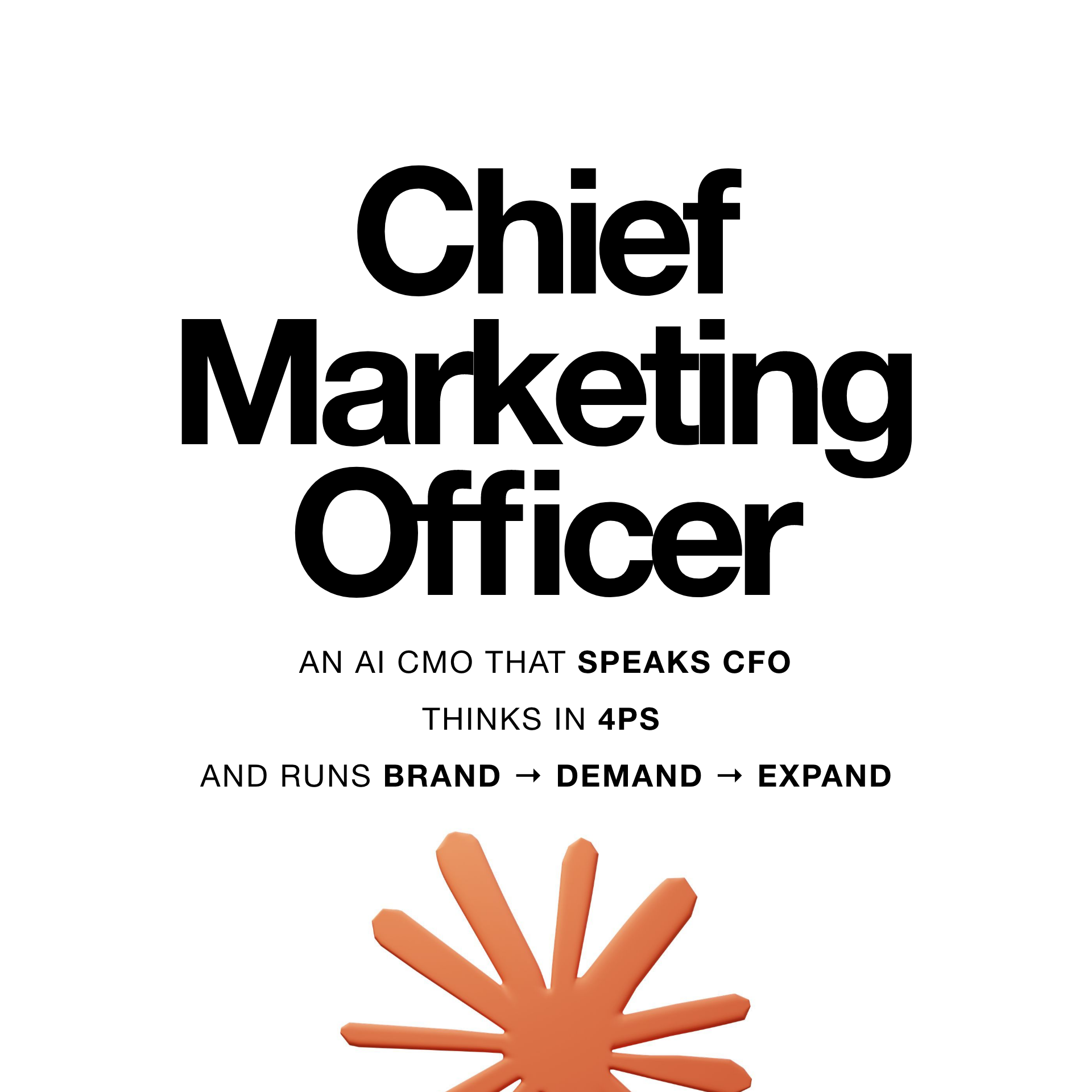
Here is your complete Open Source CMO package:
https://syng.fyi/OpenSourceCMO
What is inside:
– The full system prompt (the CMO brain)
– Output evaluator across 10 weighted dimensions
– 12 test prompts to run immediately
– Setup notes so you can install it properly in Claude
Install it in Claude, then work on your real questions.
Not theory. Application.
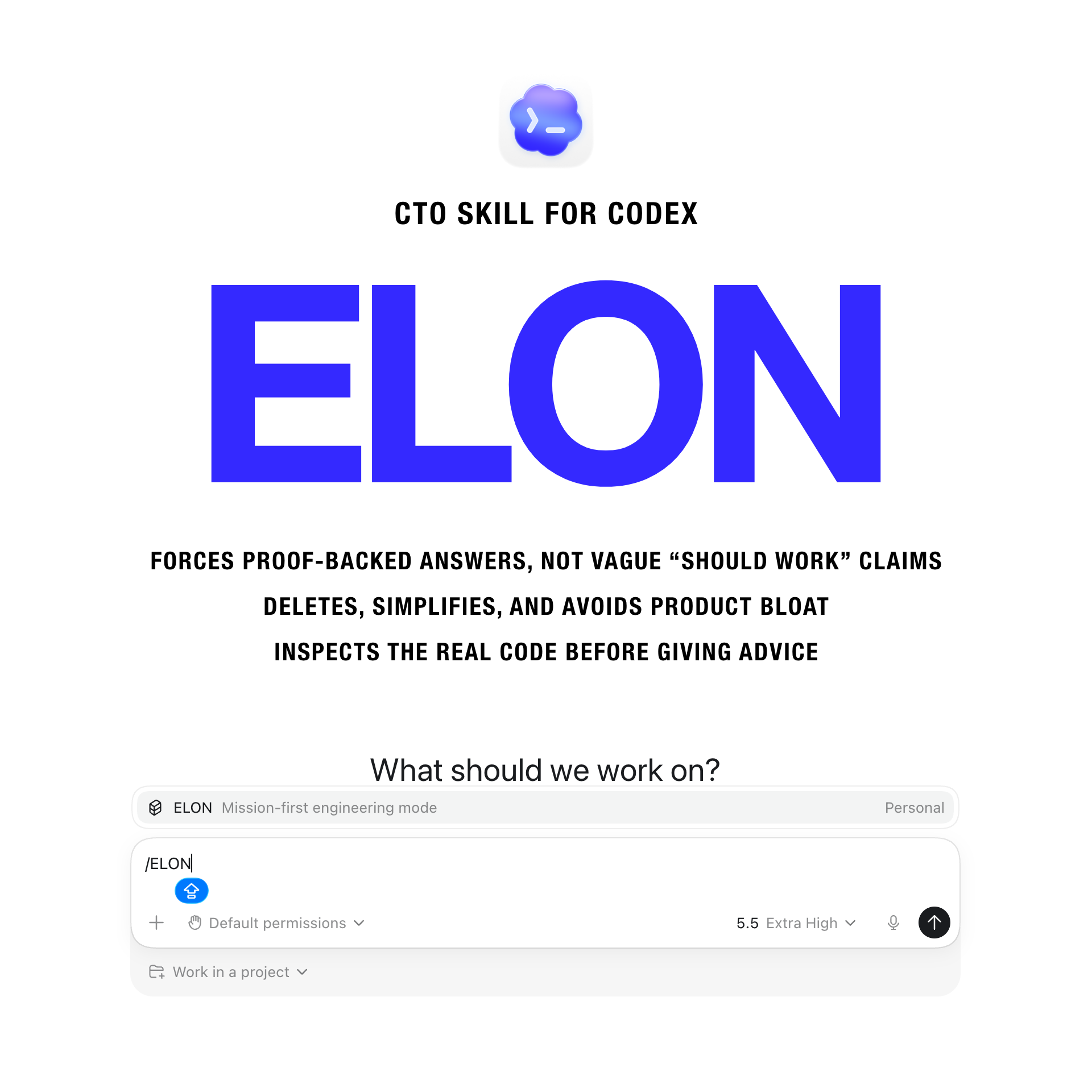
Here’s the complete ELON Codex Skill package.
Direct download:
https://syng.fyi/eloncodexskill
Public repo:
https://syng.fyi/elon-github
What’s inside:
- Codex skill folder
– Installer
– Codex UI metadata
– Optional AGENTS instructions
– Portable ELON Core version for other AI tools
– Setup instructions
ELON is free and MIT licensed.
It is not affiliated with, endorsed by, or sponsored by Elon Musk, Tesla, SpaceX, X, or any related company. The name refers to an engineering-style operating mode.
If it helps, send it to someone whose coding agent keeps creating more work than it removes.
If any of this was useful
There are three ways to go deeper, depending on where you are.
1. Read and follow.
Everything I publish is free. The Gravity Reports, the Digest, the positioning frameworks — all of it is on the blog and in your feed and inbox.
LinkedIn or X
2. Use the systems.
I’ve built a set of diagnostics for founders and brand leaders who want to do this work on their own company. Start with the free Analyzer — it shows you the gap between what you think you sell and what customers actually buy, and tells you whether AI recommends you when buyers are searching in their language. If you want to go further, the Clarity Kit and Monopoly are built for the same diagnostic, at a deeper level.
Start with the free Analyzer
CEO Clarity Starter Kit
Monopoly
3. Work together.
I take on a small number of advisory clients each year. These are founders and leadership teams who want an outside read on their position — the same method as the Gravity Reports, applied to their own company. If that’s relevant, the best place to start is a conversation. Better call Paul.
DIGEST