


“We need a new website.” By the time a studio hears that sentence, the client has already made the biggest decisions about the business. Who the company serves. What it’s selling. What gets funded. What the new site is supposed to fix. The studio wasn’t in the room for any of it.
I wrote about this back in 2023, after a conversation with Yousuf Afridi on my Dots podcast. Yousuf went from a branding studio to a big ad agency to consulting at PwC. We kept coming back to one difference between those worlds, and I haven’t been able to let it go since. This year I went looking for what has changed. Here’s what I found.
A brief and a business case
In an agency or a brand studio, the work usually starts from a business brief. The team turns it into a creative brief, the planners take it from there, and everyone moves into solution mode. How do we make this?
In consulting, the work starts earlier. You help the client shape the business case. What outcome are we after? What impact will it have? How do we get there? Where does the budget come from? Which teams need to be part of it? On the podcast, we talked about how that work sometimes goes all the way up to helping an executive team get ready for a board meeting.
The words change too. I’ve experienced this over two decades of my career, and it still holds. Agency conversations run on cost and fees. How much will this campaign cost? Consulting conversations run on funding and outcomes. What will this money buy, and what will it return? A client hears those 2 sets of words very differently, and it shows up in what they’re willing to spend and invest.
None of this is a knock on agencies. There’s a whole industry doing great work. The 2 jobs just happen at different altitude points. The business case gets shaped first, with the client, around outcomes. The brief comes after, and it carries whatever the business case decided.
What sits under every brief
Every brief sits on top of a stack of business decisions.
Who is this business for, and who should it stop chasing? What are customers really buying when they pick it? The product does something, and people also buy how it makes them feel, what it says about them and who they’re trying to become. Why should anyone choose this company over the others they’re looking at? What do competitors already own in the buyer’s mind, and where is there open ground? What can the business prove today? What should it fund, and what should it stop doing? How should it price and package what it sells, and which channels make sense? What would it have to change in how it hires, spends and runs for its promise to be true? And does the leadership team agree on the answers?
That whole stack is the strategy. The tagline and the home page sit at the very top of it. When the studio gets the call, somebody has already answered those questions, or skipped them. The answers live in the brief, in the founder’s head, or on an old slide from an offsite. And the brief starts from how the company sees itself. Nobody checked it against how buyers see it.
Think about the last time you hired a contractor for a renovation. You showed them a sketch. A good contractor builds the sketch well. A great one asks how you actually use the room before picking up a hammer. Who’s in there at 7 am? What gets in the way every morning? What are you planning to do with the house in 5 years? Sometimes the answers change the whole plan, and the sketch goes in the bin.
A lot of studios get hired as the first kind of contractor. They’re expected to build the sketch.
Where the thinking goes today
The thinking still happens. It just happens for free.
Melinda Livsey is a brand designer who went on The Futur to talk about her pricing. Her words: “I went from not doing strategy at all (using a questionnaire as my ‘strategy,’ I would say)… I wasn’t charging for that.” Her last strategy project went for $5,000.
Her before is easy to find on agency forums. A web designer on Reddit described sharing their strategic thinking in every proposal, because it feels necessary to win the project. They worried that asking for a paid discovery phase could cost them the job.
Blair Enns has spent years on this pattern. He said it plainly on Rocket’s Smarter Marketer podcast: “I was in the business of deprogramming agencies of their need to give their highest-value offering away for free.”
He has a second point that matters more. When a client hands an agency the answer, Enns compares it to a patient telling a doctor, “Here’s my diagnosis and the surgery I need. Just do it.” His line: “Yet agencies accept this from clients.”
So the studio gives away the thinking in the sales process, then builds from a diagnosis the client wrote for itself.
The brief they already know is off
Here’s the part that gets me. The people building from the brief often sense it’s off. I wrote about this earlier this year in a piece called “The Brief You Already Know Is Wrong.“
They stay quiet for a simple reason. Pushing back on a brief with only your own opinion can cost you the account. Building it as written means the work comes in soft, and you get blamed for decisions you never made. Either way, the studio carries the risk. What they’re missing is permission, and permission comes from proof that doesn’t come from them.
So they build it as written. And the cost shows up later, in the revision rounds.
Function Point’s 2025 report on creative agencies found that 79% routinely work beyond the scope of their agreements without extra pay. Ignition surveyed 273 US agency owners and executives in 2025. 57% said they lose $1,000 to $5,000 every month on work they never invoice. Another 30% lose more than that.
The Ignition write-up points to revisions as one place those hours go: “You have two rounds in mind. Your client has in mind that rounds continue until the work is right.”
Until the work is right.
Right against what?
A designer on r/graphic_design described a client who asked them to “work my magic” and avoid anything generic. Then came round after round of changes, until the work went back to the client’s usual style.
My read is that when nobody has settled on who the business is for, what its customers are buying and what it can prove, “right” keeps moving. Each round is the client looking for the strategy inside the design. A revision cap protects the hours. It leaves the target where it was.
The price squeeze
There’s a second cost, and it’s getting bigger. When a studio only sells the making, it gets compared on the making. Hours. Rates. Turnaround. And the making is the part AI keeps getting faster at. Productive surveyed more than 180 agencies in 2025. Close to 1 in 3 had already been asked for an “AI discount.”
Some clients now think the strategy is free too. A post on r/branding passed on what an agency owner had seen. Clients arrive saying they don’t need strategy because GPT already gave them one. They ask for a visual identity and brand guidelines, then use Claude to build the website.
Look at what a buyer with real budget is doing on the same forum, though. A client paying 3 agencies 10k each for a paid pitch task wrote: “The credentials and portfolios of these agencies no longer distinguish them, so I want to assess their strategic thinking before making a commitment.”
Tim Condon, Clutch’s Chief Revenue Officer, wrote this in a piece updated in September: “AI has made brand expression close to free.” And: “Now that execution costs almost nothing, brand strategy is the one part of the relationship still worth paying an agency for.”
The client surveys say the same thing. In AMI’s 2026 survey of 400 clients, 62% said they would replace an agency that doesn’t challenge their thinking. The IPA found 77% of clients value an agency that challenges their brief. Only 43% say they get it.
I think the GPT post and the paid-pitch post are both true. A strategy from a chatbot that only knows what you typed into it is free, and strategists on those same forums describe the output as generic. The strategy a client will pay for starts from their own business, their customers and their market, and it comes from someone who asked the hard follow-up questions.
Put it together. Clients are asking for someone to question the brief. A lot of the firms they hire have no way to do it. And the part those firms do get paid for keeps getting cheaper.
Why they don’t just add strategy
If the strategy is where the money is, why don’t studios offer it? The reasons are practical. Plenty of these firms have no strategist on staff and no method to follow. A senior strategist is a big hire for a small studio. An outside partner takes a margin, and sometimes the client. And strategy done on the fly in a first meeting comes out as opinion. Clients can tell.
The big consulting firms saw this gap years ago and closed it from the top. Accenture bought the design firm Fjord in 2013. Deloitte bought the Toronto digital studio TWG in 2021. They added the making to the business case. A 10-person studio can’t do that in reverse. It can’t buy a consultancy.
So the studio stays in its lane. It’s a reasonable choice. It’s also how a team with real skill ends up in the vendor seat for years.
What I built for it
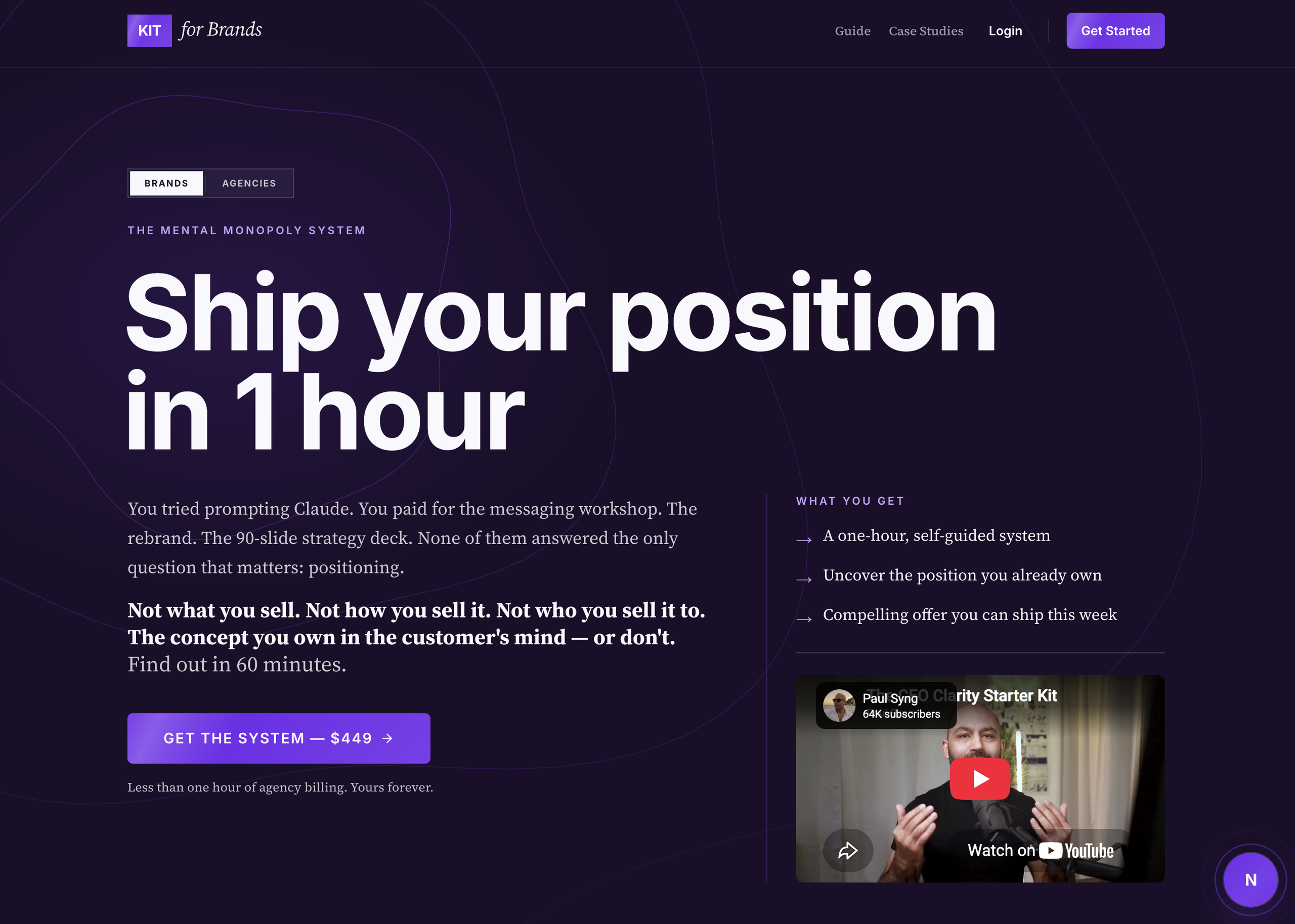
This is the gap I built Kit Enterprise to fill. It gives a firm that does execution the thinking a strategy team would do, without adding a salary. Web studios, brand designers, sales and GTM firms, and solo operators who do it all.
It starts with the questions. Kit gives the team 10 Audit questions and 9 Advisor questions, the ones a strategist would ask to get under the brief. They can run them live on a call, where Kit puts each question on screen and shows what to ask next. They can send the client a question sheet. Or they can type in answers they already have.
Each question comes with a coach note. When an answer comes back thin, Kit suggests a follow-up question. It flags filler words, claims with no proof and answers with no real customer words in them. That’s how a team that has never run a strategy session can still ask good questions, even when it came in late and the scope is already set.
Then it builds the strategy from the client’s answers. Here’s what comes out:
- Where the business stands today. A positioning score: what’s sharp, what’s vague and where the business contradicts itself.
- What the market sees from the outside. Research into the market and competitors, and the gap between what the business thinks it is and what buyers are likely to see.
- What customers actually buy, set next to what the client sells. Split that into what the product does, how choosing it feels, what it says about the customer, and who they want to become.
- The position. The concept the business should own, 2 alternatives, 3 niche options, value propositions, what sets it apart, the proof it has and the proof it still needs, and how competitors are likely to respond.
- How the business has to run. What gets funded, what gets cut, what changes right away, the hiring and spending choices behind it, and pricing, packaging and channel starting points.
- The plan. Priorities, a phased roadmap and a 30-day action plan.
- For the client’s leaders. A leadership brief so the team can agree on the direction, and a CEO memo that cuts the reports down to a 5-minute read.
Put the last 3 together, and you have the core of a business case. What the business should change, what it should fund and stop, what comes first and how the leaders get behind it.
Kit then turns the strategy into first drafts the team can react to. A homepage prototype in the customer’s words, a rewritten LinkedIn profile and launch post, and an origin story article in the founder’s voice. The studio still brings the craft, design, and judgment.
After the engagement, the client’s team gets a Second Brain they can load into Claude, ChatGPT or Perplexity. It holds the position, the evidence and the decisions. When someone asks what to build, what to charge, where to sell or what to say, it answers from that same source, and it pushes back when someone drifts. When the business changes, the studio can run the Advisor again. Kit keeps the earlier reports and notes what changed.
How it feeds the work you already sell
For a studio, the strategy feeds its own work. A brand team gets the concept to build the identity around, plus the feelings and the self-image the customer is buying. A web team gets the map of what customers buy next to what the client sells, the page copy and a prototype to start from. A sales or GTM firm gets the niches, the value propositions, the proof plan, pricing direction, channels and a roadmap to sequence the work. The client’s leaders get a brief they can line up behind, which makes every approval after that go faster.
The studio helped shape the business case, so it can write the brief itself.
The buyers I didn’t plan for
The first people to try and buy Kit Enterprise were a group I hadn’t planned for. Solo strategists and small shops who already do this work. They form their own read on a client, then run Kit to check it. And when 3 projects land in the same month, it’s the extra pair of hands they don’t have to hire.
That told me something. The people who already do strategy for a living wanted a second view on their own thinking. A studio walking into its first strategy conversation needs that even more.
What changes for the studio
The first meeting changes. The team walks in with questions nobody else at the table thought to ask. The talk moves to outcomes, budget and which teams need to be involved, before anyone talks about how the site should look.
The scope changes next. Strategy becomes a stage with its own price, in front of a brand project, a website build or a GTM plan, or sold on its own. The studio sells the thinking and the making, and the making lands better because it’s built on decisions someone tested.
Then the relationship changes. The studio helped decide who the business serves, what it funds and where it goes next. It’s the one who can rerun that work when the market moves. A cheaper quote from someone else is a weak reason to replace them after that.
Try the Kit
Pick the next client conversation on your calendar. Before you talk about scope or design, ask the 3 questions I wrote down in 2025. What’s the real goal behind this? What would success look like? How will this impact your business? Then add one more. Would everyone on your leadership team give me the same answer?
Watch the room. If they answer cleanly, you’ve learned something. If they look at each other, you’ve found the work that should come before the work.
That’s the conversation I want more studios having. I built Kit Enterprise so they can have it without hiring a strategist first, and I’d like to hear from you if you try it.
Leave a Reply