Why Elon’s Following Is Not the Marketing
Every time someone brings up that Tesla grew 10x with a marketing budget of precisely zero, the same comeback lands in less than ten seconds:
"Come on. Elon’s 240 million followers are the marketing."
It sounds obvious. It lets everyone nod, laugh off Tesla as a celebrity freak show, and go right back to whatever they were doing before.
It is also backwards.
Saying Elon Musk’s following is the marketing confuses a megaphone with gravity. It mistakes the effect for the cause. And if you look closely at what people are actually arguing when they say it, it turns out to be the exact same argument I watched six of the sharpest thinkers in marketing wrestle with in Six Doors, One Room — where everyone walked right up to the same empty room and stopped at the doorway.
Most people who argue about Tesla are standing at the wrong door.
Walking Tesla Through the Six Doors
In Six Doors, One Room, I watched the brand growth debate play out across six different camps. At Cannes, Byron Sharp and Mark Ritson shared a stage for the first time in a decade and agreed on five things — including one line everyone nodded at and immediately walked past: consistency is criminally undervalued. Consistency over time, of decision, of cue, of meaning.
The one thing they still could not resolve on stage was positioning. Sharp argued for distinctiveness (being recognizable and coming to mind first). Ritson argued for distinctiveness plus relative differentiation (being recognizable while carrying a meaning buyers attach to you, like Volvo with safety).
Look at what happens when you hold the "Elon’s following is the marketing" argument up against the doors from that essay:
- Door 1 — The Demand Space (Erich Joachimsthaler): Penetration is an operating metric inside a market, not how you pick which market deserves your capital. People did not wake up with a Category Entry Point for "battery-powered sedans," just like nobody woke up wanting a smartwatch before they wanted health and fitness. They wanted speed, energy independence, and a car that felt like the future instead of a slow golf cart. Tesla walked into that demand space before legacy carmakers believed it existed. Picking the room early got them through the front door — but once the sales charts turned vertical, BYD, Rivian, Hyundai, Ford, and GM all saw the room and walked right in behind them.
- Doors 2 and 3 — Recall and Meaning (Byron Sharp and Mark Ritson): When someone says "Elon’s X account is the marketing," they are making a pure Door 2 claim. They are treating Tesla as a giant mental-availability hack powered by a famous founder’s feed. Even if you step a foot left to Ritson’s door and add meaning, neither door explains where that meaning came from or what keeps it yours once funded competitors show up.
- Door 4 — The Product Lever (Jelena Veselinovic): Coming from the opposite side, Jelena pushes back on both the Silicon Valley cliché ("advertising is the tax you pay for being unremarkable") and the ad-world habit of pouring media onto a finished product. She argues the brand has to be baked into the product itself — like the 1915 Coca-Cola bottle you could recognize in the dark, or a supplement so well-made you stop comparing it to the hundred cheaper options next to it. As I noted in Six Doors, One Room, she calls this distinctiveness (being recognizable) while every example she uses proves difference (being un-substitutable). Tesla had that in spades: a Model Y with no dashboard clutter that outsold the Camry and RAV4, and a test drive that felt like a rocket ship. Yet Door 4 still stops one step early. Clean screens and fast zero-to-sixty times can be copied within two product cycles.
- Door 5 — The Two Rory Sutherlands: This is where the Elon myth really comes apart. There are two Rory Sutherlands. The first talks about cheap perceptual tricks — expensive aspirin relieving more pain, or serving free champagne on the Eurostar instead of making the train faster. Those moves can spark a single transaction, or a wave of viral hype, because of how human wiring works. They cannot hold a position, because a cheap trick is cheap to copy — and collapses the moment reality contradicts it. The second Sutherland writes about costly signalling, where the expense itself is the proof. Sutherland applies that to ad spend. My argument is its cousin: costly operating decisions, made every day and accumulated over years, are the real signal.
- Door 6 — The Floor Underneath: In the 1950s, George Miller showed that human working memory has a brutally low ceiling — you hold only three to five slots in any category without effort, and everyone else is invisible. In the 1970s, Eleanor Rosch showed that categories do not have clean edges; they have centers. A robin is a more obvious bird than an ostrich. Buyers do not run a feature checklist; they judge how close a brand sits to the center of the category.
Put all six doors together, and you see what actually sits inside the empty room.
A costly operating decision only turns into a lasting position at the end of a four-link chain: decision → perceptible proof → repetition → memory. The buyer never sees your internal budget, your engineering tradeoffs, or what you refused to build. They only see the proof those decisions leave behind, repeated until your name sits in one of George Miller’s three slots — right at the center of Eleanor Rosch’s category.
Now test the "Elon’s following is the marketing" claim against the actual receipts.
Receipt 1: The Timeline Is Backwards
People love to project today’s 240-million-follower Elon Musk backwards onto Tesla’s breakout years. The calendar doesn't allow it.
When former Tesla President Jon McNeill sat down on The Knowledge Project Podcast, he laid out the exact conditions when he joined to help scale sales 10x: "The marketing budget here is precisely zero, and you need to double the company every six to eight months". And when asked how anyone does that without being Elon Musk, McNeill corrected the assumption immediately: "Elon wasn't Elon back in 2014, 2015 when we started doing this. He didn't have 100 million followers on X".
Musk didn't reach 69 million followers until January 2022, and didn't become the most-followed person on X (at 133 million) until March 2023.
Yet back in April 2016 — six years before he crossed 100 million followers — Tesla unveiled the Model 3. Within 24 hours, buyers placed 180,000 reservations (roughly $7.5 billion in implied orders). Within two days, it passed 232,000, and climbed past 325,000 within days — with ordinary people camping outside Tesla stores to put $1,000 down on a car they had never driven.
How did Tesla even build Musk’s early audience? McNeill described it plainly: they grew it first around space fans watching rockets land upright, and then applied strict scarcity to Tesla — posting only genuine product breakthroughs like All-Wheel Drive and Ludicrous Mode.
Nobody followed an industrialist in 2015 because he had a clever content calendar or knew how to write viral hooks. They followed him because his companies were bending physics in public.
Decision (engineer reusable rockets and a mass-market EV that out-accelerates supercars) → Perceptible proof (rockets land on barges; buyers hit the accelerator on a test drive and feel a rocket ship) → Repetition → Memory.
The following didn't build the demand. The operating decisions built the following.
Receipt 2: Peak Followers Produced Falling Sales
If a founder’s follower count were truly the marketing engine moving cars, the curve would be straightforward: double the megaphone, and sales should surge right alongside it.
Look at what actually happened once Elon Musk became the biggest account on X:
- 2023: Musk crosses 133 million followers in March. Tesla hits its peak of 1,808,581 global deliveries.
- 2024: Musk surges from 169 million in January past 200 million. Tesla deliveries fall to 1,789,226 — its first annual decline in twelve years.
- 2025: Musk climbs past 225 million followers by October. Tesla deliveries drop another 8.6% to 1,636,129 — the sharpest slide in the company’s modern history.
Let’s name the nuance honestly, the same way you have to name the thumb on the scale whenever you cite brand data: two things happened at once in 2024 and 2025. Tesla’s core lineup aged while competitors caught up on range and price, and Musk’s feed drifted away from product breakthroughs into polarizing politics.
Both of those facts prove the same point. Reach is neutral at best, and corrosive at worst, when it stops pointing at undeniable product proof. Over 225 million followers could not stop two consecutive years of falling deliveries.
Then look at what turned the curve back up in 2026, while Musk sat around 240 million followers. Tesla delivered 838,149 vehicles in the first half of 2026 (up 16.3% year-over-year), including a 25% jump in Q2 to 480,126 and 486,532 in Q3. Did buyers suddenly come back because Musk discovered a better post format? No. They came back because Tesla shipped refreshed Standard trims of the Model Y and Model 3 — a product and pricing decision, not a follower decision.
Receipt 3: The Cybertruck Experiment
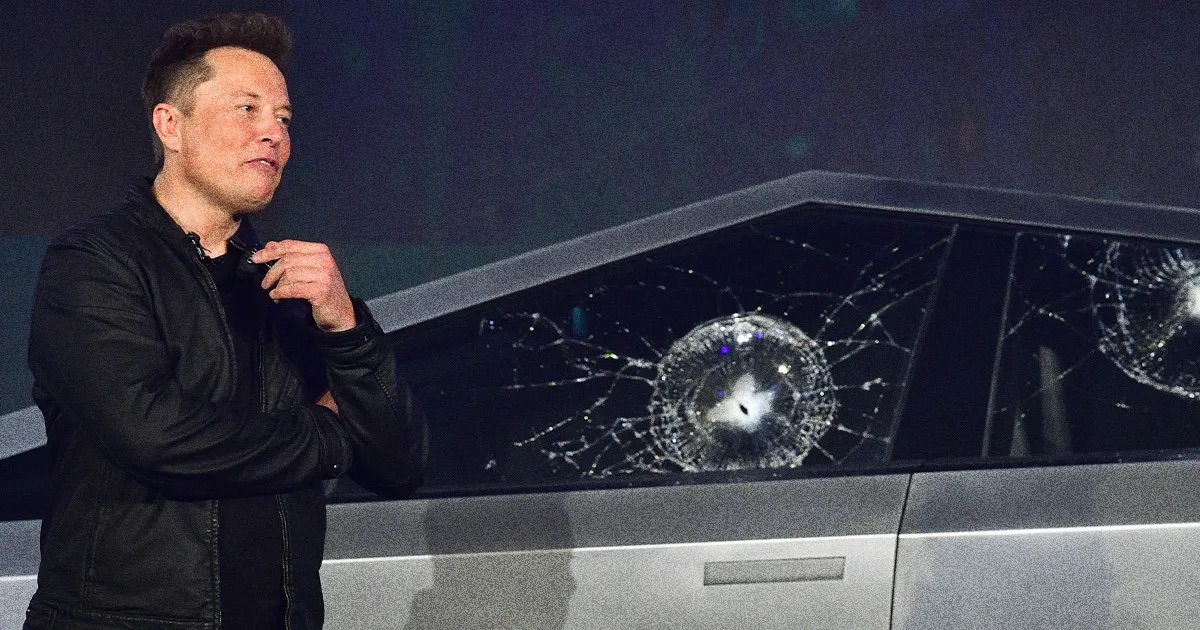
If you want a clean lab test separating Sutherland #1 (viral perceptual theatre backed by the world’s largest megaphone) from the four-link operating chain, look at the Cybertruck.
Unveiled at the height of Musk’s global fame, the Cybertruck pulled in over 1 million reservations at $100 a click. The factory line was designed for 250,000 trucks a year, with installed capacity listed above 125,000.
That is what a 240-million-person megaphone can do. It can generate global curiosity and convince a million people to put down a refundable $100 impulse deposit.
Now look at what happened when buyers actually had to wire real money. One caveat worth naming upfront: Tesla does not report Cybertruck deliveries separately, bundling them into its "Other Models" line, so the cleanest public yardstick comes from Cox Automotive’s U.S. sales estimates. Those numbers tell a brutal story:
- U.S. Cybertruck sales peaked at an estimated 14,416 in Q3 2024.
- Across the first three quarters of each year, estimated U.S. sales slid from 25,974 (Q1–Q3 2024) to 16,097 (Q1–Q3 2025) to 11,586 (Q1–Q3 2026 — just 3,519 in Q1, 3,744 in Q2, and 4,323 in Q3).
- By November 2026, Tesla had stopped taking orders on the lower Dual Motor and Premium trims, leaving only the ~$109,990 Cyberbeast on sale.
Roughly 93% of those one million reservation holders walked away.
Why? Because when the truck arrived dramatically more expensive than promised, racked up recalls, and failed the daily utility test for pickup buyers, the second link in the chain — perceptible proof — snapped. A 240-million-person following can get the whole planet to stare at a stage. It cannot force people to write a $90,000 check when the proof breaks.
Receipt 4: Detroit Already Buys a Bigger Megaphone
The last crack in the Elon myth is the quiet assumption that reach itself is rare — that nobody else can match the volume of Elon’s X feed.
Legacy automakers already buy vastly more reach than Elon Musk every single day of the year.
Across fiscal years 2023 to 2025, General Motors averaged $3.3 billion a year in marketing, advertising, and promotional expenses (2.0% of revenue). Ford Motor averaged $2.7 billion a year ($2.8 billion in 2024 and $2.7 billion in 2025, or 1.6% of revenue). Over that same three-year stretch, Tesla averaged $105.2 million across all marketing and promotional lines combined — 0.1% of revenue.
GM and Ford own the Super Bowl, NFL broadcasts, streaming TV, billboards, and dealership lots in every town in North America. If sheer reach — or Sutherland #2’s expensive ad-spend signalling — were enough to create un-substitutable demand, Detroit would own 90% of the electric vehicle market, and the Model Y would never have outsold the Camry and RAV4.
So what was sitting inside Tesla’s room, generating the signal that Detroit’s $6 billion combined ad spend couldn't drown out?
Strip the logo off Tesla’s operating decisions from the McNeill interview and look at what becomes visible:
- Cutting half the factory in two: Instead of syncing hundreds of robots to weld a 300-piece metal chassis skeleton, Tesla’s engineering head Doug Field rolled a Hot Wheels car across a table and pushed them to pour 1,600-degree liquid aluminum into giant molds — casting the chassis in two pieces. Incumbents called the physics impossible; Tesla funded the hard bet and built an eight-year structural moat.
- Turning a depreciating asset into an appreciating one: While traditional carmakers treated cars as static hardware that lost value the moment you drove off the lot, Tesla pushed software updates two or three times a week — adding range, speed, and smoothness to a car sitting in your driveway.
- Refusing the dealership tax: Elon banned sales commissions because customers can feel desperation in a car dealership, owned the stores and service centers directly so frontline repair data flowed straight back to engineers, and invented mobile service vans after realizing 80% of repairs could happen in a buyer’s driveway.
- Eating their own dog food off the line: Instead of driving specially polished executive vehicles, Tesla’s leaders walked onto the factory floor every night, grabbed a random car five spots from finished, drove it home, and put raw notes in engineers’ inboxes by 8:00 AM.
Every one of those is a costly operating decision. Every one of them left behind proof a buyer could actually feel — in the seat of their pants, in their driveway, and in their wallet. Repeated consistently over a decade, those decisions moved Tesla to the exact center of Eleanor Rosch’s category.
Elon’s X account was simply the copper wire carrying the current. It was never the power plant generating it.
Why We Keep Repeating the Excuse
If the numbers are this clear, why do so many smart founders, marketers, and builders keep insisting that Elon’s following is the whole secret?
Because the excuse is deeply comforting.
In Six Doors, One Room, I suggested a simple test: take your company’s logo off the last twelve months of your actual spending and operating decisions, and ask what positioning they make visible. If nobody can guess the word you claim to own, your capital and your messaging are telling two different stories.
Admitting that hurts. It is much easier to tell yourself, "Tesla only pulled it off without ad spend because Elon has 240 million followers — and I’m not Elon."
That sentence gives you a clean moral exit. It lets you stay outside the empty room, tinkering with Door 2 reach, Door 4 cosmetic polish, or Door 5 clever hooks — so you never have to ask the harder questions waiting inside:
- What hard, costly operating decision am I avoiding because buying more reach or posting more content feels safer?
- Where does my four-link chain snap between the promises I make and the proof my customer actually feels six months later?
- If someone handed me 240 million followers tomorrow morning, what would they actually discover when they looked past the megaphone into what I built?
Hand a 240-million-person megaphone to an undifferentiated business, and you will not build a category leader. You will just announce to 240 million people at the exact same time that there is nothing inside the room.
Audiences do not create gravity. They orbit it. Build the mass first.
Join the conversation
Sign in to comment. We’ll email you a secure sign-in link.