
♛
14.10.2025
“Tiger”
Read Time: 6 Minutes
Hello
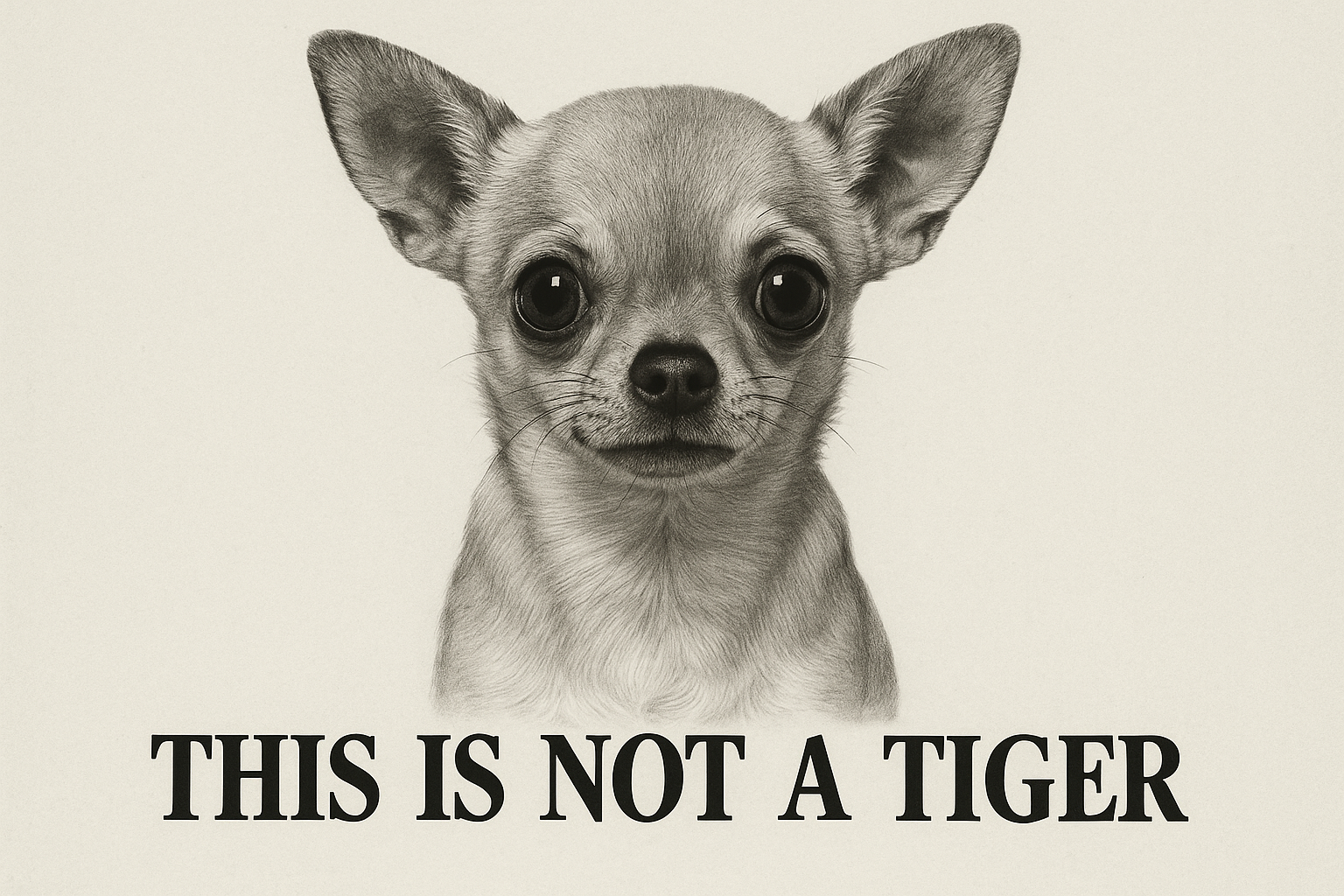
The day a dog became “Tiger” is one of my favourite stories, and today I’m sharing it with you.
Years ago, at Northpoint Centre of Learning (Mumbai), visiting faculty Adi Pocha (ex-Creative Director Lintas; founder Squircle Productions) shared a story that permanently rewired my understanding of positioning.
Imagine the first time in human history someone named a dog “Tiger.”
Adi took us to a small village long ago. A man insists on calling his little dog “Tiger.”
The villagers mock him.
Ridicule him.
“That’s not a tiger. That’s just a dog!”
The man becomes an outcast for this absurd naming. His neighbours avoid him. The name becomes a village joke.
Then one night, while everyone sleeps, a real tiger approaches the settlement.
The little dog (tied outside, alone) sees it first.
He barks. And barks. And doesn’t stop. Fierce, relentless, unafraid. His barking wakes one villager, then another, then everyone. The commotion builds. The real tiger, facing an awakened village, retreats into darkness.
The village survives because a little dog had courage when it mattered.
That morning, something shifts. The same villagers who mocked now understand. They don’t just accept the name “Tiger” they insist on it.
Because the dog didn’t just claim courage. He demonstrated it when everything was at stake.
That’s positioning: You earn your name through action, not declaration.
The little dog owned “Courage” in their minds. Not through size or species, but through behaviour when it counted. The name “Tiger” became obvious only after the position was proven.
For business folks:
Most companies start with the name, the claim, the campaign. Then wonder why the market doesn’t believe them.
But positioning works in reverse:
- Choose what you’ll stand for (the noun you’ll own)
2. Act from that identity (especially when the stakes are high)
3. Let the market name you (they’ll insist on it once you’ve proven it)
Tesla acted like the future before anyone called them that.
Volvo saved lives before owning “safety.”
Your “Tiger” moment comes when you prove what you stand for.
The village taught us: Ridicule often precedes recognition.
The same people who mock your positioning today will champion it tomorrow, but only after you bark when the tiger comes.
Thank you, Adi Pocha, for masterfully telling this story. If I’ve altered details in retelling, please correct me — though the principle you taught remains indelible.
_
PS: In Adi’s original telling, I believe the villagers actually kill the tiger that night; they don’t just scare it away. The little dog’s courage didn’t just buy them one night of safety. It gave them the chance to eliminate the threat forever. That’s what positioning does: it doesn’t just create temporary advantage. It changes the game permanently. When you truly own your position, you don’t just survive the crisis. You transform the entire landscape.
The Gap Between Identity and Perception
Here’s what the Tiger story reveals about positioning: The market decides what you are. You don’t.
The dog’s owner insisted on “Tiger.” The villagers insisted on “dog.” Both were wrong until behaviour settled it.
Most founders live in this gap:
- What you think you built vs. What the market thinks you built
– What you call yourself vs. What customers call you
– The business you’re in vs. The business they think you’re in
You can’t see this gap from inside. The dog couldn’t read his own label. Neither can you. This is the perception problem every founder faces: You’re either being mocked like the dog owner (before proof), or you’re being named Tiger (after proof). But you rarely know which one you are.
NEW: Gravity Reports
I’ve started writing 5,000-word deep-dive reports that answer one question: What business are you actually in? Not what you think you’re in. What you’ve actually created.
Based on:
– Customer sentiment (what they say you do)
– Market (how you’re perceived vs. competitors)
– The gap between your intent and their interpretation
– 100+ data points across your content, messaging, and feedback
You can’t read your label from inside the jar. I read it from the outside.
Examples:
1. Wynter Report
2. Exit Five Report
3. Hampton Report
How it works:
Only available as an add-on to the CEO Clarity Starter Kit
– Takes 2 weeks per report
– Limited to 4 per month
Pricing:
$7,500 (public – I publish it on my socials)
$10,000 (private – for your eyes only)
The Clarity Kit guides and coaches you on how to find clarity on your own. The Gravity Report does the analysis for you.
What People Are Saying
(See testimonials below)
Two Paths to Clarity
Path 1: Get the Clarity Kit ($249):
The frameworks, tools, and prompts to diagnose your positioning.
Path 2: Get the Kit + Gravity Report ($7,749 or $10,249):
I do the deep-dive analysis and show you exactly what business you’re in.
Both work. One is self-guided. One is done-for-you.
P.S. The little dog didn’t know he was earning the name “Tiger.” He just barked when it mattered. Most founders don’t know they’ve already earned a position in the market. They’re just calling it the wrong thing. That’s what The Gravity Report reveals: the name the market has already given you, whether you know it or not.
Yours truly
Paul Syng