
♛
30.06.2026
Why Clients Don’t Buy Because They Understand You
Read Time: 8 Minutes
Hello
Before you dive into this week’s Digest, here are two other articles I published last week worth exploring.
Now, back to our scheduled programming.
Buyer Experience Design
From Order-Taker to Trusted Advisor
Why the gap between you and the work is smaller than you think — and why it’s the same gap.
You walk out of a meeting with a prospect, and you have no idea what they want. Worse, you are pretty sure they don’t either. And now you have to go write a proposal.
If you have felt that, this is for you.
I have felt it from every seat there is. Solo, trading my skills for money. Running an agency. And inside a firm with a logo everyone knows, coaching teams on the strategic and refuse-to-lose deals. The dials changed every time. The mechanism never did. Neither did the mistake.
So when you see the advice that floats past on LinkedIn every week, build awareness, get more visible, own an idea, post until they know your name, hold it lightly. It isn’t wrong. It’s just answering a smaller question than the one you’re actually facing. Getting known is not the same as getting in the room. And getting in the room is not the same as winning the work. Three different problems. Most advice solves the first and leaves you stranded on the other two.
Let me take the other two apart slowly.
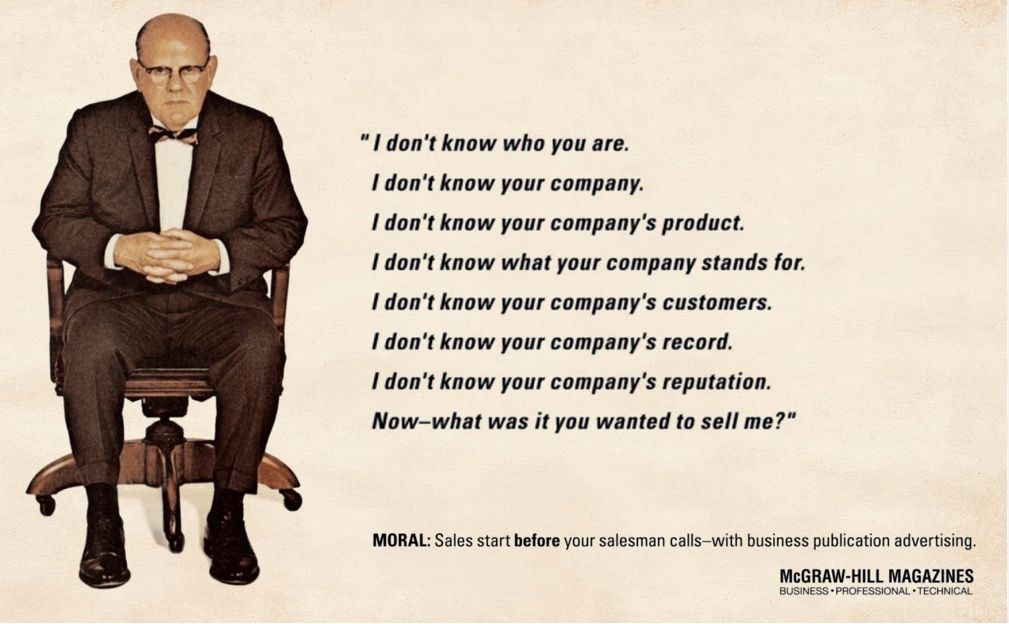
This LinkedIn post made the oldest case in advertising: the buyer doesn’t know you exist, so advertise, build awareness, get into the consideration set at all. I pushed back against the idea that clients buy when they feel understood, heard, and seen; that awareness is the cheap part, and being understood is the thing.
You are selling something you can’t show
Start with a fact nobody says out loud.
The client can’t check your work before they buy it. Most of the time, they can’t check it after, either. They hire you, you hand over the work, and they will never run the other version to see if someone else would have done better. The quality is invisible when they decide. It stays invisible.
So the client isn’t really judging your quality. They can’t. They are judging one thing. How much trouble am I in if I pick these people and it goes wrong?
That changes what you are actually selling. Not proof that you’re good. That proof doesn’t exist yet. You are selling a smaller chance that the buyer gets burned.
And that fear is personal before it’s about the company. The buyer is protecting their own name first, their job second, and the company third. There’s research worth keeping in your back pocket. When CEB studied B2B buyers, they found that the personal payoff, “Will this make me look good?” and “Will it protect my job,” carried twice the weight of the business payoff in the decision to buy. Twice. So when you talk to the company and miss the person, you lose to whoever saw who was actually nervous in the room.
Five ways to make a stranger feel safe. You can build one today
There aren’t many ways to lower that fear. Count them.
Brand. Nobody got fired for hiring the famous firm. Takes decades.
Social proof. Testimonials, case studies, and a warm intro. Needs clients you don’t have yet.
Relationship. Trust built over years. Needs the years you haven’t spent.
A guarantee. Only pay if it works. Sounds great, but it only works when the result can be verified. A recruiter can promise it. A performance marketer can promise it. You usually can’t, because the work you sell stays invisible. A guarantee on invisible work reads as desperation, not confidence.
That leaves one. You show, before anyone pays you, that you already understand their specific problem.
Look at the five again. The first four all need something you don’t have. Time, clients, a name, or a checkable result. The fifth costs only the work of actually understanding the problem. You can build it on a Tuesday with nothing.
Call it what it is. Gravity, not glitter. Glitter is what you say about yourself, the awards, the logos, the adjectives. Gravity is proof that’s already there before you open your mouth. The famous firm spent thirty years building its gravity. You can build yours this week, in a document.
So why doesn’t everyone do it?
Here is the question that should be bothering you by now.
If the fifth one is free and the other four are locked behind years, money, and luck, why does almost nobody do the free one? Why do smart people with real talent keep walking into the room and talking about themselves instead?
The honest answer isn’t strategy. It’s not that they don’t know better.
Most of them do.
The honest answer is underneath all of it, and it’s older than any sales technique.
Think about the last time you had to approach a stranger at an event. Not someone you were introduced to. A stranger, cold, and you had a reason to go say something. Remember the half-second of friction before you crossed the room. The little voice doing the math on how this could go badly. Most people never cross. They stand by the wall and wait to be approached.
Now think about putting your read of someone’s business in writing and sending it to them before they asked for it, before they paid you, before you knew if you were even close. Your name on a point of view that might be wrong. Handed to someone who didn’t invite it.
Same half-second.
Same little voice.
Same wall.
Research on what holds people back from talking to strangers keeps finding the same thing. We expect it to go worse than it does. We brace for the rejection and the awkwardness, and we badly underestimate how often the other person is glad we came over. The fear is real. The forecast behind it is wrong. And the cost of believing the forecast is a roomful of conversations that never happened.
The work is people. So the fear travels straight up into the work.
That’s what the order-taker is actually doing. Not failing at strategy. Avoiding exposure. Waiting to be told what to do is the professional version of standing by the wall. It feels safer to let the client define the problem and then answer it than to walk across the room with a point of view that might land wrong. If they tell you what they want and you deliver it, you can’t be blamed for guessing.
You never guessed.
You waited.
And the awards slide, the proprietary framework, the wall of logos, the long recital of we do this and we do that. Look at it again now. That isn’t ego. It’s armour. It’s the most respectable way there is to talk for ten minutes without ever saying, “I think your real problem is this,” “here’s what I’d do,” or risking that you’re wrong in front of someone who matters. Credentials let you fill the room with yourself while keeping yourself completely safe. I and we are a place to hide. You and your is where the exposure lives.
The whole time, the client is thinking one thing. So what. Nobody cares that you won the award. People see the whole world as it relates to them, and you are not in that picture yet, and you put yourself at the center of it anyway, because the center of your own story is the one place the rejection can’t reach you.
How you show up is how you close
You can hear it before you can fix it. Listen to the language in the room.
The order-taker’s questions are about the order-taker. So, can you tell me a bit about your process? You came in saying you do X. Can you walk me through how you do it? Every question loops back to the seller. The whole meeting is the seller waiting for the buyer to hand over the spec.
The trusted advisor’s questions are about the buyer. Why are you doing this now? What does success look like for you, for your team, for your customers? Where are you trying to get to, and what’s in the way? The eyes are on the buyer’s future the entire time.
And the proposal lands exactly the way the meeting sounded. We-language in the room becomes we-language on the page. Slide after slide about you. You-language in the room becomes a proposal that’s about them, their problem, their outcome, with you as the way there. How you show up is how you close. You can’t be I-centric for an hour and then write a you-centric document.
The proposal just records which way you were already facing.
(See the video at the top of the newsletter)
There’s a reason the facing matters beyond manners. Most of what you want to brag about, your price, your quality, your methodology, your process, is table stakes (fyi, also did a podcast with the guy). It’s the bottom of the pile, the bare minimum to be in the room at all. And it’s the part procurement cares about. The thing at the top, the vision and the outcome, is the part the person signing the check cares about. Lead with the bottom, and you’ve aimed your whole pitch at the wrong person about the wrong thing. Lead with the top, and you’re suddenly in a different conversation, with a different person, about something they actually lose sleep over.
Write the read before you send the invoice
So here’s the move, and it breaks the usual order.
Everyone says you earn credibility first, then you get the meeting, then you win the work. They say a nobody can’t sell to a somebody.
Wrong. And proving it is the whole point.
Write a real point of view on the prospect’s specific problem. Not a capabilities deck. Not here’s what we do. A document that says their situation back to them more clearly than they’ve managed to say it inside their own company. Show them you see the thing under the thing they asked for.
Then send it cold.
This is the wall, and this is you crossing it. It costs you the exact thing the order-taker spends his whole career avoiding. You put your read on the table first, with your name on it, before anyone owes you anything. You make the first move. You let yourself be seen guessing.
If it’s good, it earns the two things that normally take years. It gets you in the room. And it gets you taken seriously once you’re there, as a peer instead of a vendor. Because it proves the one thing the awards slide only claims.
This isn’t a hunch. Gartner’s 2026 research on B2B buyers found that the buyers who reach real clarity on the problem and the outcome, the ones who feel sure they understand what they’re deciding, are twice as likely to call it a high-quality deal. Read that from your side of the table. The firm that makes the buyer feel clear wins (real fucking understanding where they feel seen for the first time). A written read of their problem is how you manufacture that clarity before anyone else in the running even tries.
So awareness, the thing the be-more-visible crowd keeps selling, turns out to matter least. Awareness gets you known. Demonstration gets you in.
Now do the same thing with a logo on it
Everything so far reads like a manual for the underdog. It isn’t.
I learned this most clearly from the other seat, inside the big firm, watching it lose deals it assumed were already won. The brand keeps the bill hidden, so the loss is harder to see, but the mechanism is identical.
Here’s the trap of carrying a big name. The logo lowers blame risk for free. The buyer can hire you and never get fired for it. So your people stop working the other kind of risk, the one that’s actually about whether the thing works. Why cross the room with a point of view that might be wrong when the name already closes most rooms? The capabilities deck still gets the meeting. The awards slide still gets nods. The brand is doing the selling, so nobody learns to sell.
It’s the same fear from the top of this piece, just better funded. The big firm gets to avoid exposure and still win for a while because the logo crosses the room, so its people don’t have to. That’s the disease. It trains a whole bench of talented people to lean on the name instead of the read. I watched it happen over and over. A famous firm can lose, and lose badly, by getting the mechanism wrong, because the brand lets everyone forget the mechanism existed.
Then the insurgent shows up with a written point of view on the client’s exact problem, dated, and handed over before anyone paid. And the buyer feels something they never felt from the big team.
Seen.
Now the brand only covers blame risk. It does nothing for the buyer who just realized the smaller firm understood them better. The cover is intact, and the advantage is gone, because the one thing the logo can’t fake is understanding, and the big firm stopped bothering to show it.
So the lesson doesn’t flip when you have a name. It sharpens. The name buys you the room. It does not buy you the work. Spend the brand to get in, then earn it like you have no brand at all. The moment you coast on the logo, you’re the order-taker with a better lobby.
Where this loses. Say it out loud, or you don’t believe it
A take you can’t break is just a slogan. So here’s where this one bends.
It loses to the famous firm.
Often.
Nobody got fired for hiring the big name, and pretending otherwise would be lying to you.
Hold both like this. Risk is two different things wearing one word.
One is outcome risk. Will this actually work? On that, understanding wins.
The other is blame risk. If it fails, who takes the hit? On that, the safe name wins, because the safe name is a built-in excuse.
So the famous firm’s real product isn’t better work. It’s cover. When every firm looks the same from the buyer’s chair, the thing that tips it is whoever made the buyer feel most sure along the way.
That tells you when to fight and when to walk. The decision is quiet; the buyer owns it; the result will clearly trace back to whoever did the work; your point of view wins. The decision is loud; a committee owns it; the result will stay murky; the safe name wins. Know which room you’re in before you spend the effort.
Don’t attack the safe choice. Pry it open
Now the hardest room. A committee, spending other people’s money.
Your instinct is to stand up and say the famous firm will get it wrong. Don’t. That instinct walks you straight into the trap, and the trap tells you what a committee really is.
A committee isn’t there to find the right answer. It’s there to spread the blame so no one person owns the outcome. Nobody got fired for hiring the big firm isn’t laziness. That’s the committee doing its job, building a shared excuse in advance.
So when your champion stands up and calls the safe choice risky, everyone else hears: I want you to drop our shared excuse and bet on my personal opinion instead. You just asked them to take on blame, not shed it. The harder your champion pushes, the more exposed they get. You handed them a sword and pointed it at their own career.
Do the opposite. Turn your champion’s belief into a fact they’re just carrying into the room.
I trust them is an opinion. Opinions get blamed, and they belong to whoever said them.
They’re the only firm that put their read of our problem in writing, dated, before we paid them a dollar is a fact. Facts don’t get blamed, and they belong to you.
Then propose a fair test. Ask every firm for a written read on this exact problem before anyone signs. You’ve already passed it. The brand firm almost never will, because their economics push them toward a capabilities deck rather than a custom diagnosis written for free.
Don’t name the winner. Let the room get there on its own.
The things this rests on. Knock one down, and it falls
Every argument has structural parts. The beliefs that, if they’re wrong, bring the rest down. I’d rather name them than hide them.
Buyers care most about not being wrong. If they were really chasing the lowest price, or if they could check quality before paying, the whole thing collapses.
Demonstrated understanding is the only safe-maker you can build from zero. And where the result can’t be checked, the cheap shortcut, the guarantee, isn’t open to you.
The personal stake beats the company stake. If buyers were cold, rational agents of the firm, the blame game wouldn’t run the decision the way it does.
And the last one, the one I’ve been holding back, the one the whole piece rests on.
You actually have a sharper read to show, and you’re willing to put it on the table where it can be judged.
That last one is the whole game, and it’s the hardest, because it isn’t a technique. It’s a willingness. A point of view is high-risk by design. A sharp one gets you the room. A weak one does the opposite; it proves you’re generic, and generic raises the buyer’s fear instead of lowering it. So the read has to be good, which takes real work, and then you have to be willing to be seen holding it, which takes something else entirely.
That’s why the free thing stays rare. The one safe-maker you can build from zero is open to everyone and earned by almost no one, because the nerve required is rare.
What this means Monday morning
Pick the last piece of work you won.
Strip it.
Take away your ‘brand.’
Take away your case studies.
Take away the warm intro that got you in the door.
What’s left that proves, to a stranger who’s never heard of you, that you understood their actual problem before they paid you?
If the answer is nothing, be honest.
You didn’t win on understanding.
You won on the weight you happened to be carrying.
So here’s the work for next week, and notice that none of it is about getting more visible. Pick one prospect. Find the real problem they never got to say out loud. Then write the read on it, the one document that would make a stranger feel safe enough to let you in. Put your name on it. Send it before anyone pays you. That’s how you get in the room. Not awareness. A point of view, on the table first, with your name on it.
Then, once you’re in, remember that getting in was the first-half. How you show up is the work. Spend the meeting on their goals, not yours; every question pointed at them. Be curious longer than is comfortable, hold your breath and count to ten before you jump to a solution. Because every touchpoint is a sample. The cold read, the first meeting, the way you ask a question, the proposal, the follow-up. Each one tells the buyer exactly what it’s like to work with you. They’re not waiting for the contract to find out.
They’re deciding the whole time.
The POV gets you in. How you show up closes it. And both come down to the same nerve, the nerve to cross a room and talk to a stranger, to put your read on the table before you know if it’s safe.
The work is people.
The fear is the same fear.
The ones who win are just the ones who cross.
Access 30+1 Positioning Reports
If any of this was useful
There are three ways to go deeper, depending on where you are.
1. Read and follow.
Everything I publish is free. The Gravity Reports, the Digest, the positioning frameworks — all of it is on the blog and in your feed and inbox.
LinkedIn or X
2. Use the systems.
I’ve built a set of diagnostics for founders and brand leaders who want to do this work on their own company. Start with the free Analyzer — it shows you the gap between what you think you sell and what customers actually buy, and tells you whether AI recommends you when buyers are searching in their language. If you want to go further, the Clarity Kit and Monopoly are built for the same diagnostic, at a deeper level.
Start with the free Analyzer
CEO Clarity Starter Kit
Monopoly
3. Work together.
I take on a small number of advisory clients each year. These are founders and leadership teams who want an outside read on their position — the same method as the Gravity Reports, applied to their own company. If that’s relevant, the best place to start is a conversation. Better call Paul.
DIGEST