
♛
12.05.2026
The intelligence layer every research tool is missing
Read Time: 6 Minutes
Hello
Two things this week. A Gravity Report on Cloudflare, and a chart I drew to explain why reports like it can exist in the first place.
Both sit on the same idea. Most of what executives call “market intelligence” is performed for an audience. The interesting layer is the one that isn’t.
- Gravity Report: Cloudflare
Cloudflare spent its first decade owning a clean three-word story: security, speed, reliability, rooted in the 2019 S-1 and repeated across every investor touchpoint since. That story carried the company from a 2019 IPO to roughly $4.7B in 2024 revenue, 55.3% GAAP gross margin, 27% YoY growth, and 1,275 customers spending more than $100K, with six reported $1M+ customers.
The gravity question is whether the original positioning still holds as the company reframes 2026 as “The Year of the Intelligent Internet” under Matthew Prince, with Michelle Zatlyn and Dane Knecht extending the story into AI infrastructure.
What the report found, in plain terms:
The original three-word spine still carries weight with customers, but the new AI narrative is being layered on top rather than earned through structural proof.
Outages, security incidents, and customer-visible reliability events create friction between the claim “the network is the internet” and the lived experience of developers and enterprise buyers.
The pivot toward “intelligent internet” risks the same trap I have catalogued elsewhere, a Level 3 or Level 4 ambition communicated before the Level 1 foundations have been re-proven.
The full report walks through each layer with evidence, including regulatory filings, litigation records, customer complaints, hiring velocity, patent activity, and the footnotes inside Cloudflare’s own disclosures. That evidence mix is the point, and it is also the segue to the second thing I want to share.
- The intelligence layer they’re all missing
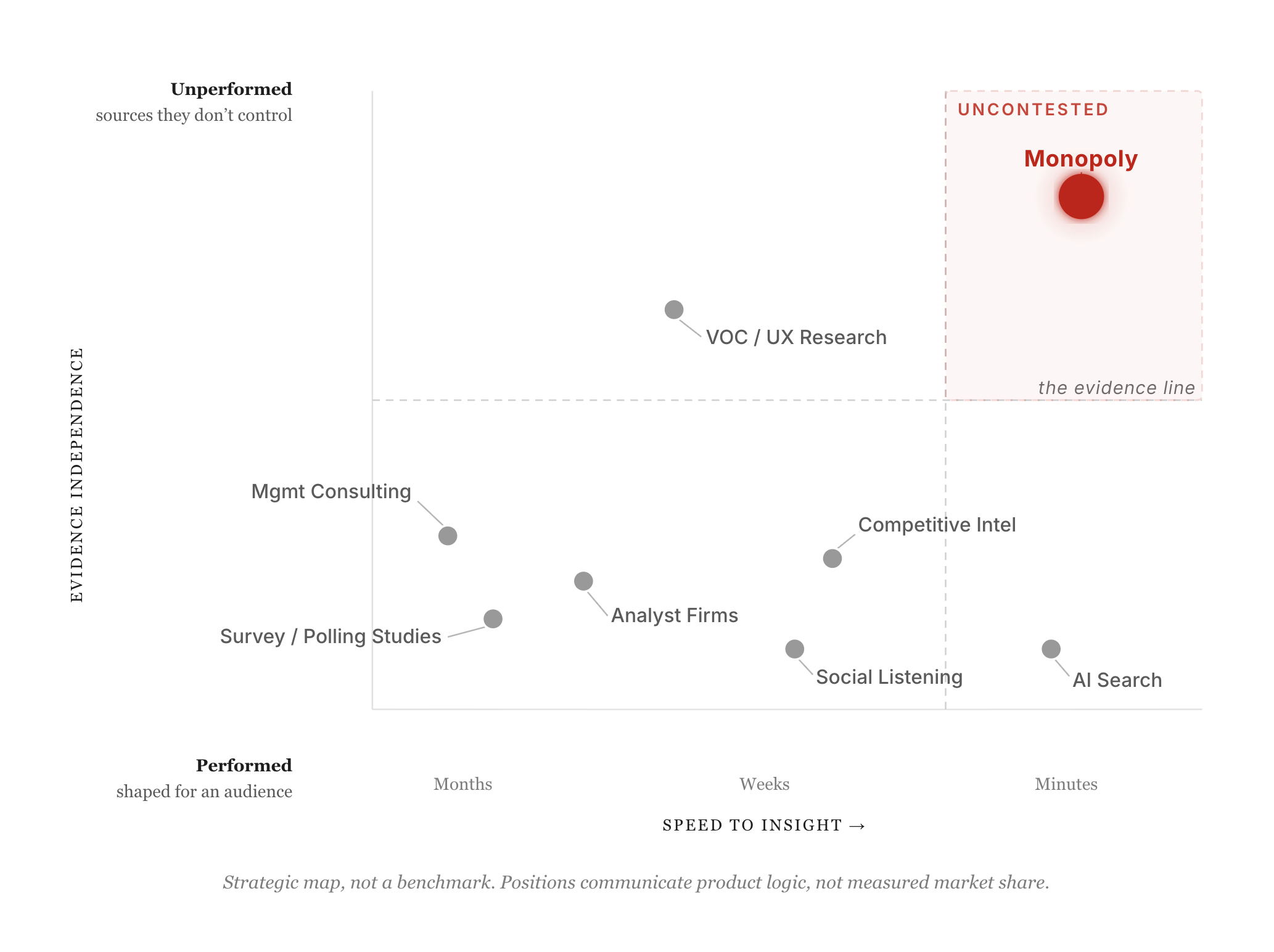
Last week I put every research tool I could think of on one chart. Surveys, management consulting, analyst firms, social listening, competitive intel, VOC/UX, AI search. Two axes, speed of insight and evidence independence.
They grouped more cleanly than I expected. They all sit below the same line.
The Evidence Line
Below the line is performed signal. Anything produced because someone created it for an audience. A survey is performed for the survey-giver. An executive interview is performed for the consultant in the room. A vendor briefing is performed for the analyst writing the Magic Quadrant. A PR statement is performed for the press. Even a customer review is performed, for other customers and for the ranking algorithm.
Above the line is unperformed evidence. Regulatory filings, litigation records, complaints filed with regulators, workforce sentiment captured outside HR, hiring velocity, patents, procurement records, footnotes in financial disclosures, and unsolicited customer language. These exist because something happened, not because someone produced them with you in mind.
Where each category lands
Surveys and management consulting live in months, both below the line. Analyst firms sit in weeks to months, still performed. Social listening, competitive intel, and VOC/UX research move in weeks, all performed. AI search collapses to minutes, but the corpus it draws from is still performed. Monopoly is the only category I could place in minutes and above the line, drawing from unperformed sources.
The part worth sitting with
AI search is the category you might expect to break the pattern. It doesn’t. The corpus underneath is the published internet, company websites, press releases, marketing pages, SEO, analyst commentary, and social posts. All of it performed. AI search is the fastest possible synthesis of performed signal, the same layer the industry has always worked in, retrieved at a different speed.
Below the line, faster makes it worse. Faster means you arrive more quickly at a polished, internally consistent picture of what the company wants you to believe.
The top-right quadrant, fast and independent of what the company shapes, is the quadrant nobody built a tool for. That is where I drew Monopoly, and that is the architecture behind the Cloudflare Gravity Report you’re reading alongside this note.
A small test you can run yourself
The next time you read something about a company, trace the source. Most of what’s available leads back to something the company produced, or something produced for an audience the company was part of. Once you see it, you can’t unsee it.
DIGEST