
♛
16.06.2026
The Adult Table
Read Time: 16 Minutes
Hello
A lot of new faces this month, so a note.
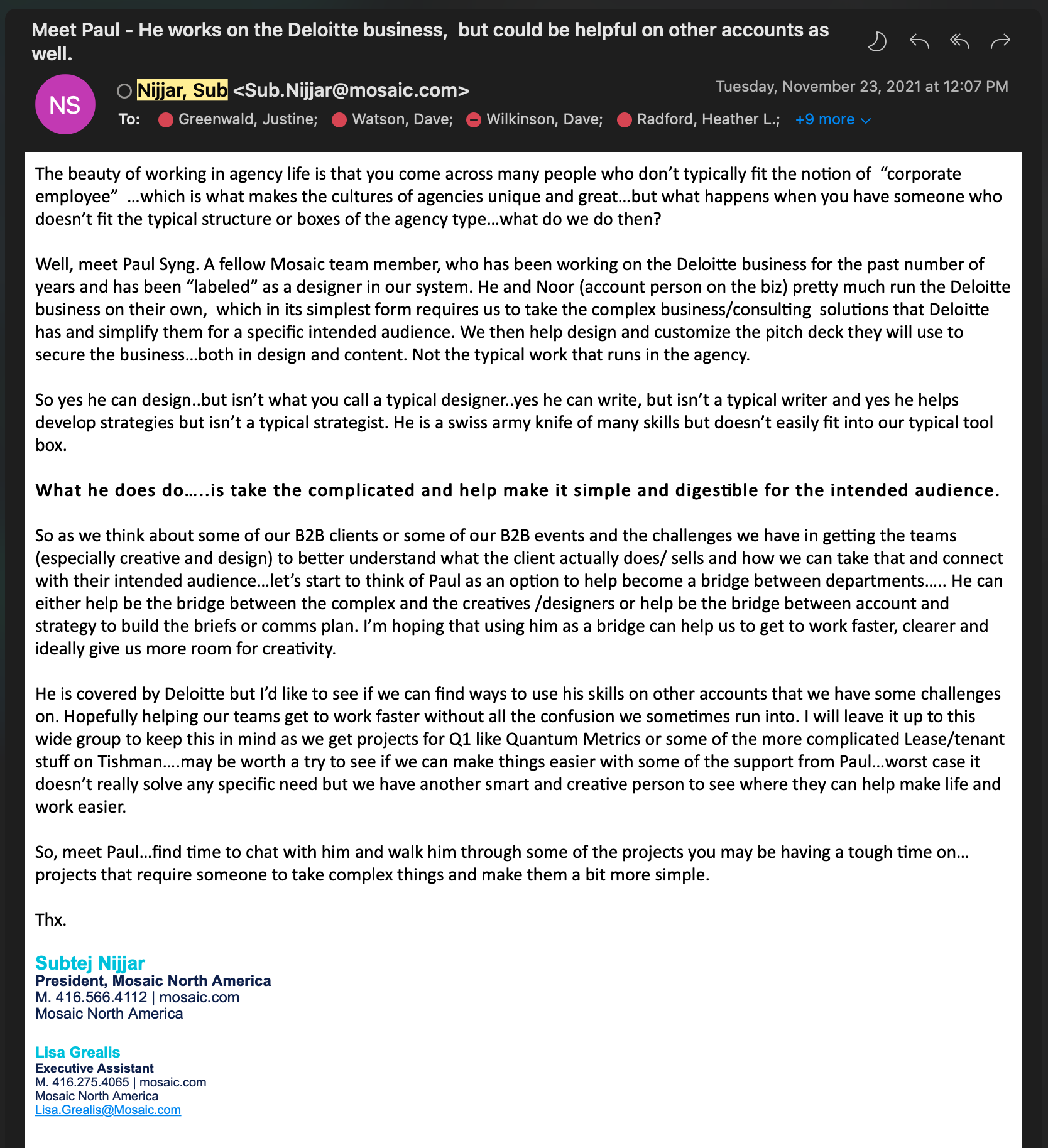
I have been doing this work for 20 years, and I have never once called myself an expert. Every room I walk into picks a label for me. Creative director in one. Sales coach in another. Strategy guy. Thinker. Designer. The only niche I have ever had is curiosity, which is a real problem if you read the consulting playbooks and a real advantage if you do not.
The arc, briefly. Copywriter in Mumbai. Designer always. 7 years running an agency in Chandigarh. 7 years at Deloitte, in the rooms where over $2 billion in deals were won. Now independent, in Toronto, working mostly with founders and CEOs.
Industries the work has touched: frozen yogurt chains, music festivals, sports teams, logistics, airlines, fintech, deep consulting, complex B2B sales. The variety is the point. The pattern spans industries, never one.
~30,000 hours.
That is roughly what twenty years of positioning work adds up to when I count it honestly. Not just the client work. The reading. The dissecting. The nights spent pulling a problem apart because I could not put it down.
That number does not mean I am better than you. It means I have failed more than most of you combined.
I have mistaken a tagline for a position. I have handed a client beautiful language sitting on top of nothing. I have watched a deck I was proud of land in silence. I have chased clarity in the copy when the problem was three layers deeper, in the business itself.
Every one of those hours has a failure attached to it. The hours are just where I kept the receipts.
That is the part nobody puts in the bio. The twenty years are not twenty years of being right. They are twenty years of being wrong in slightly more useful ways each time.
People want the shortcut. The framework, the playbook, the five steps. I wanted it too. But the thing that compounds is not the wins. It is the volume of mistakes you have survived and learned to read. There is no shortcut that skips the failures. I have looked.
So when someone asks how I see a positioning problem so fast now, the honest answer is unglamorous. I have made that exact mistake before. Probably more than once. Probably with my own money on the line. The hours are not a flex. They are a record of everything that did not work.
I started writing publicly because the alternative was watching the feed fill with regurgitated, navel-gazing, zero thought and saying nothing back. I would rather be wrong in public than fluent in slop. Independent thinking is the only thing I find interesting anymore. Confident regurgitation is everywhere, and I have run out of patience for it.
What I am building right now is Monopoly, which reads the unprompted customer voice a company has no control over, and GNYS “Genius,” which is the positioning coach I wished existed when I was inside Deloitte or running an agency. Both are focused on positioning as I actually understand it. Operating model. P&L impact. The refusals that make a position real. Not copywriting. Not messaging. Not homepage rewrites.
There is also the CEO Clarity Kit, a four-week agency sprint compressed into 60 minutes for founders and CEOs who never had four weeks or the agency budget anyway.
If you came here expecting certainty, I will disappoint you. If you came here expecting questions worth sitting with, you are in the right place.
A note before the table.
In 1977, Chris Argyris published a piece in Harvard Business Review that should have ended a lot of arguments and instead got quietly ignored for fifty years. He drew a line between two kinds of learning.
Single-loop learning is a thermostat. The room gets cold, the thermostat notices the gap, and it turns on the heat. Error detected, action corrected, governing variable untouched. The thermostat never asks whether 68 degrees was the right target, or why the house leaks heat in the first place. It just keeps correcting toward a number nobody questions.
Double-loop learning is the person who asks why the target is 68, why the house is built this way, and whether the whole system is solving the right problem. It questions the governing variables, not just the outputs. Argyris’s finding was that organizations almost never do this, because double-loop learning threatens the assumptions, the status, and the comfort that single-loop learning protects. So the deeper error survives. His example was a company that wrote off Product X for over $100 million. Five people knew it was failing six years earlier. Nobody surfaced it, because surfacing it meant questioning the things nobody was allowed to question.
Here is why I am opening with a 49-year-old paper.
Almost everything sold as “positioning” today is thermostat work. The numbers dip, so you rewrite the homepage. Conversion softens, so you refresh the tagline. The brand feels tired, so you run a sprint and pick new words. Error detected, action corrected, governing variable untouched. Nobody asks the double-loop question: is the position itself wrong, or have we just never had one? That question is uncomfortable, expensive, and lands on the CEO’s desk, which is precisely why the industry built a whole vocabulary to avoid it.
That avoidance has a sound.
It sounds like crayons at the adult table.
Every other function in a company runs on double-loop discipline, whether it wants to or not. Accounting cannot redefine “revenue” to feel better. Engineering cannot rename an outage a “vibe problem.” Finance cannot wish EBITDA into existence. The governing variables are enforced like gravity. Marketing is the one seat where you can correct the output forever and never touch the system underneath, because no one bleeds when the word is loose.
So this issue is a double-loop exercise. We are not going to adjust the thermostat. We are going to ask what the house is for. And the most honest description of that work I have read recently was not written by a positioning consultant. It was written, by accident, in a Deloitte job description that never uses the word once.
Pull up a chair. Adults only.
Before we read the document, two distinctions.
There’s a confusion sitting under almost every conversation about positioning, and it’s worth naming before we go further.
What most positioning experts teach or sell isn’t positioning. It’s framing.
Framing is how you present what you’ve built. Positioning is what concept you own in a mind. Framing asks, “How should we describe ourselves?” Positioning asks, “What noun do we want to own?” One produces value props, messaging hierarchies, pitch decks. The other produces mental monopolies, category ownership, perceptual gravity.
Watch for the tell. When April Dunford describes how your product is a leader at delivering something, that’s framing. When Ogilvy talks about what a product does and who it’s for, that’s framing. When the standard playbook asks “What is it? Who’s it for? How’s it different?”, that’s framing. Every one of those definitions starts with your product or your offering. That’s the giveaway. They work inside-out, from what you have. Positioning works outside-in, from what concept is available to own.
Positioning doesn’t start with your product. It starts with the territory. What’s owned, what’s contested, what’s vacant.
The difference, in two examples:
Framing says, “We’re an AI-powered CRM for SMBs that’s easier than Salesforce.” Positioning owns simplicity as a concept and builds everything to prove it.
Framing says, “We make sustainable outdoor gear for conscious consumers.” Positioning owns activism and becomes inseparable from it.
Companies spend months crafting messages, refining value props, wordsmithing taglines, and never claim any mental territory at all. They perfect how they talk about themselves without establishing what they are. It’s meticulous decoration of a house they don’t own.
So perfect your framing. Craft the value props, nail the five questions, polish the messages. Just don’t call it positioning when it’s a better way to describe what you already built.
That’s the first distinction. Here’s the second, and it’s the one that decides which moves survive.
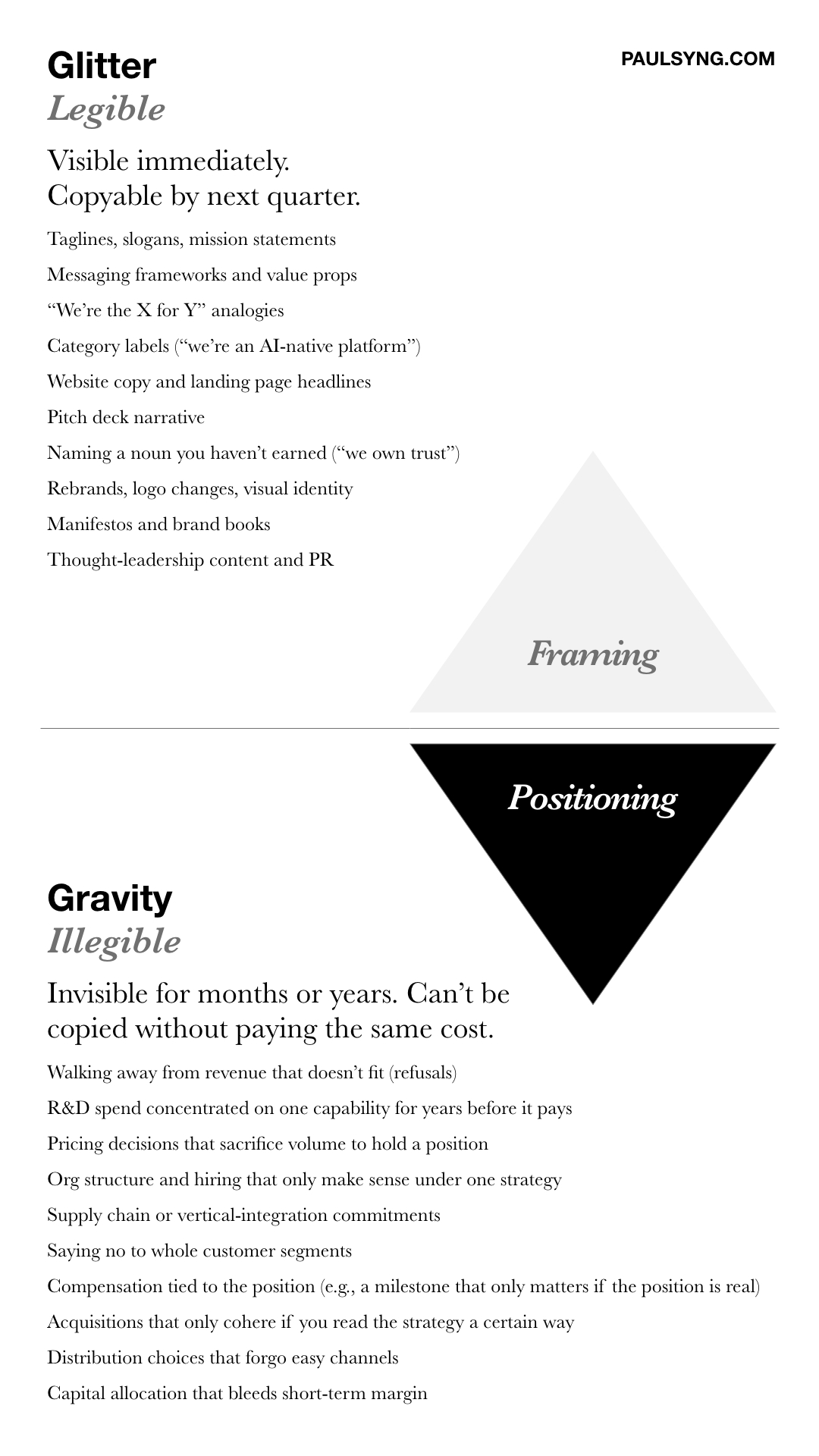
I draw a lot of two-triangle diagrams. One points up into the visible. One points down into the invisible. A single line runs between them, and that line is the whole argument.
Above the line, everything is legible. Taglines. Mission statements. The category label. The “we’re the X for Y.” The rebrand, the manifesto, the homepage headline. You can read all of it in an afternoon. So can your competitor. And what a competitor can read in an afternoon, they can ship by next quarter.
Most people get this backwards. They treat legibility as strength. Clear messaging, sharp narrative, a position you can say out loud. It feels like an asset. It’s the opposite. The faster the market can read a move, the faster a rival can copy it. Legible and copyable are the same property wearing two outfits.
Above the line is framing. Words doing the work of proof. It’s cheap, fast, and reversible by Friday. It shows up the day you publish it, and that immediacy is exactly why it commoditizes. Nothing that arrives that fast was expensive enough to defend.
Below the line is positioning. What you spend, and what you refuse. The R&D budget pointed at one capability for three years before it pays. The segment you turned away. The pricing that sacrifices volume to hold a line. The hire that only makes sense under one strategy. These hit the P&L. They register slowly, over months and sometimes years, and that lag is the entire point.
The refusal is the sharpest move and the one nobody can see. Every other decision leaves an artifact. A refusal leaves nothing. There’s no press release for the revenue you didn’t take. The market can’t read an absence, so a competitor can’t copy what they can’t detect. And if they did detect it, copying it would cost them the same revenue you walked away from. The cost is the moat. The invisibility is the receipt.
So here’s the diagnostic you can carry into the rest of this issue. Take any move you’re proud of and ask one question: how fast does it show up in the market? If the answer is “immediately,” you built glitter. It reads well and it commoditizes. If the answer is “I won’t know for a year,” you built gravity. It reads as nothing and it compounds.
The legible moves are the ones you can lose. The illegible ones are the only ones that were ever yours.
Now read the document with me.

What a Deloitte Job Description Accidentally Teaches About Positioning
A management consultancy wrote the most honest job description for positioning work I read recently, and they did not use the word once. Read it with me.
For 20 years, I have worked on positioning for owner and founder-led companies. In that time, the word “positioning” has been stripped of meaning by a generation of marketers, copywriters, and brand consultants who use it as a synonym for homepage rewriting. Open LinkedIn on any given Tuesday and you will find someone calling a tagline refresh a “repositioning.” Someone calling a homepage edit a “category shift.” Someone selling a Notion template that promises to fix positioning in three Loom videos.
This week, a job description from Deloitte Canada crossed my desk. Manager, Operating Model & Org Design, Business Agility. Toronto office. $90,000 to $175,000. Hybrid. It is the most accurate description of positioning work I have read in a while. The word “positioning” appears in the document exactly once, buried in a bullet about workshop facilitation. The rest of the document, the part nobody calls positioning, is what positioning actually is.
I want to walk through it with you. Not to recruit you for the job. To use a 1,400-word JD as forensic evidence of what real positioning labour looks like, what it costs, what it requires of an organization, where it shows up on a financial statement, and why the work has to be done at the CEO level, or it does not happen at all.
The framework I will use is one I have been working on for years. It is called Gravity. Gravity is what a company is. The structural decisions, the operating model, the refusals, the costly commitments that cannot be faked. Glitter is what a company says. The taglines, the homepage copy, the messaging architecture. Gravity is illegible from the outside, which is exactly why it works as a moat. Glitter is legible to anyone with a screenshot tool, which is exactly why it does not.
The Deloitte JD describes how to build Gravity. The “messaging and copywriting” industry sells Glitter. That is the entire delta.
I. Read the Surface First, Then Read What Is Underneath
Here is what the JD asks for, copied verbatim:
End-to-end Business Agility transformation across all business functions, with a focus on: Enterprise Transformation Strategy and Design. End-to-end Product Delivery Flow. Organizational Design & Culture Change. Leadership Advisory and Coaching.
Leading large-scale transformation implementations with various clients’ business functions, including Product, Engineering, Data Analytics, Marketing, Sales, Finance, HR, Risk, and IT.
Notice what is happening. The role works across every function in the business. Not marketing. Not brand. Every function, including the ones that ship the product, set the price, hire people, audit risk, and account for money. The work is not adjacent to operations. The work is operations.
Now compare this to how positioning gets sold on the open market. A typical positioning engagement in 2026 looks like this. A four-week sprint. Three workshops on Zoom. A Miro board. A finished deliverable that is some combination of a homepage headline, a category statement, a tagline, and a messaging architecture PDF. The buyer is the head of marketing or the founder. The engagement ends when the words are approved.
The Deloitte role does not end when the words are approved. It ends when Product, Engineering, Data, Marketing, Sales, Finance, HR, Risk, and IT have changed how they work. That is the difference between a sentence and the structural layer that earns the sentence.
If your positioning project did not touch four of those functions, you bought a brand exercise. There is nothing wrong with a brand exercise. It is not positioning.
II. Notice What the JD Treats as Skill, Not as Output
Read this list slowly:
Business/Product management. Change Management, Organization Transformation Strategy. Customer Experience / Design thinking. Culture Hacking / Culture Change. Agile methodologies. LEAN methods & tools (e.g., A3s, Value Stream Mapping). Strategic agile framework definition, operating model design, product delivery flow, organizational design, Centre of Excellence (CoE) setup.
These are skills. Not deliverables. The “messaging and copywriting” industry sells deliverables, a deck, a doc, a tagline. The Deloitte JD describes capabilities, value stream mapping, operating model design, organizational design, CoE setup.
Why does that matter? Deliverables are the artifact left behind after the work. Capabilities are the work itself. A consultant who only sells deliverables has nothing to sell when the client asks the second question. A consultant who carries the capability can keep working on the problem as it evolves.
This is the cleanest test I know. Ask your positioning consultant what they leave behind. If the answer is “a document,” they sell Glitter. If the answer is “a working operating model the client now runs themselves,” they sell Gravity.
III. The Customer Is Named Twice and the Word “Customer” Is Almost Absent
Count the customer references in the JD. There are two. One is “how our clients deliver value to their customers.” The other is “customer journey mapping.” That is it.
In a 1,400-word job description for the role that redesigns how a company operates, the people the company exists to serve appear twice, as references inside other phrases.
This is the failure mode the entire enterprise-consulting world shares with the messaging-and-copywriting world it claims to be more serious than. The brand crowd skips the customer by writing taglines for an imagined buyer. The transformation crowd skips the customer by redesigning operating models against an imagined market. Both end up optimizing internal theatre. The deliverables look different. The blind spot is identical.
This is the gap I built Monopoly to close.
Most companies make positioning decisions against three inputs. The CEO’s belief about the market. The brand tracker, which measures politeness. The NPS score measures whether the respondent felt obligated to give a number above 7. None of these is the market. All of them are filtered through what the company hopes the market thinks. The operating model gets built on hope; the brand gets built on hope; and the gap between hope and reality compounds silently until something on the P&L moves and nobody can explain why.
Monopoly reads unprompted customer voice. The conversations buyers and former customers are having about the company when the company is not in the room. Public reviews, forum threads, Reddit, comparison posts, churn explanations, the language sales prospects use before sales calls, and the language former employees use to explain why they left. These signals exist whether the company collects them or not. The company has no control over them, which is exactly what makes them useful.
I think of it as bloodwork.
A bloodwork panel does not care about your feelings. It does not care about your polished McKinsey slide deck. It does not care about your brand tracker or your last all-hands. It returns numbers, and the numbers either match the story you have been telling yourself or they do not. When they do not, you have a choice. Treat the bloodwork as the truth and change the body. Or treat the story as the truth and ignore the bloodwork. Most companies pick the second option, which is why most repositioning projects fail.
The Deloitte JD describes the labour required to change the body. The work is real. The methods are real. The seniority and scale are real. But none of that labour produces a position if it is calibrated against the wrong reading of the market. Operating model redesign anchored to the CEO’s belief about customers is faster, more expensive, and more institutionally validated internal theatre than a homepage rewrite, and it still does not move the position.
The order matters. Read the market first, with an instrument the company cannot bias. Use that read to identify the concept the market already half-attributes to the company, or the concept the market is asking for and nobody owns. Then redesign the operating model to structurally deliver on that concept. Then refuse everything that contradicts it. Then let marketing amplify what is now actually true.
Skip the first step and the JD-scale labour produces a more sophisticated version of the same delusion the messaging-and-copywriting industry sells. The difference between Deloitte’s operating-model work and a four-week messaging sprint is real. Both fail the same way if the customer voice driving the work is the customer voice the company invented for itself.
I wrote a longer piece on why this is structural rather than individual. The CEO is not lying. The brand tracker is not malfunctioning. The internal narrative is honest. It is just biased seven different ways before it ever reaches a strategy deck. The full breakdown is here.
The rule is simple.
Bloodwork first.
Operating model second.
Copywriting last.
IV. The Soft Sell Is Inside the JD Itself
Here is the line I want you to read three times:
We measure our success by the business outcomes we help our clients achieve, and the positive impact we have on our team members.
Every positioning engagement should be measurable by business outcomes, not by artifacts produced. If your positioning consultant cannot tell you, in advance, which business outcomes the work is meant to move, they are selling decoration.
This is also where I have to name what the survey-and-tracker industry has done to the question of business outcome. A worked example: NPS. Two-thirds of the Fortune 1000 use some version of NPS. SAP paid $8 billion for Qualtrics in 2019 largely on the strength of NPS-centric survey infrastructure. The academic record is damning. Keiningham et al. (2007), using longitudinal data from 21 firms and 15,500 interviews from the Norwegian Customer Satisfaction Barometer, found NPS was the best or second-best predictor in only 2 of 5 industries. Morgan and Rego (2006) found no evidence NPS was superior to other loyalty metrics. The paper that exposed it won the 2007 MSI/H. Paul Root Award for the most significant contribution to marketing practice.
A measurement layer the Fortune 1000 has organized itself around, validated at $8 billion, demolished in peer-reviewed marketing research, and still running. That is what happens when an industry settles for a number it can produce instead of a structure it has to build.
The Deloitte JD does not promise a number. It promises business outcomes the operating model produces. That is the right unit.
V. What This Costs on the P&L
Here is where most conversations about positioning go quiet. The work has to show up on a financial statement or it did not happen.
The lines it touches:
Gross margin. A company with structural positioning prices on the concept it owns, not on the comparable. The premium is a margin floor the operating model defends. A company without that structure discounts to close because the salesperson has nothing to point to when the buyer asks, “Why you and not them?” Discounting becomes the operating model by default, and gross margin compresses quarter over quarter while nobody connects the compression back to the absent position.
CAC payback. When the position is structural, the buyer arrives pre-qualified. They came because they understood the concept the company owns before they took the meeting. CAC payback shortens because the sales conversation starts at the close. When the position is decorative, every deal restarts the education, and CAC payback stretches. The CFO calls it a sales productivity problem. It is an absent-position problem expressed in dollars.
Win rate against named competitors. Real positioning produces an asymmetric win rate against a specific named competitor in a specific named scenario. A documented, repeatable advantage in a defined fight. If your sales team cannot tell you which competitor you beat the majority of the time and why, you do not have a position. You have a product catalogue.
Net revenue retention. Customers who bought the position renew the position. Customers who bought the discount renew it until a cheaper one arrives.
Multiple on exit. This is the line nobody wants to print. Acquirers and public-market investors pay for category ownership, not for revenue alone. Two companies with the same financials can exit at materially different multiples because one of them owns the noun the category will be called in five years and the other does not. The premium is positioning, capitalized.
Now hold that against the JD.
Operating model design moves gross margin because it changes pricing discipline. Value stream mapping accelerates CAC payback by changing how the buyer experiences the company before contract. Culture change moves retention because it changes whether the second-year customer still receives the experience that closed them in year one. Org design moves exit multiple because it makes the position survivable beyond the founder.
The P&L only moves when the structure moves.
VI. Gravity Is Illegible. That Is the Mechanism.
There is a principle from Venkatesh Rao’s writing at ribbonfarm.com, which Scott Stevenson at Spellbook has extended in his own work, that I have folded into how I think about positioning. The principle is legibility. Humans default to replacing messy systems that work with neat systems that look orderly. The metaphor Rao uses is scientific forestry. Rows of identical trees look rational and fail. Wild forests look chaotic and thrive.
Apply it here. Glitter is legible. A homepage tagline can be read in three seconds and copied in five. A messaging framework can be reverse-engineered from a sales deck. Anything legible to a buyer is also legible to a competitor, which means anything legible is copyable, which means anything copyable is not a moat.
Gravity is illegible. The reason a company actually wins — the operating model behind the position, the specific decisions that compound into the position over years — cannot be read from the outside. A competitor would need to spend years inside the company’s operations to see it clearly enough to imitate. By the time they could, the company has compounded further.
This is why a JD like Deloitte’s is the right shape. Operating model design, value stream mapping, organizational design, leadership coaching, none of these produce a quotable artifact. They produce a company that operates differently in ways a competitor cannot describe, let alone replicate. The work is supposed to be illegible from the outside. That is not a bug of structural positioning. It is the mechanism.
A tagline is legible. That is why the buyer’s nervous system discounts it. A money-back guarantee, a refusal to serve a segment, a price floor held against pressure, a roadmap line that costs revenue this year to defend the position five years out, those decisions are expensive enough that a fraud cannot afford to make them. The cost is the proof.
VII. The Refusals That Make the Position Real
Positioning is what a company refuses, more than what it says. This is the part nobody puts on a homepage and nobody includes in a four-week sprint. A real position is built from a sequence of refusals. Accounts walked away from, features killed, segments stopped serving, partnerships turned down, hires not made, regions not entered, price points not matched.
Look at the JD again. “Influencing clients, teams, and individuals positively, leading by example and establishing confident relationships.” That language is doing work. The Deloitte practitioner is not there to validate the client’s existing operating model. They are there to tell the CEO which parts of the current company have to be subtracted for the new model to function. Half the engagement is refusal work.
The categories of refusal that produce a real position:
The customer who pays but uses the product wrong for the category you claim to own. The usage pattern dilutes the position for every prospect who reads the case study. Refusing the renewal is a costly signal. The cost is the signal.
The feature your second-largest account keeps requesting that does not belong in the concept the company owns. The feature is not the threat. The pattern of saying yes to off-position requests is the threat. Each yes erodes the position by a fraction of a degree that nobody measures until the position is gone.
The discount the salesperson wants to give to close the quarter. The discount tells the buyer the position is negotiable. A negotiable position is a price catalogue.
The partnership that adds revenue but blurs the category. The revenue is real. The blur is permanent.
The hire who is competent but does not believe the position. Competence inside an unbelieved position produces a quiet erosion that looks like execution.
The agency engagement that promises to fix the messaging without redesigning the operating model. The work product will look professional. The position will not move.
Every refusal is expensive. The expense is what makes the refusal credible to the market. A company that says no to revenue is making a claim a discounter cannot fake. Buyers, investors, employees, and competitors all read that signal and price accordingly.
A company that cannot point to a specific list of refusals from the last 12 months does not have a position. It has preferences.
VIII. This Has To Be CEO Work. Marketing Amplifies. Marketing Does Not Originate.
Here is the question that makes everything above operational. Who in your company has the authority to refuse revenue? Not who has the opinion that revenue should be refused. Who has the authority? Authority to fire a customer. Authority to kill a feature. Authority to walk from a partnership. Authority to hold price when sales wants to discount. Authority to decline a hire who is competent but off-position. Authority to redirect engineering capacity from a roadmap item that pays today to a roadmap item that defends the position five years out.
There is exactly one role with that authority. The CEO.
This is the load-bearing point of the entire essay. Positioning cannot be delegated to marketing because marketing cannot authorize sacrifice. Marketing can request the sacrifice. Marketing can model it. Marketing can write the case for it. Marketing cannot grant it.
The Deloitte JD is explicit. The role engages with “‘C’ level executives.” Not VPs, not directors, not marketing managers. The buyer of structural work is the executive who can authorize the sacrifice the work requires.
Founder-led companies outperform on positioning until they professionalize and lose it. The founder, by default, holds the authority. The founder can fire the customer at lunch and have it done by 3 p.m. The professional-CEO successor inherits a company in which authority has been distributed across a leadership team that votes, negotiates, and compromises. Positioning dies in the compromise, because positioning requires asymmetric decisions and committees produce symmetric ones.
Once the operating model is built, once the refusals are in place, once the costly signals are running through the P&L, then marketing’s job begins. Marketing’s job is amplification. Marketing takes the signal the CEO authorized and broadcasts it across the surfaces where buyers will encounter it. Homepage. Sales deck. Conference keynote. LinkedIn post. Earnings call. Analyst briefing.
Great marketing looks effortless at companies with real positions because the signal is already there. Marketing is amplifying, not inventing. The amplification is honest because the signal underneath is honest.
Marketing looks frantic at companies without positions. There is nothing structural to amplify, so marketing manufactures noise. More channels, more campaigns, more agencies, more rebrands, more taglines, more sprints. Volume goes up. Signal goes down. Marketing gets blamed for failing to produce positioning that marketing was never authorized to produce in the first place.
Marketing amplifies the signal that is already there.
If the signal is not there, no amount of amplification will manufacture it. The work has to be done at the CEO level, in the operating model, against the P&L, through refusals that cost the company real revenue and real optionality, before marketing has anything worth carrying to the market.
The Exercise
Open your last positioning project. Then open your last twelve months of board materials. Find the line items that should have moved if the work were structural. Gross margin. CAC payback. Win rate. Net revenue retention. Did they move?
Then list the refusals. Customers fired. Features killed. Partnerships declined. Discounts held. Hires reversed. Roadmap items cut. If the list is empty or short, the positioning work was Glitter.
Then ask the harder question. Who in the company is authorized to refuse revenue? If the answer is “nobody really, we would have to talk about it,” that is the absent position, named.
The Test, One More Time
Positioning is the operating model the sentence describes. The operating model is built from refusals. Refusals require CEO authority. The P&L records whether the refusals were real. Marketing amplifies the signal the refusals generated. Marketing does not originate the signal.
If your positioning engagement did not redesign how the company operates, did not require sacrifice, did not move financial lines, and did not engage the CEO as the authorizing principal, it was a brand exercise. Call it that. Pay for it accordingly. Stop expecting it to do what only structural work, authorized at the top, sized to the operating model, and proven by what the company refused, can do.
The Deloitte JD describes the work. It does not call it positioning because the brand industry already took the word. The work is positioning anyway.
Access 30+1 Positioning Reports
If any of this was useful
There are three ways to go deeper, depending on where you are.
1. Read and follow.
Everything I publish is free. The Gravity Reports, the Digest, the positioning frameworks — all of it is on the blog and in your feed and inbox.
LinkedIn or X
2. Use the systems.
I’ve built a set of diagnostics for founders and brand leaders who want to do this work on their own company. Start with the free Analyzer — it shows you the gap between what you think you sell and what customers actually buy, and tells you whether AI recommends you when buyers are searching in their language. If you want to go further, the Clarity Kit and Monopoly are built for the same diagnostic, at a deeper level.
Start with the free Analyzer
CEO Clarity Starter Kit
Monopoly
3. Work together.
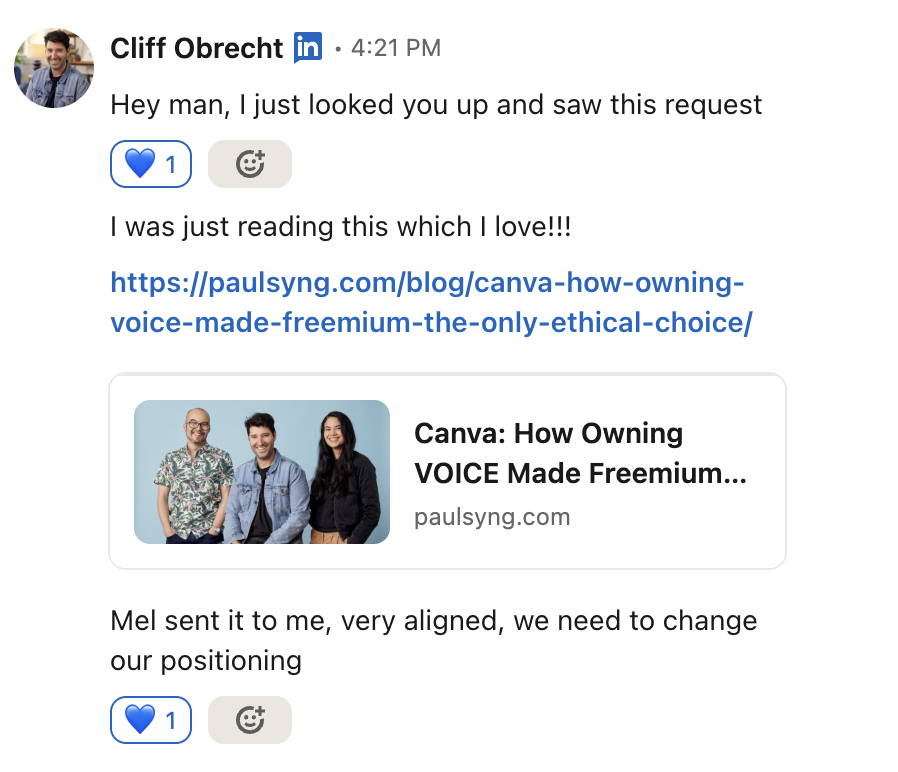
I take on a small number of advisory clients each year. These are founders and leadership teams who want an outside read on their position — the same method as the Gravity Reports, applied to their own company. If that’s relevant, the best place to start is a conversation. Better call Paul.
DIGEST