
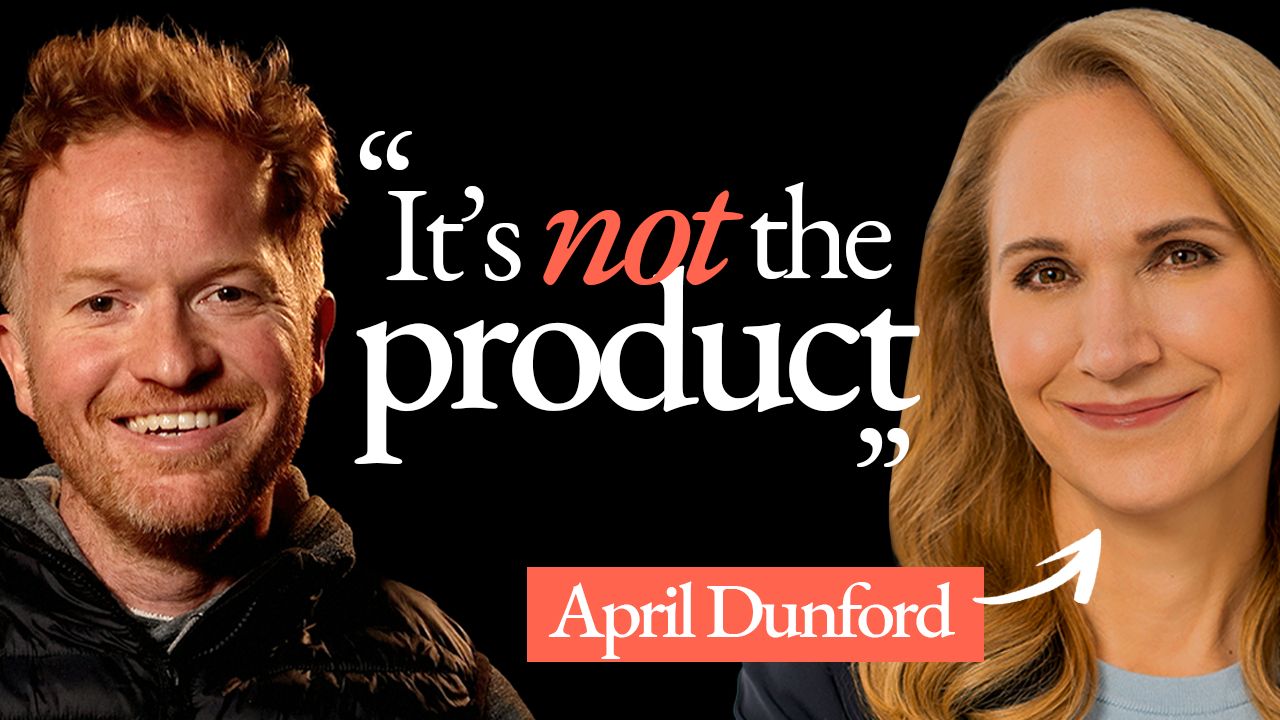

An hour of two people who agree with each other, congratulating each other for disagreeing with people who aren’t in the room. What follows is what actually happened, not what they think happened.
1. The setup — what the conversation is announced as
Alex Smith opens with a frame. He is the “no bullshit strategy” guy. His book is a “spiritual masterpiece masquerading as a book on strategy,” per a review he reads aloud. His guest is “maybe the world authority on positioning.”
April accepts the compliment with a qualifier delivered fast: “B2B, tech, with a sales team.” Note the qualifier. It will do a lot of work later. Every time evidence from outside that box appears, it will be waved off as “different.” The jurisdiction wall goes up in the first thirty seconds.
Two authorities on strategy, one interviewing the other. The audience is meant to feel it is watching a masterclass. What it is watching is two people co-signing each other’s revenue models.
2. What the hour is actually about
Not positioning. Not in the Ries–Trout sense the word was invented to describe.
The hour is about sales-call comprehension. Every diagnostic April offers for “you have a positioning problem” is a first-call symptom:
- “New customers can’t figure the thing out.”
- “So wait, so you’re like Salesforce?”
- “I get it. I just don’t see why I would pay that much for it.”
- “Takes us two, three calls before the light comes on.”
Every fix she describes lives in the pitch and the homepage. “Imagine if the light came on in marketing… before they even got to your salesperson.”
That is not positioning. That is onboarding a prospect into a story a salesperson can close on. Useful work. Not what the word means.
The move April has made — professionally, over a decade — is to plant her flag inside sales enablement and call it positioning. The word carries prestige. Sales enablement doesn’t. Her market pays her to conflate the two. The conflation is the business.
3. What positioning actually is — the definition she skips
Ries and Trout, 1969, then again in 1981: positioning is what you do to the prospect’s mind. You position in the mind, not on a slide.
Mental territory. A concept owned by a company in the customer’s head, whether or not any salesperson opens their mouth, whether or not any homepage is ever visited. Amazon owns convenience. Volvo owns safety. Tesla owns the future. Patagonia owns environmental commitment. Costco owns value that refuses to gouge.
You do not build these positions with better pitches. You build them by making structural decisions — capital allocation, refusals, product architecture, hiring criteria, what you will never do — that only make sense if the concept is real.
The homepage is downstream of that. The sales pitch is downstream of that. The story a rep tells is downstream of that.
April operates one layer above the concept and calls it the concept. She is fixing symptoms at the pitch layer and telling her clients they’ve fixed their positioning. She is not lying. She believes it. Her industry believes it. That’s the point.
4. The five structural errors
Remove any one of these and the argument falls over.
Error 1 — Happy customers mean positioning is fine
Her heuristic, delivered as authority: if your existing customers love you and don’t churn, the problem is not positioning. The problem is upstream — awareness, lead generation, marketing reach.
Watch the causal error. Happy customers prove the product delivers value to whoever managed to buy it. It says nothing about the concept the company owns in the market’s mind that never entered the funnel. Every miscategorized company in history has had happy customers — of the small slice of buyers who could figure it out on their own.
Happy customers are a survivorship signal. It selects for the buyers your positioning accidentally reached. It cannot diagnose positioning because it cannot see the buyers who never came near you.
The Bain finding she never cites: 80% of executives say they deliver a superior experience. 8% of customers agree. That gap is not fixed by asking customers who bought.
Error 2 — Positioning changes over time as a positive doctrine
Her CRM ladder, delivered as strategy: CRM for investment banks → CRM for banking → CRM for financial services → CRM for large enterprises.
Read the mechanism carefully. At each step the noun loosens. From a real position — CRM for investment banks, an owned mental territory in a specific mind — to Salesforce’s position, which is to say, no position at all. She is describing what happens when a company runs out of a distinct territory and starts renting a bigger one from the incumbent.
This is not a positioning ladder. It is a positioning drift ladder narrated as progress. The endpoint by construction is undifferentiation.
She calls this the strategy. Roger Martin would call it the absence of strategy — because there is no where-to-play sacrifice at the far end. Porter would call it the loss of a distinct activity system. She calls it the vision. This is how positional drift gets sold as ambition.
Error 3 — Bolt-ons and competitors caused the confusion
Her diagnosis of why once-clear companies become confused: feature bolt-ons, new releases, AI, a VC-funded lookalike showing up.
She names the smoke and calls it the fire.
The real cause is absence of a governing concept. A company that owns a concept refuses features that dilute it. A company that owns a concept is not confused by lookalikes, because lookalikes cannot copy the operating model underneath the concept. A company that owns a concept can announce a bolt-on, and the market automatically slots it into the existing mental territory.
Feature confusion is downstream of positional emptiness. She treats the effect as the cause. Every intervention she prescribes leaves the actual cause untouched.
Error 4 — 50 to 70% of B2B deals lost to no decision, blamed on champion risk aversion
She names a real statistic. She reads it as a champion-psychology problem: the person in the middle of the deal is scared to pick badly, so they pick nothing.
Cleaner read: the vendors were interchangeable. When no one on the shortlist owns a concept, “no decision” is the rational default because nothing is lost by waiting. The champion isn’t being cowardly. The champion is being correct. Nothing on the table earned the risk of moving.
Risk aversion is downstream of undifferentiated fields. Her fix — a sharper sales narrative and a cleaner homepage — treats the effect. The cause is that no company on the shortlist stood for anything specific enough to make choosing feel safer than not choosing.
Error 5 — The credit-union story as positioning victory
Her signature win. A company at $10M in revenue trying to serve everyone. They pick credit unions. They stay in credit unions. They hit $100M+. She tells it as positioning genius.
Read what she actually describes. They chose a segment. They focused resources on it. They tailored the go-to-market. They refused adjacent markets.
That is segmentation and focus. That is the Roger Martin where-to-play choice. That is Porter making a distinct activity-system decision. That is real strategic work.
It is not positioning in the Ries–Trout sense. It is not mental-territory ownership. It is market selection. Two different jobs. Both matter. Not the same craft. She conflates them because her practice sits at the seam and profits from the ambiguity.
The company won because the CEO made a costly refusal — everything else they didn’t chase. That refusal is the closest thing to real positioning in the whole hour. She narrates it and doesn’t see it. She names the fix as sharper messaging and market focus. She never names the refusal as the mechanism.
5. The consider / unconsidered axis — collapsed on inspection
Her most theoretically ambitious move: the distinction between “considered” and “unconsidered” purchases. Enterprise software is considered. Fruity Pebbles is unconsidered. Buying a house is more like enterprise software than like Fruity Pebbles.
Sounds sophisticated. Falls apart in ninety seconds.
Fruity Pebbles has one of the most owned positions on the shelf. Fun. Sugar. Cartoon. Kid-authority. Anti-parent. It got there through decades of costly consistency in packaging, licensing, media, and shelf presence. That position was engineered. That position is defended. That position generates margin.
She hand-waves the whole category.
“You can pull on a lot of levers.”
“Value comes in all kinds of flavours.”
“There are no stakes.”
There are no stakes for the individual buyer. There are enormous stakes for the brand. The whole discipline of distinctive assets — Byron Sharp, Ehrenberg-Bass, forty years of empirical marketing science — exists because in low-consideration categories the buyer is not thinking. Which means the buyer is retrieving from memory. Which means positioning matters more, not less. What gets retrieved is what wins.
She has the direction reversed. Low consideration raises the burden on positioning. It doesn’t lower it.
The reason she can’t see this is that her practice has no tools for the mechanism. Retrieval from memory, distinctive assets, mental availability, category cues — these live below the sales call. She has no product for that layer, so it doesn’t exist on her map.
6. The assumptions the whole hour rests on
Strip these, and the argument dissolves.
Assumption A — Positioning is a communications output.
Every “fix positioning” example she gives is words. Sales pitches. Homepages. Category framing. Taglines. The physical business is treated as fixed and off-limits. Explicit line: “The value is the value you could deliver. We don’t get to just make this stuff up like the product does what it does.”
That is the whole game right there. She has firewalled the operating model off from positioning work. Which means her practice cannot, by construction, move any layer of positioning below the sentence. She sells L1 Saying It. She calls it strategy.
Assumption B — The buyer is a rational-ish committee with information-processing problems.
Every diagnostic is comprehension, comparison, justification. Nowhere in the hour do the words cue, association, memory, salience, habit, automatic, retrieval, or heuristic appear. She is running a folk-cognitive model in which buyers are miniature executives who Read Things and Weigh Things.
Sixty years of behavioural science say otherwise. Buyers — including B2B buyers — retrieve associations from memory, form a shortlist automatically, then justify. She optimizes for the last 5% of the decision, the explicit justification, and ignores the 95%, which is the automatic shortlist formation. She is invisible to the mechanism that actually decides most sales.
Assumption C — Consultant leverage equals teaching the team a framework.
Her breakthrough story is that she stopped being a doer and became a guide. Fine on its own terms. But the framework she guides teams through cannot touch capital allocation, product refusals, hiring criteria, business model design, or organizational structure.
She has built a business by locating her work exclusively at the layer that is easiest to sell and safest to workshop. The layer where the CEO can nod along without refusing a customer or killing a product line. She has monetized the exit ramp before the hard decision.
Assumption D — B2B tech is a special universe with its own physics.
The qualifier (“B2B, tech, sales team, in-market”) gets used as a jurisdictional wall. Every time evidence from outside — consumer behaviour, behavioural economics, brand memory research, category theory — could disprove her, the wall goes up. “That’s different.” “That’s consumer stuff.” “You don’t have that problem here.”
This is rhetorically effective. It is epistemically empty. There is no mechanism she describes that is unique to B2B tech. The mechanisms of memory, association, cue, retrieval, and shortlist formation operate identically across categories. The stakes and time horizons differ. The mechanisms don’t.
Assumption E — Words carry the position.
The deepest assumption. Never surfaced. Never questioned.
Test it: strip a company of every piece of copy, every tagline, every deck, every homepage word. What does the market say the company stands for? April’s methodology has no answer because it only produces the copy, the tagline, the deck, and the homepage.
The Burj Khalifa does not need a sign that says “we are tall.” In-N-Out does not need a tagline. Patagonia’s ad copy is downstream of Patagonia’s donation policy, not the other way around. Real positions survive silence. Fake ones evaporate the moment the words stop.
April sells the words.
7. What they completely miss about human behaviour
The words System 1 and System 2 do not appear in the hour. That is not incidental. That is diagnostic.
Her whole model implicitly assumes System-2 buyers. Reading the homepage. Comparing options. Doing the analysis. Weighing risk. Writing the business case. When she says “the light comes on,” she means System 2 achieved coherence.
The actual buying process:
- System 1 forms the shortlist. Fast. Automatic. Associative. Cued by category thoughts matched to distinctive memories. “We need a CRM.” “The one for financial services.” “The one that’s not Salesforce.” If you don’t own an association, you are not retrieved. If you are not retrieved, no sales-call clarity fixes it.
- System 2 justifies the choice. Slower. Explicit. Deliberative. The pitch. The ROI. The deck to the boss. This is where she works.
She is a System-2 consultant selling in a market where System 1 does the sorting. Her interventions work when the client already had a viable System-1 position and needed the System-2 handoff cleaned up. Her interventions fail — quietly, invisibly, without a return call — when there was nothing System-1 to hand off.
This is the largest missing piece in the entire hour. Not one mention. Not one gesture.
8. Actions louder than words — the century of science she ignores
The evidence is not contested. It is one of the most replicated findings in behavioural science across disciplines that do not talk to each other and independently converge on the same result:
- Infants imitate observed behaviour before they can decode words. Mirror neuron systems are operational by twelve months.
- Preschoolers weight demonstrated outcomes over stated intent when deciding whom to trust.
- Nonverbal cues account for 60 to 93 percent of the emotional meaning in communication.
- The say-do gap is one of the most replicated findings in behavioural research. Veylinx: 83% say they’ll buy, 42% actually bid.
- Costly signals are honest because they cannot be cheaply faked. Zahavi, 1975. The peacock’s tail.
- Revealed preference. Samuelson, 1938. If you want to know what someone prefers, watch what they do.
- Behavioural integrity research. The gap between what managers say and what they do predicts trust, engagement, and organizational credibility.
- Bain’s 80/8 gap. Executives believe they deliver a superior experience. Customers do not agree.
- CEO/employee gap. 75% of CEOs believe they’ve clearly positioned their company. 22% of employees can translate it to customers.
Not one of these findings surfaces in the hour. The industry April represents has been informationally quarantined from a century of science governing its own subject matter. The reason is structural: this evidence, taken seriously, would render the deliverable untenable. The workshop cannot produce a costly signal. The workshop can only produce words about a costly signal. So the workshop pretends the science does not exist.
She is not the villain of this story.
She is a symptom.
The whole ecosystem is built on the inversion.
9. Who already solved what she is groping toward
The people who worked out this problem — thirty, fifty, a hundred years ago — and whom she does not cite:
- Ries and Trout, 1969, 1981. Positioning as mental territory. She nods once and departs.
- Al Ries and Laura Ries, Marty Neumeier. Different, not better. The whole hour is about better explained more clearly. Never about different in kind.
- Roger Martin, Playing to Win. Strategy as an integrated cascade of choices with sacrifice at the heart. Her credit-union case is a Martin where-to-play choice mislabeled as positioning.
- Michael Porter. Position as a distinct activity system. Copyable if only words. Uncopyable if the operating model bends around it. She addresses none of it.
- Chris Argyris. Espoused theory vs. theory-in-use. Her entire practice sits inside espoused theory. She produces better versions of what companies say they are while leaving what they actually do untouched.
- Donald Schön. Knowing-in-action vs. technical rationality. Her workshops are technical rationality. Companies that own positions have knowing-in-action encoded in their operating model.
- Byron Sharp and Ehrenberg-Bass. Mental availability, physical availability, distinctive assets. This is what actually predicts market share. She treats it as if it does not exist.
- Les Binet and Peter Field. The 60/40 brand-vs-activation split. She is selling 100% activation-layer thinking and calling it strategy.
- Daniel Kahneman. System 1 and System 2. Absent from the hour.
- Amotz Zahavi and costly signalling. Why words are cheap and structural decisions are expensive, and why only the second is trustworthy.
- Paul Samuelson, revealed preference. Watch what people do, not what they say. Her method is stated-preference all the way down.
- Rory Sutherland. Psycho-logic. The value of the “irrational” cues she treats as noise.
- Bandura, Hebb, mirror neuron research. Humans learn by watching, not listening, from birth. Settled science she does not touch.
Any one of these would have changed the shape of the hour. The absence of all of them is not an oversight. It is the practice’s operating condition.
10. What they get right — accidentally
Moments where she brushes against something real and walks past it.
- “Positioning was in your head from the beginning.” True and truer than she realizes. It was in the founder’s head as an operating instinct, a set of costly choices about what the company would and would not do. That is real positioning. It was never a document. She stumbles onto this and buries it.
- “You can’t outsource positioning.” Correct instinct, wrong mechanism. She thinks it’s because the team knows the market. Real reason: positioning lives in capital allocation, refusals, and product decisions no consultant can make for a CEO. She glimpses this in the “cold dead fingers” line and walks past it.
- “CEO in the room or it’s disqualified.” Correct. But not for ownership psychology reasons. Because positioning decisions are P&L decisions. Only the person who has the authority to refuse revenue can make them.
- “Niching is a race to bigness.” Directionally right. She’s describing focus and market selection. She just calls it positioning.
- The refusal instinct. When she says “just credit unions. Never left credit unions. Absolute undisputed king of credit unions” — she is describing a costly refusal. Everything else they didn’t chase. This is the closest she gets to real positioning. She does not recognize it as the point.
- The say-do gap on features. “We had this thesis, we launched it, and we find out where the thesis is right or wrong.” Half-formed but real. What she is describing is the same mechanism revealed preference formalized in 1938. She doesn’t cite it. She doesn’t know she is rediscovering it.
11. What they get right — on purpose
Credit where it’s due.
- “If we can’t answer why pick us, we’re dead.” Correct. Understated if anything.
- Not all business problems are positioning problems. True and important. Half her clients don’t need her. They need distribution, lead gen, or a better sales team. She names this out loud. Respect.
- “We build on vibes when it’s easy. We get in trouble when it stops being easy.” Genuine insight. Companies that grew on tailwinds are the ones that most need to figure out what they stand for, because they never had to.
- The “confusion in the sales call” diagnostic is a real signal. She is just wrong about which layer of the problem it points to.
- The jurisdictional honesty. “B2B, tech, sales team, in-market” — more scope discipline than most consultants have. She’ll tell you when it’s not her problem to solve.
12. What Alex Smith brings — or doesn’t
He introduces himself as the contrarian. “In this world where every idiot is getting ChatGPT to tell them what to do, this is the stuff that matters more than ever.”
Then he spends an hour agreeing with everything.
The one moment he pushes — the “niching is a race to smallness” line — she bats down with the CRM example, and he immediately concedes. “Oh, I completely agree.” He then continues to defend the position he just conceded. He is not doing forensic interviewing. He is doing courtesy interviewing dressed as skepticism. His book review self-quotes and his “hyper-competition era” branding do most of the intellectual lifting on his side. He is selling his book.
The most telling exchange is when he correctly observes that CEOs are usually wedded to the concept of the business as-is and treat poor performance as an optimization problem. This is a real insight. It is also structurally identical to Argyris’s forty-year-old finding on organizational defensive routines and single-loop learning. Neither he nor she has the vocabulary to place it. So it lands as a folk observation, gets a nod, and dies.
He is not the problem in this hour. He is the amplifier. Someone with a “no bullshit strategy” brand hosting the world’s most productized positioning consultant (glorified copywriter if you ask me) and calling it a masterclass. The bullshit-detection apparatus never fires.
13. The revenue model explains the framework
This is where the autopsy has to go and where polite interviews never do.
The reason April’s framework stops at the pitch and homepage layer is not intellectual. It is commercial.
L1 Saying It — words, decks, homepages, sales narratives — is a productizable deliverable. It fits a workshop. It fits a book. It fits a keynote. It fits a repeatable engagement. It scales.
L3 Being It — costly decisions like refusing revenue, cancelling product lines, changing hiring criteria, restructuring capital allocation — is not productizable. It is a series of refusals only the CEO can make. Consultants cannot ship refusals. Consultants cannot invoice for a market that has not been entered.
L4 Owning It — a business model bent around one owned concept — is a decade of operating decisions. It cannot be workshopped. It cannot be delivered in a six-week engagement.
So the industry sells what it can sell. The rest gets pretended.
This is not April’s individual failure. It is the shape of the entire ecosystem. FletchPMM, Andy Raskin, StoryBrand, the PMM Twitter world — all of them clustered at L1 for the same reason. The refusal test — what specific revenue did you decline, what customer did you turn away, what product line did you kill — cannot be run against their deliverables because their deliverables are copy. Copy has no refusals. It only has words.
April is the best-known practitioner of this school. That is her achievement. It is also the school’s ceiling. Her mass authority makes engagement with her framework amplifying rather than corrective. Because her work is L1-marketed as L4, citing her as an authority silently endorses the inversion.
14. The one-sentence verdict
April Dunford is running a competent, honest, well-scoped sales-narrative and homepage-comprehension practice, mislabeled as “positioning,” resting on a folk-cognitive model of buyers, informationally quarantined from a century of behavioral science that would move her clients from L1 Saying It to L3 Being It and L4 Owning It — and the industry rewards her precisely for that mislabeling, because L3 and L4 aren’t productizable and L1 is.
15. The consequence
For a founder listening to that hour and thinking of hiring her:
Don’t hire her, or her school, to do your positioning. Hire her school to write a sharper first-call story once you already own a concept in the market. The concept itself — what the business will and will not do, who it will refuse, what it will sacrifice, where the capital flows — is yours to decide.
The decision is a P&L decision, not a workshop.
If your P&L does not already reveal what you stand for, no deck she produces will fill the gap.
If your P&L does reveal what you stand for, you might not need her at all — you need a copywriter, and she is an expensive one.
The test is one question the whole hour never asks: what did you refuse last quarter, and can you name it in dollars? If you cannot answer, the positioning is words. If you can, you don’t need April Dunford.
You need someone to help you keep refusing.

Leave a Reply
You must be logged in to post a comment.