
♛
15.09.2026
Your P&L is your brand
Read Time: 12 Minutes
Hello
Your customers don’t read your financial statements. They experience them.
I keep coming back to two statements. In March 2024, Nike’s finance chief acknowledged that the company had become too focused on its sales-channel targets and paid too little attention to “serving consumer demand where the consumer is shopping.” Management preferred one arrangement for the business. Customers had their own shopping habits.
Ralph Lauren’s chief executive, Patrice Louvet, described a different decision: “We left about a billion dollars off the table.” The company had walked away from revenue because of places and ways it no longer wanted to sell.
Both were discussing decisions that affected the accounts. Which sales to encourage. Which relationships to protect. What the company would accept to reach its numbers. Those are brand decisions. They determine what customers can buy, where they find it, and what the experience teaches them to expect.
But there is a complication. Both companies pulled back from parts of distribution. We cannot turn either story into a general instruction to sell directly, close more doors, or refuse revenue. The same action can help one business and hurt another. We have to understand what the decision does to the reasons people choose the company. Which brings me to the meeting where this should be discussed.
The most important brand meeting in your company probably isn’t called a ‘brand’ meeting. It’s called the budget review.
The customer experiences the budget. When I say your P&L is your brand, I don’t mean the profit at the bottom determines what people think of you.
I mean the decisions underneath it. Where money went, which capabilities received funding, what you kept producing because it sold, and what you refused. The P&L is shorthand for that wider record. You also need investment plans and rejected opportunities. Revenue you never accepted can’t show up in the sales total.
Imagine a company reducing its customer service team. Inside the building, the decision arrives as a staffing adjustment. Outside, a customer waits longer to get help. In another meeting, marketing discusses how to make the company feel more personal.
The two meetings have produced different answers to the same question: what kind of company are we?
The connection also works the other way around. Funding a repair that prevents recurring failures might give customers less to complain about and less reason to consider an alternative. Nobody needs to publish a campaign about the repair for it to matter.
This is the relationship I describe as inside-out and outside-in. Inside-out is what the company makes possible through its choices. Outside-in is what people experience and come to believe.
The company decides what to fund and what it will accept to make a sale. Customers encounter the result and learn what to expect from the name. That expectation can influence what they consider, what they will pay, and whether they return.
The next set of financial results contains part of their response.
Money alone doesn’t create the meaning. A spending pattern gives us something to investigate. We still need to know what customers experienced as a result.
Nike had a plan for where people should buy
The easy version of Nike’s story is that an outsider arrived and didn’t understand the business. John Donahoe had served on Nike’s board since 2014. The board selected him for his digital and technology experience, and Mark Parker remained executive chairman. Nike’s shift to direct-to-consumer was already underway. This was a company mandate, not something one person slipped past everyone else.
There was a reasonable business case. Selling through your own stores and website can give you more control over presentation and the customer relationship. You keep revenue that would otherwise go to a retailer, though you also take on more of the work.
Someone still has to attract the customer, hold the stock, help them choose, and deal with returns. The plan depends on customers wanting your products enough to buy them where you want them to.
In the March 2024 earnings call, Matt Friend referred to Nike’s ambitions for digital to reach 40% of the business and Direct to reach 60%. He acknowledged excessive attention to those measures and said they would no longer guide forward plans.
A runner has no reason to care about that target. They might want to compare several shoes, try different sizes, or speak to someone who understands the problem with their current pair. Someone else may know exactly what they want and prefer ordering online.
Nike’s preferred channel mix cannot settle those questions.
The direction had also entered its reward system. Nike’s fiscal 2021 executive incentive design explicitly included digital revenue to support Consumer Direct Acceleration. The organization formally paid people to deliver digital growth.
Meanwhile, retailers had their own businesses to protect. In February 2022, Foot Locker announced plans to reduce supplier concentration, partly in response to a major vendor’s accelerated direct strategy. The same release described opportunities with Reebok and Puma.
Consider the possible customer experience. Someone visits a familiar store and cannot find the Nike shoe they wanted. The store still needs to make a sale. An employee recommends another pair. If it works well, the customer now has a reason to choose differently next time.
That sequence is an illustration, not a calculation of Nike’s lost sales. It exposes the assumption leadership needed to test: how many customers would follow Nike, and how many would buy something else?
A retailer’s margin is easy to see. The contribution that retailer makes to earning the sale takes more judgment.
A familiar product can make the numbers look good
The product range added another problem. In October 2024, Friend acknowledged that Nike’s portfolio had become too concentrated in classic styles. Nike was reducing supply of Air Force 1, Air Jordan 1 and Dunk. These products generated attractive margins, particularly through digital, but the company needed to reduce their weight in the business.
You can understand the appeal of a familiar product in a planning meeting. Customers recognize it. The company knows how to make it. Sales history can be used to forecast. A new product comes with unanswered questions. It needs funding before anyone knows whether people will want it.
Keep favouring the sales you can forecast, and uncertain work may struggle to get resources. The business may become increasingly dependent on demand it earned earlier. That is the risk I see in Nike’s admissions. The products helping the plan look successful could also make the company harder to renew. Eventually, repair meant shrinking some of the revenue those products produced.
It would be wrong to stretch this into a claim that Nike stopped producing anything exceptional. Kelvin Kiptum set his 2023 marathon world record wearing a development version of the Alphafly 3. Elite performance credibility was still being earned during Donahoe’s tenure.
But someone can admire Nike’s racing technology, love their Jordans, and choose another company’s shoes for daily runs. The damage does not have to be universal to matter. A company can remain familiar and desirable in some situations while becoming less useful in others.
Nothing about that requires the logo to change. Customers are learning from the products, their availability, and the price they expect to pay.
Ralph Lauren chose which revenue to keep
Louvet started with a different problem. Shortly after joining Ralph Lauren, he visited Ralph at his Colorado ranch and asked what business they were in. Their answer was the “dreams business”: inviting people into a world they wanted to participate in.
He applied two tests to the operation: “Are we proud of the way we show up?” and “Is it financially attractive?” A failure on either called for fixing the problem or leaving.
Both tests deserve to stay together. Pride without financial discipline can become an expensive indulgence. Financial attractiveness without a standard for the experience can justify almost anything that produces a sale. The definition had to change what the company would accept.
Imagine a shopper who repeatedly encounters the clothes in surroundings that feel careless, or learns that another promotion is always coming. The company may intend to invite that person into an aspirational world. The shopper may instead learn that waiting produces a better bargain.
A campaign can introduce the dream. The product, store, service and price still have to support it. This is the risk I understand Louvet to be addressing. Reducing some sales can remove occasions when the business teaches customers something it later has to work against.
But the billion-dollar figure is Louvet’s account of revenue forgone, not an audited measure of profit sacrificed. Leaving a dollar of sales behind does not mean losing a dollar of earnings. Some costs disappear with the sale. Exiting weak business can improve the customer experience and the accounts at the same time.
The financial record gives us a more grounded comparison. In fiscal 2018, Ralph Lauren’s reported revenue fell 7% to approximately $6.2 billion, while adjusted gross margin rose 2.9 percentage points to 60.8%. That does not isolate the effect of the distribution decisions. Nor does a higher margin percentage automatically establish more total profit. It does show why revenue growth alone cannot describe the quality of the business being built.
The footwear discussion in Louvet’s interview makes the allocation problem more tangible. His team considered making footwear a greater priority, but the space shoes required in stores made the economics less attractive. He left room for future opportunities rather than declaring the category permanently off limits. That refusal is based on what else the company could do with limited resources. The next opportunity might be viable and still be the wrong priority.
Once people want your name on something, you can find many things to put it on. Being able to sell the next thing doesn’t tell you whether it deserves the floor space, people, and attention.
The same action can mean different things
Put the distribution decisions side by side. Nike acknowledged putting too much weight on where it wanted transactions to happen. Louvet described leaving places that failed his tests for presentation or financial value. Those accounts involve different problems, even though both reduced parts of distribution.
There is no useful rule about closing doors here. You need to understand what each door contributes.
For a runner, access to comparison and advice may help turn interest into a purchase. For a fashion customer, the setting may influence whether a garment feels desirable at its asking price. A retailer can provide both. An owned store can disappoint on both.
When I talk about a position, I mean a particular meaning attached to a company’s name. In my reading of Nike, athletic achievement is useful territory to investigate. Louvet’s account of Ralph Lauren centres on aspiration: a world people can see themselves in. Neither interpretation is a substitute for evidence of what customers actually believe.
Those ideas become useful internally when they help judge decisions. Does this product give people another reason to believe in what they associate with us? Does this partnership make that experience easier to find? Does this price support the business we intend to build?
Simply making customers happier is too broad an instruction. The work is to understand what they specifically value about choosing this company, and which decisions keep earning that value. That also changes how I read the contrast. This is not finance against creativity.
Financial judgment depends on understanding what makes the money possible.
Without that understanding, a coherent plan can optimize something the customer never asked for.
Who can change the decision?
I call the boundary between describing a position and making its consequential decisions the Refusal Line.
Above it, you can change the language. Below it, someone has to change what the company accepts, funds, and stops. Crossing the line does not require losing money. It requires authority over the trade-off.
I have run workshops where people worked hard to find language they believed in, then returned to a business that continued as before. The enthusiasm was real. The authority to change the underlying decisions was missing.
Imagine everyone agrees the company should mean simplicity. Then sales accepts another custom requirement. Product adds another pricing tier. Operations preserves an exception because an important customer depends on it.
Each team has a defensible reason. Nobody can protect the shared standard against the individual opportunity.
The workshop has given the conflict better language. It has not resolved it.
This is why a headcount tells me less than knowing who can act. A designer may see a product problem. A salesperson may hear something the forecast misses. Their knowledge only helps if someone can change the plan.
When customer evidence conflicts with the number a manager has promised, which one gets reconsidered?
Nike’s later repair included decisions about that operating system. In June 2025, Elliott Hill described plans for dedicated teams by sport and hiring in retail marketing, visual merchandising, and account management to better serve wholesale partners.
Those changes matter because they can affect what employees notice and deliver. The announcement itself does not establish that the repair worked.
Clear language internally matters here too. Louvet used his definition of the business to test the operation. Naming the standard helped make the decisions discussable. A sentence can help people make a shared decision. It cannot fund that decision or give them permission to enforce it. Keep the writer involved. Make sure the person approving the words can point to who is paying to keep them true.
A bad quarter doesn’t explain itself
There is a dangerous way to use these cases: celebrate every painful result as evidence of strategic courage. Falling sales might reflect a deliberate retreat from unhealthy business. They might also reflect customers no longer wanting what remains. Sometimes both are happening.
Leadership has to separate them. For Nike, the test is whether a more desirable product range and better access produce stronger demand without dependence on promotions. For Ralph Lauren, it is whether customers keep choosing the remaining offer at prices that support the business.
Those are tests to apply, not outcomes to assume. The reverse mistake is just as costly. Suppose a company cuts the people who prevent recurring customer problems. Expenses fall immediately. Existing customers may take time to notice the deterioration, and even longer to leave. For a while, the company can report the savings while benefiting from a reputation it has stopped funding properly.
The calendar hides the connection. The cut belongs to one planning cycle. The lost customer belongs to another. Marketing then gets asked to restore confidence in an experience the business no longer maintains.
Spending more would not automatically fix that. Waste exists. Removing unnecessary work may improve service. The distinction is between a cost that persists through habit and a cost that makes the company worth choosing. A strong brand can fund a better experience. A better experience can strengthen the brand. Total spend alone cannot tell us which happened first.
That is why “long term” needs evidence attached. Before approving a difficult change, name what customers should experience differently and what would make you reconsider.
Bring a different record to the next meeting
Before discussing what your company stands for, pull your last fifty significant decisions. Bring what you funded and stopped, the people you hired, the products you shipped, and the exceptions you allowed. Include opportunities you declined. Keep the dates and original reasons attached so you don’t rewrite every decision to fit the ending.
Then put the company’s self-description aside. What pattern remains? You may find a standard the team has protected for years without knowing how to name it. You may find decisions pulling in different directions, held together mainly by the story everyone tells. Both are useful findings. Forcing a flattering answer would defeat the exercise.
Now compare that record with customer evidence. Look at what people return for, what they complain about without prompting, and what changed after choosing you. For every proposed concept, identify the decisions that earn it. Those are the checks I use: remove the self-description, examine customer language, and match the meaning to the proof.
Choose one reason customers value the company. Find the revenue stream or proposed saving that puts it at risk.
Perhaps a contract consumes the team your other customers rely on. Perhaps a product needs constant discounting. Perhaps a sales promise requires service the current budget cannot support.
Write a rule that changes the next attractive decision. “We value simplicity” leaves room for almost anything. “We won’t accept custom work that makes the core product harder for existing customers” gives someone a boundary to enforce.
Name the owner. Calculate the revenue at risk, the costs avoided, and the investment required. Give the team a customer-visible result to check, whether that means fewer repeat problems or more purchases without a discount.
You won’t earn a new place in someone’s mind in an afternoon. You can stop approving decisions that contradict the place you’re trying to earn.
At the next budget review, before approving the number, ask what customers will have to experience for you to reach it. Then ask whether that experience gives them a better reason to choose you again.
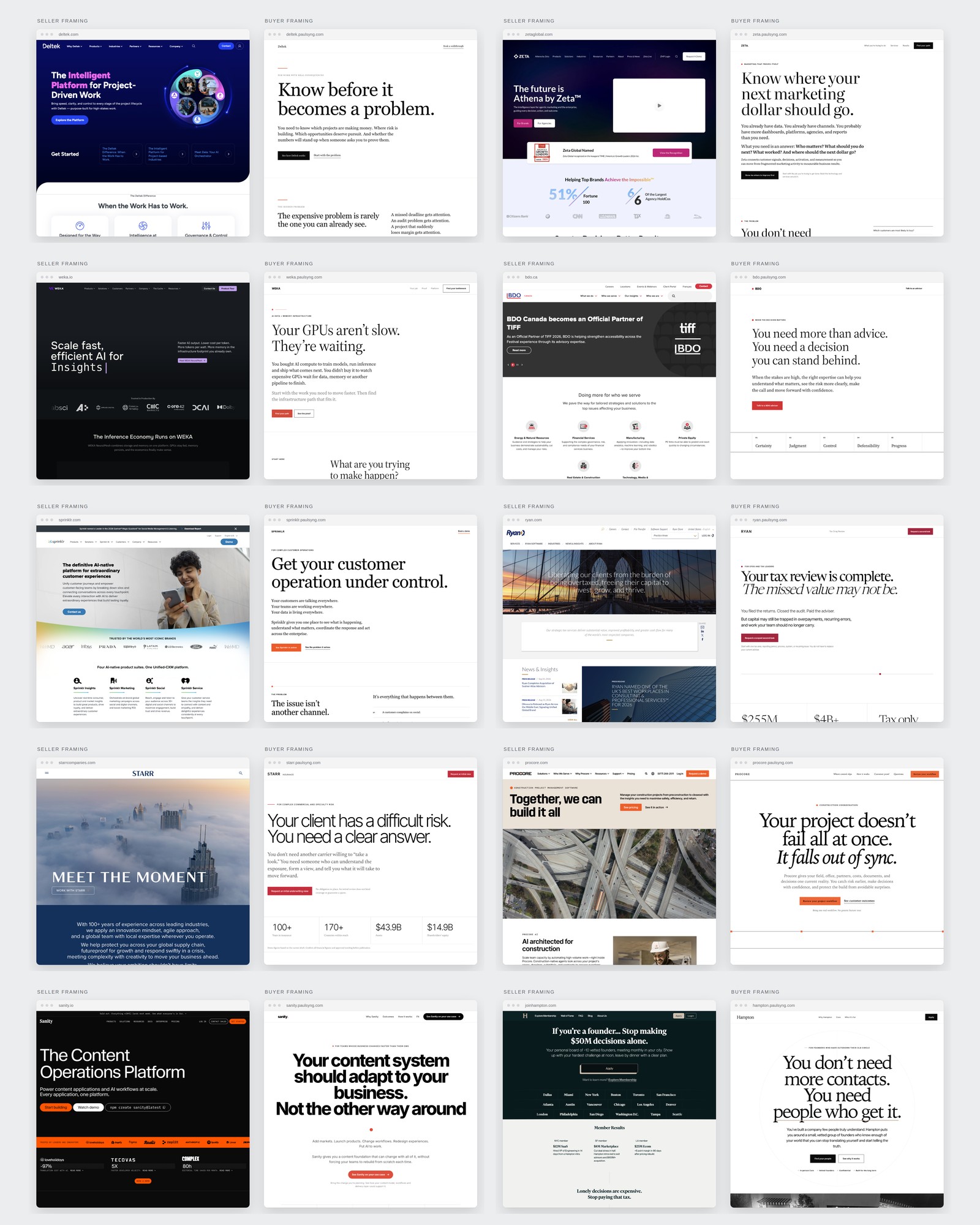
Ten B2B homepages, rebuilt from the buyer’s frame.
The left column shows each site exactly as it stands today. The right column is the same company, rewritten from the buyer’s side.
Eight of the ten headlines on the left are about the company or its product. A buyer has to work out where they fit before reading on.
“The intelligent platform.”
“The definitive AI-native platform.”
“Together, we can build it all.”
All ten on the right speak to the buyer first.
Your GPUs aren’t slow.
Your tax review is complete.
Your project doesn’t fail all at once.
Same companies, same products, and only the framing changed.
They sell construction software, tax work, insurance, a CMS and a founder network. Three of them are public companies. The category made no difference, and the pattern held every time.
People don’t buy when they understand you. They buy when they feel understood.
Find your own homepage in the left column. Then read the one on the right and decide which page you would rather buy from.
DIGEST