Your Homepage Isn't Your Positioning
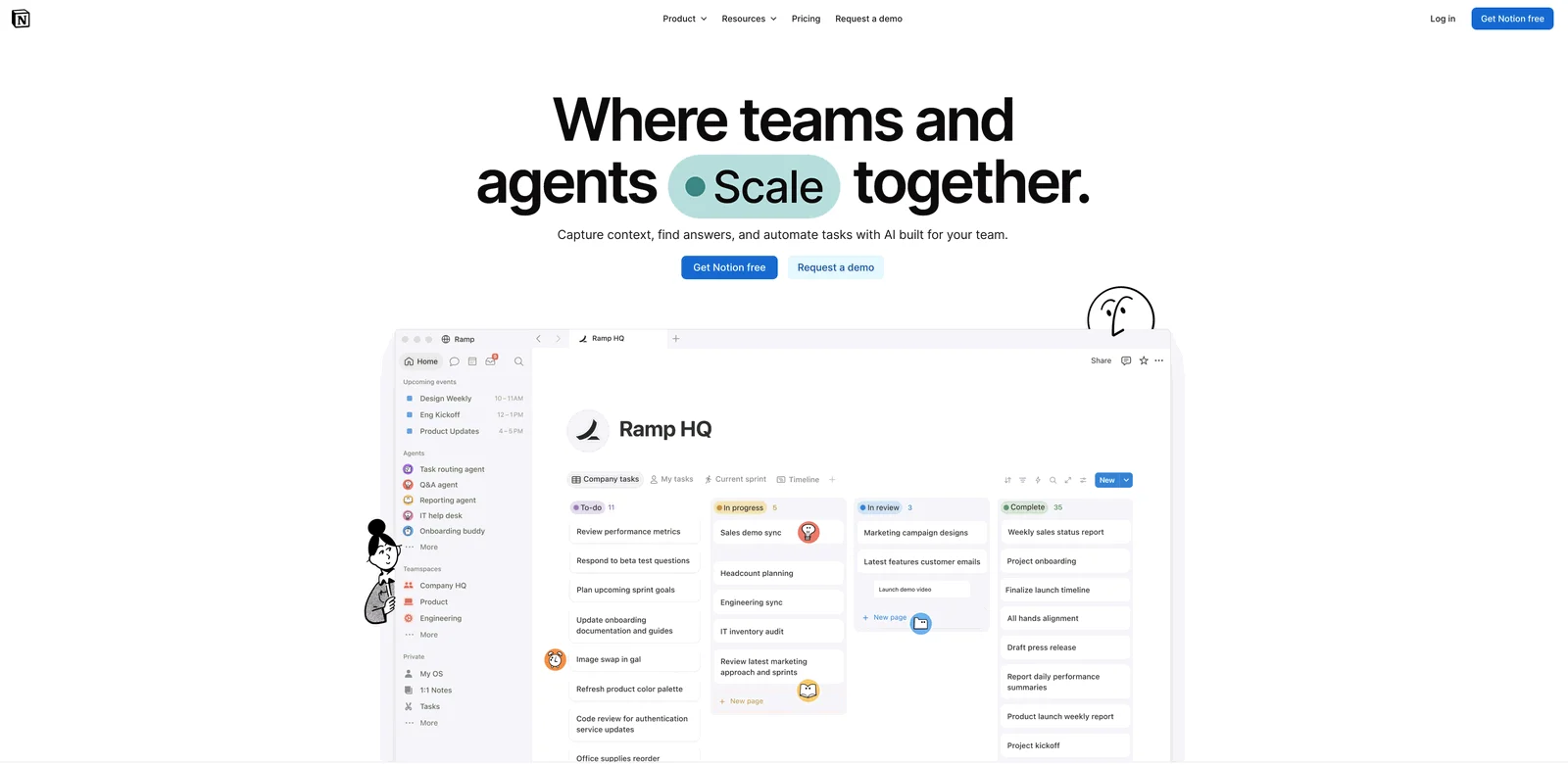
"Tighter positioning. Notion is the context system. The missing half of AI."
John Hurley posted that on LinkedIn to explain Notion's new website. He runs product marketing there.
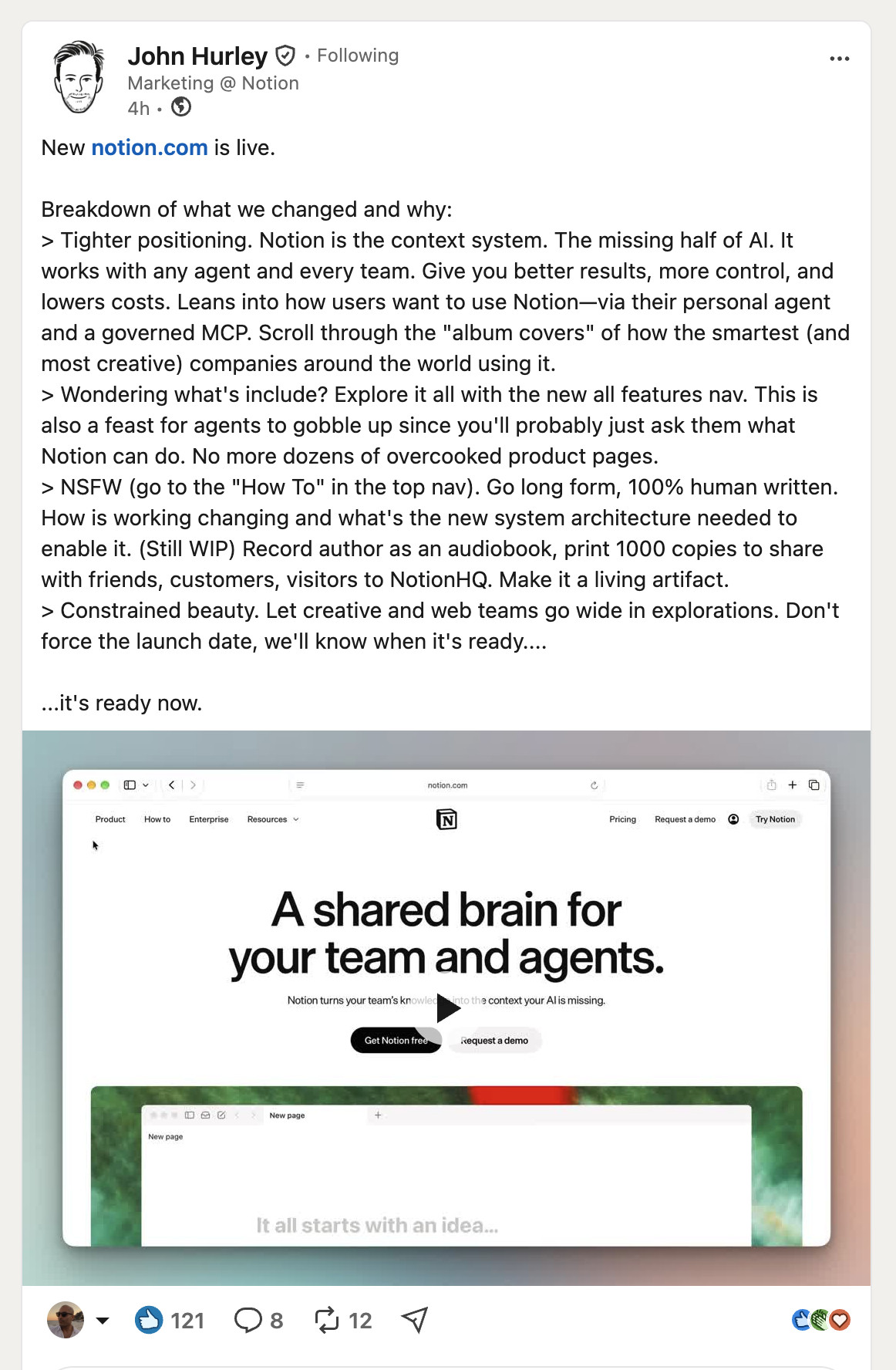
Notion put new words at the top of its homepage. He calls that positioning. HubSpot did the same thing this month and then took it back. On 12 November, HubSpot's co-founder Brian Halligan came back as chief executive. He called it a refounding, his word for starting the company over. The next chapter, he said, was "building the customer relationship harness". The homepage changed to match. About a week later, the old homepage was back. Co-founder Dharmesh Shah posted this.
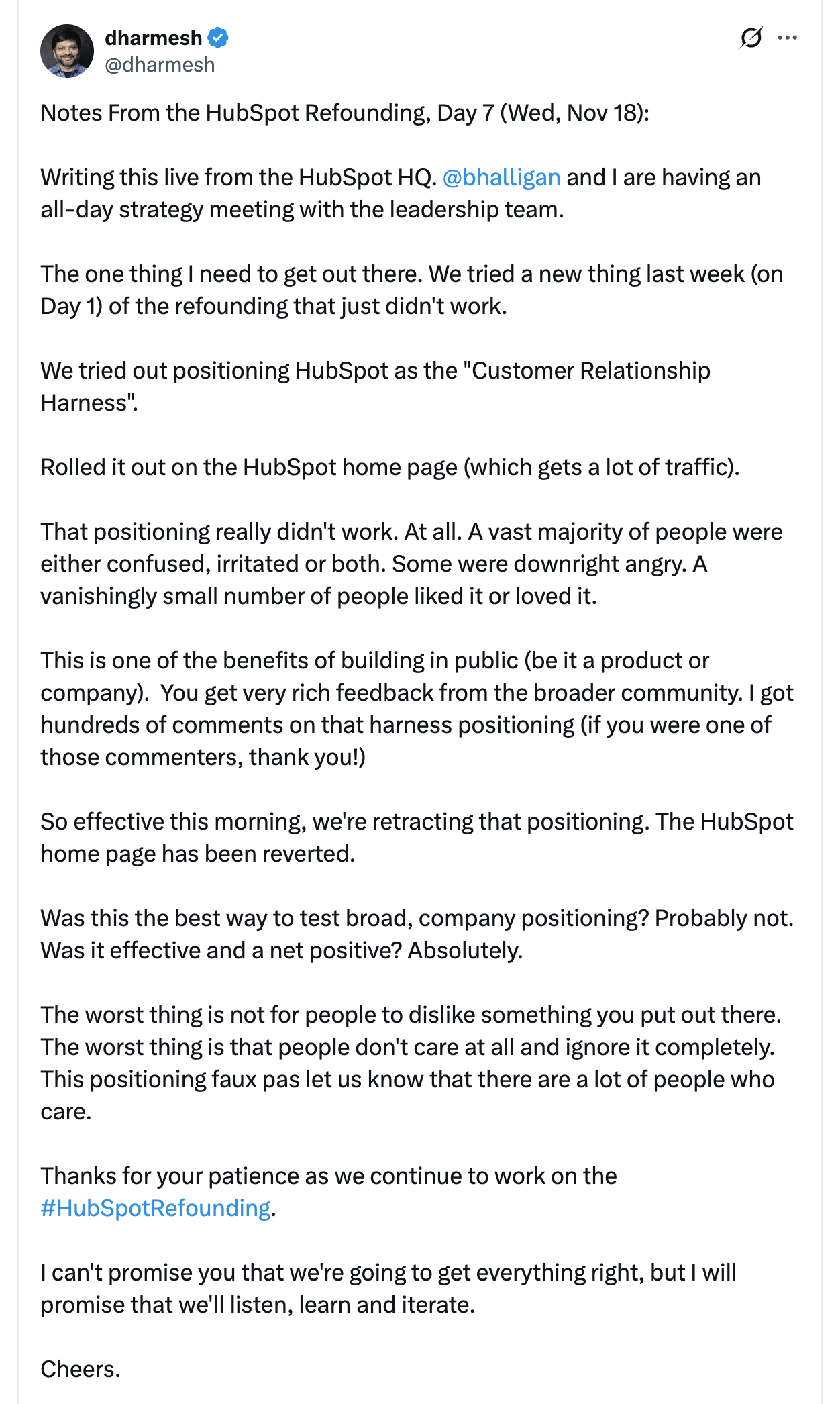
He calls it a test of company positioning. What they tested was a new value prop at the top of a web page. So in one month, two of the best-known software companies changed a headline and called it positioning.
Neither one changed its position.
A position is what customers believe you are to them after they've used you. It sits in their heads. Nobody at Notion or HubSpot can reach in there and edit it in a week.
To be fair to Notion, it changed the product first. It added AI agents in September 2025. This September it shut down its email app, Notion Mail. Its chief executive now puts the share of Notion pages made by agents at about half.
The new homepage is Notion putting those changes into words. Those changes still have to reach users. They have to show up in what people feel using the product, and in who they become with it. That's when a position moves.
HubSpot made real changes too. In October it cut nearly 660 jobs, about 7% of its staff, and reorganized its product teams around the results customers want. Then it changed its chief executive. None of that stopped the pushback. I think people judged the new name against the HubSpot they'd used for years.
A position works like a nickname. You don't get to pick it. People give it to you, based on what they've seen you do. Print a new one on a T-shirt and they'll still use the old one. Change what you do for long enough, and they might change it for you.
Three words that got mixed up
Three words get used as if they meant the same thing. Your homepage is what you say about yourself. You write it, and you can change it before lunch. The words on it are called copy.
Positioning is the work that leaves a belief in your customer's head. It's where the money goes and what you refuse to do, year after year. It takes years. It costs you customers and revenue you could have had.
Your position is the belief itself. It's what changed for a customer after using you, carried around in their head. Usually it comes down to one word, and the customer may never say that word out loud.
A homepage tells strangers what you think you are and what you hope to become. That has a use. It's still you, talking about you.
A position comes from a customer's lived experience. A homepage is galaxies away from that.
Think of someone you know who's toxic. They buy new clothes and get a haircut. Are they any less toxic? And how have they proved they've changed? They haven't. You'd believe it after months of them treating you better. Customers are the same. A new homepage is the haircut.
A quick test tells them apart. Take every word off your website, logo and headline included. Your customers would still know something about you, from using you. That leftover knowledge is your position.
Notion shows the gap.
In 2019, Notion's homepage called it "the all-in-one workspace for your notes, tasks, wikis, and databases". That June, a daily user wrote this on Hacker News.
"My life is in Notion now. It is my repository of life."
Nothing on that homepage mentioned a life.
Last year I wrote a 5,000-word report on Notion. I called what users like this one get coherence. Scattered notes and tasks pulled into one whole that makes sense.
The headline has changed several times since. This summer it read "Where teams and agents Think together". Now it reads "A shared brain for your team and agents."
That 2019 sentence holds up under every one of them.
The new words come from the top. On 5 November, Notion's chief executive Ivan Zhao wrote that "Notion is the best context system for every agent on the planet". He doesn't define context. I read it as what a team knows, kept in one place and up to date.
So what does context do? Put what a team knows in one place, and people and agents stop working from different versions. I'd call that coherence again. The new headline describes what that user was getting in 2019, in this year's words.
Where founders and marketers are today
Here's how it usually goes. Growth slows. A board member asks what the positioning is. Nobody can say it in one line. So the company hires help. Six weeks later there's a workshop, a slide deck, a messaging doc and a new homepage. The headline is shorter. Sales has a cleaner pitch. Everyone agrees the positioning is fixed.
Part of that is real. A clear homepage helps a stranger work out what you sell in five seconds instead of fifty. That's worth paying for. Call it what it is, though. It's better framing.
Now look at what didn't move. The product is the same. So are the price, the customers, the roadmap and the budget. Nothing your customers go through with you has changed. And what they believe about you comes from what they go through.
If you're a founder, the homepage is the fastest lever you have. A product change takes a quarter. A headline takes an afternoon. You can ship it by Friday and count the clicks by Monday.
If you're a marketer, you were probably hired to fix the positioning and handed a website. You own the words. Someone else owns the budget, the roadmap, the price list and the hiring plan. So you fix the part you own.
A headline costs almost nothing. Everyone in the room can have an opinion on it. Moving money is harder. So is turning a customer away. A marketer rarely gets a vote on either. So the homepage gets the meeting, and the money stays where it was.
I wrote about why smart leadership teams make this trade in Why You Keep Changing Your Story to Avoid Changing Your Business.
Here's what the mix-up costs.
First, leaders think the hard part is done, so nobody looks at where the money goes.
Second, every new trend turns into a rewrite. Customers watch a company change what it says it is every few months, and they get confused. HubSpot found that out in days.
Third, teams test what they call positioning with clicks. It's copy. A click tells you about a stranger's first few seconds. It can't tell you what a customer believes after a year with your product.
Fourth, the biggest decision in the company ends up with whoever writes the homepage.
That's backwards.
How the word drifted
Jack Trout worked at a New York ad agency run by Al Ries. In 1969 he wrote about "positioning" in a trade magazine called Industrial Marketing. It took off in 1972, when the two of them wrote a three-part series for Advertising Age. I traced the whole story in The Origin Story of Positioning.
The series said a position lives in the prospect's mind. That part was right. It still is.
It was written by ad men, for ad men, though. So the tools they reached for were ads and slogans. From the first day, the word lived in the marketing department, next to the tagline.
In 1991, a business book called Crossing the Chasm gave marketers a fill-in-the-blanks formula, two sentences long. Marketers now call it a "positioning statement".
Now positioning had a format. It was two sentences.
Every blank gets filled by the company. None of them asks what the company will give up to make the sentences true. You can fill them in over an afternoon without changing a thing about how the company works.
Then the job titles settled it. In many software companies, 'positioning' belongs to product marketing, and product marketing's work is mostly words. The homepage, the launch post, the sales deck.
So positioning came to mean whatever product marketing writes. No surprise, then, that the person explaining Notion's new homepage comes from product marketing, or that he called it positioning.
This year added one more push. Boards and investors want to hear an AI story, and a headline is the fastest way to tell one. Notion's new headline names agents. HubSpot's board backed the refounding and tied it to AI. Customers saw the new name before the product it names.
The market's favourite words now change every few months. A company that thinks its homepage is its position will change its homepage as often.
That's the loop HubSpot stepped into.
Who sells the mix-up
If you've gone looking for positioning advice in the last few years, you've met two names. April Dunford and Anthony Pierri.
Dunford's 2019 book, Obviously Awesome, promises "product positioning so customers get it, buy it, love it". Her method is a workshop. A team sits in a room and writes down five things. What customers would use instead, and what the product does that those don't. What that's worth, who cares most, and which market to say you're in.
What comes out is a document. It tells marketing and sales what to say.
Pierri runs an agency called Fletch with a partner. His bio says it helps early-stage startups "sharpen their positioning and rewrite their homepages". He calls the homepage "your most important positioning asset". In 2025 he gave a master class called "The Ultimate Guide to Homepage Positioning".
The last two words of that title are the whole mix-up.
What comes out is a homepage.
Both of those are words on a page. They answer a product question. How do we describe this so buyers get it?
Dunford's subtitle calls that "product positioning". Al Ries and Jack Trout ruled the phrase out on page 3 of their 1981 book, Positioning. It's "incorrect to call the concept 'product positioning'", they wrote.
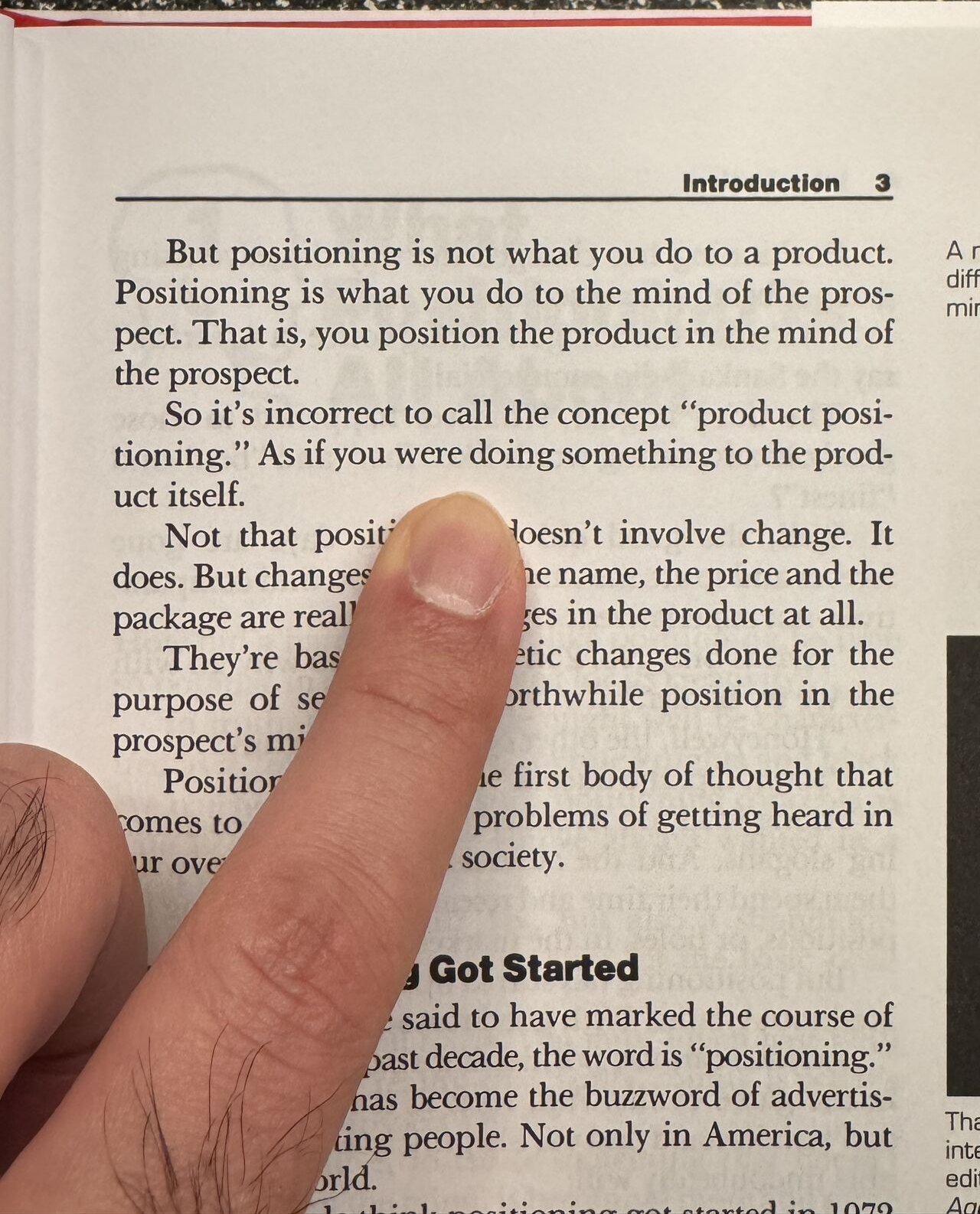
Positioning sits at a completely different altitude. It answers one question.
What business are you in?
The answer is never the thing you sell. It isn't your industry, your technology, your product or your service. It's what you are to the people who use you. It lives in their heads. So it works the same in Toronto and Tokyo, for a bank and for a cereal.
A company gives its answer in the budget, the roadmap, and the hiring plan. It answers with where the money goes and how the company runs. It answers with what it refuses when refusing costs it.
Customers feel the results over years of using the product.
Neither method moves anything above the page. You can finish the workshop without moving a dollar. You can ship the new homepage without turning away one customer or killing one product.
Both of them say positioning is too big for marketing alone. Then they deliver a document and a homepage. So what they sell is copywriting and messaging with a bigger name. The invoice says positioning.
That label does the damage. A founder pays for positioning and gets a rewrite. Sell a rewrite as positioning, and positioning starts to mean whatever a rewrite can do.
It sells for a business reason. A workshop and a new homepage fit a project with an end date. Five years of hard choices don't. So the part that fits in a few weeks got called positioning, and the rest got left out.
It feels right to the buyer too. A team gets a before-and-after to show the board this month. Hard choices pay off years later, in what customers say when you're not in the room.
Social media finishes the job. A before-and-after homepage makes a good post, because anyone can judge a headline in a few seconds. Nobody can judge five years of spending that fast. So the posts teach people to judge headlines.
The only positioning statement that exists is your P&L.
What your customers can't tell you
If the homepage isn't the position, the obvious fix is to ask customers.
That doesn't work either. In 1977, two psychologists published a study they ran in stores, dressed up as a consumer survey. They laid out four pairs of nylon stockings and asked people which pair was the best quality. All four were the same.
The pair on the far right got picked more than three times as often as the pair on the far left. That's the small finding. The big one came next. Asked why, not one person brought up where the pair sat. Asked straight out whether that played a part, nearly all of them said no.
People choose for reasons they can't see, then hand you reasons that sound right.
Your customers do the same. Ask why they chose you and you get features and a tidy story. In my experience, you'll also hear your own homepage read back to you.
Treat those answers as a performance, given because you asked.
So you can't ask customers for your position. You can't ask them for the word either. They can tell you what they do, but they can't tell you why, or what to call it. You have to read it from the outside.
Read what customers write when they aren't answering you. A review nobody asked for, or a reply to a stranger on a forum. That's where the 2019 Notion user wrote about a life.
Look for what changed in their lives, and skip the parts about your features. A sentence about a life tells you more than a sentence about a button. People who post in public tend to feel strongly, though, so don't stop there.
Watch what customers do, especially when it costs them time or money. Look at what they open every morning and what they'd panic about losing. When your product goes down for an hour, read who complains and what they say they couldn't do. When you raise prices, see who stays.
That's what you are to them.
One caution. Some customers stay only because leaving is a chore. Think of someone whose pay and mortgage both sit at one bank. Watch most closely the customers who could leave easily and don't. I wrote about this in Stuck is not loyal.
Then put a word on it, because they won't. The Notion user wrote "repository of life" and never said coherence. That word was mine to find. It sits underneath the words.
HubSpot shows the same thing from the other side. People already held a belief about HubSpot. The new name didn't fit it. Shah got hundreds of comments, and he says most people were confused, irritated or both.
The belief was there before the new copy went up, and it was still there after the copy came down.
What positioning is
The same week the new homepage went up, Notion posted this on X: "your sidebar is your company's story". I quoted it.
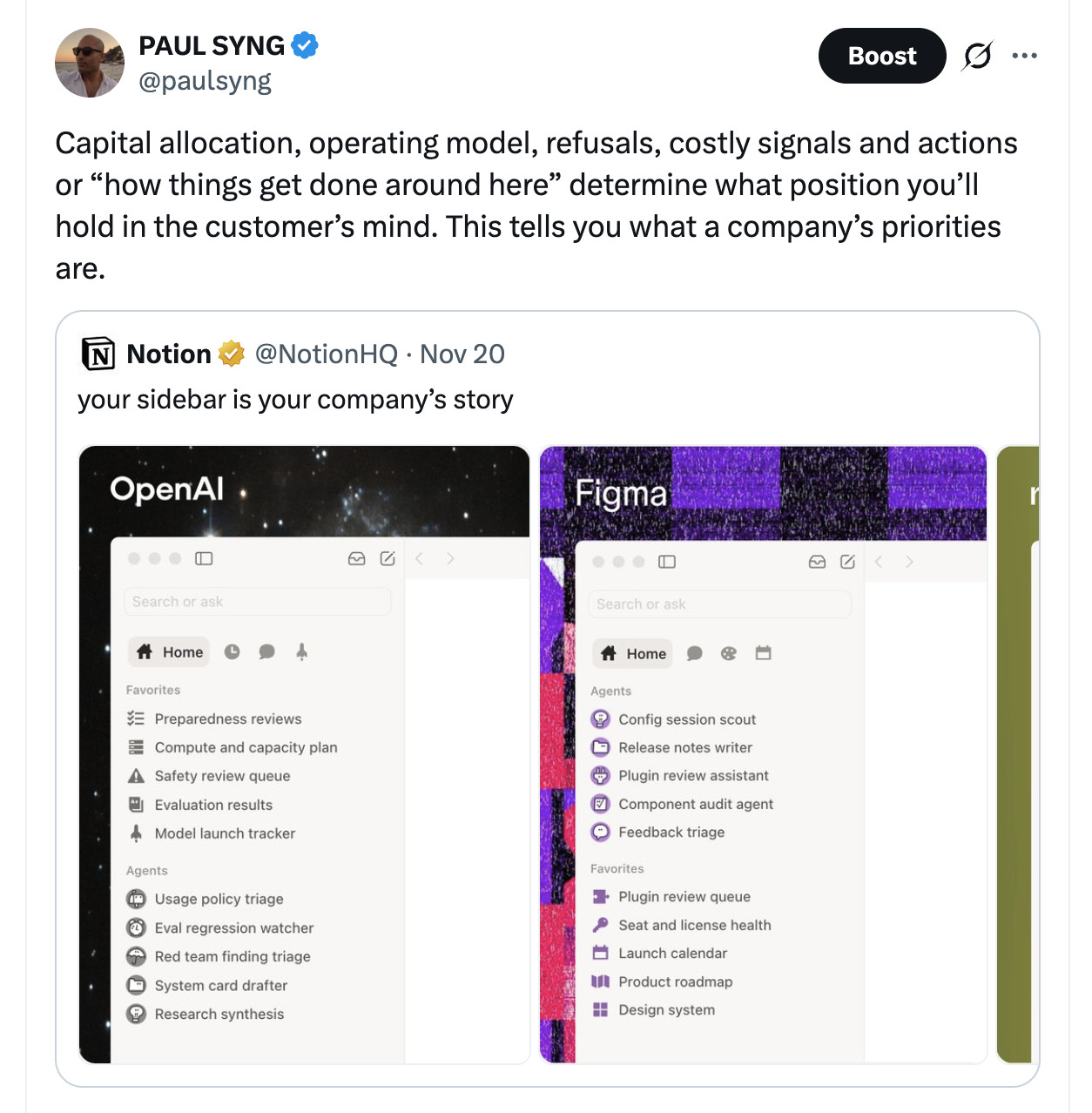
A sidebar is the list of pages down the left side of a Notion workspace. Notion is right about this one. Cover the two company names and you can still tell which sidebar is OpenAI's. It's the one full of safety reviews.
That image is Notion's own graphic, so treat it as an example. Then look at a real sidebar, like yours. A real one shows what a company spends its days on. That's hard to fake for long.
That's the point of my quote. Customers end up believing what a company does. Where the money goes, what it refuses, what it pays a price for, and how things get done day to day.
A homepage shows what a company would like customers to believe.
Notion made a choice like that in 2020. It made the app free for personal use, with no limit on how much you could put in. Until then, that cost $5 a month. People were already moving their lives into Notion in 2019. The free plan let many more of them do it.
In 2021, a developer on Hacker News wrote that their whole life was in Notion.
Cost alone proves nothing, though.
Quibi raised $1.75 billion and announced it was shutting down six months after launch. A costly choice counts when customers feel the result and a copycat would hate to match it.
So positioning is every decision that changes what a customer goes through with you. The costly ones that customers can feel count most. Your position is what those decisions leave behind in the customer's head.
The right order
I use four levels to keep this straight.
- Saying it. Your homepage, your pitch, your tagline. Anyone can copy it overnight.
- Proving it. Verbs. Results a customer can check, with numbers and dates.
- Being it. Where most of your money and time go, and what you turn down.
- Owning it. Nouns. The one word customers believe when they think of you.
Saying it is the cheapest level to copy. On 20 November, the founder of LM Studio posted Notion's new homepage next to his own company's page for Bionic, its AI agent app.
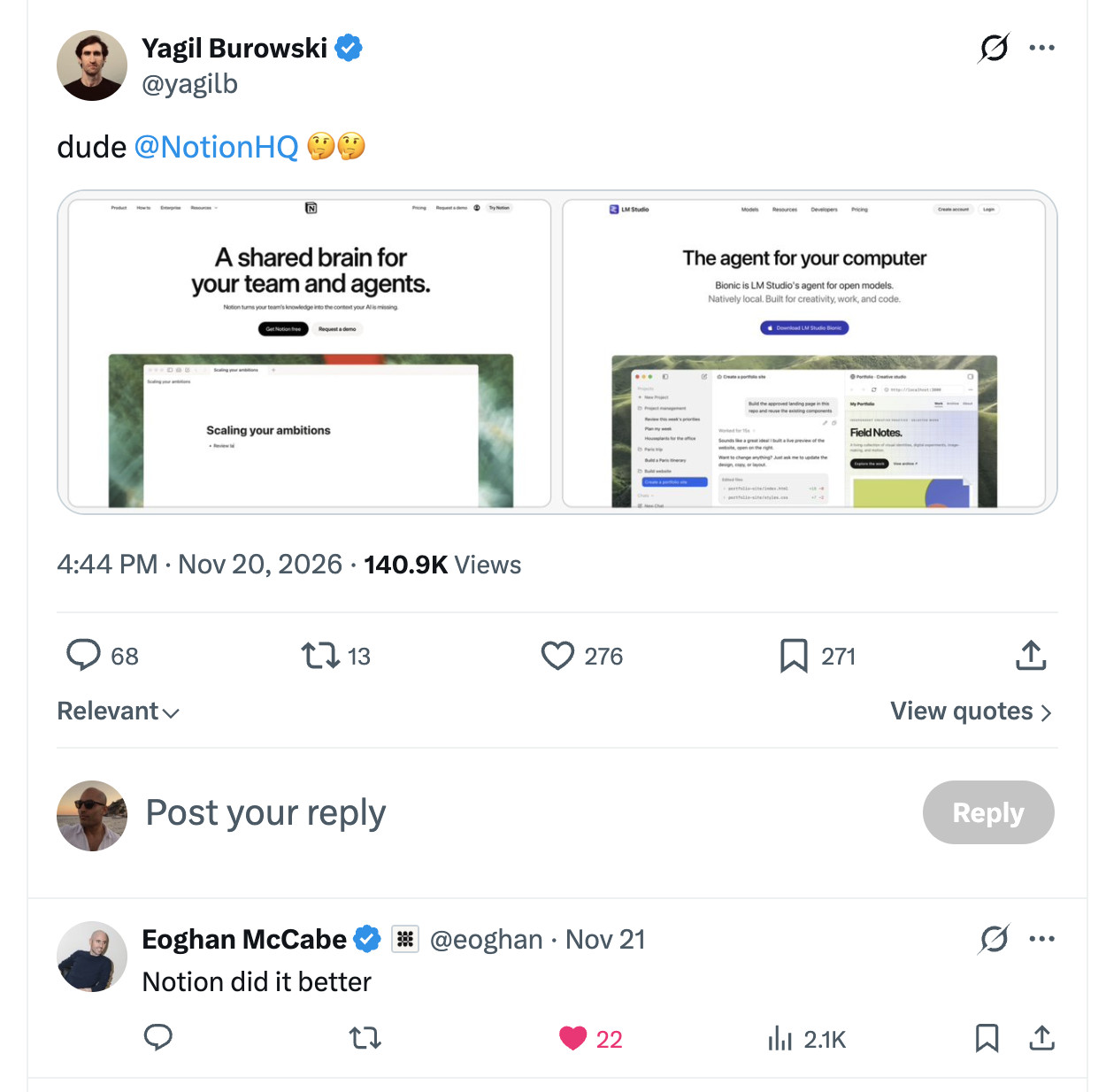
Whoever got there first, two different companies ended up with near-twin front pages. That can't happen with five years of spending.
Proving it is where most homepages stop short. They prove reach. Logos and user counts. Reach tells a stranger you're safe to try. It doesn't show what changes for a customer, and that's the proof that counts.
Being it is where most companies stall. It means most of the money backs the one word, even when other projects look like more fun. I wrote about the cuts this takes in Positions are made on the cutting room floor.
Owning it can't be bought. You find out you own it when customer after customer describes the same change in their own words, without being asked. "Repository of life" is what that sounds like before anyone names it.
Most companies work the list from the top. They start with the homepage and hope the rest follows.
Work from the bottom instead.
If you have customers, start with their heads. Have someone from outside read what customers say when they aren't answering you, and watch what they do. Name what changed for them in one word.
Then check the money. Does most of your spending back that word? Have you turned anything down to protect it? If not, the word is a wish.
Then prove it. Show what changed for a customer, in a way a stranger can check.
Then write the homepage last, in your customers' words.
Notion's new headline does that last part well. Its users were writing about their brains years ago. In 2019, one wrote on Hacker News, "I just love that I can mould it around how my brain works." Plenty of others call their Notion setup a second brain.
Now the headline says brain.
That's a homepage doing its job. It borrowed a word customers were already using. HubSpot reached for a new word instead, and people pushed back within days.
Notion's only mistake was calling the headline positioning.
If you're new, or changing direction the way HubSpot is, nobody holds a belief about the new thing yet. Nobody has lived it. So choose the change you want customers to feel. Put money and refusals behind it, and prove it with results people can check.
Then keep at it for years. Don't contradict yourself. Keep the homepage plain. Customers will describe the change in their own words later, once they've lived with it.
The coaching moment
If you run a company, start with one question. The next time someone says "our positioning", ask whether it's something you wrote or something your customers believe. If you wrote it, call it your homepage or your pitch, and judge it like copy.
Then do two pieces of homework.
Pull fifty things customers wrote about you when they weren't answering you. Reviews and forum posts will do. Underline what changed in their lives. Skip the features. See which words come back, and put one word on the change. Better still, have someone outside the company do it.
Pull last year's spending and last year's no's. A customer you turned away. A feature you didn't build. Write down what that list says you care about.
Then try a test from my essay on where positioning came from. Picture a competitor's finance chief reading that list with your logo taken off. Would they guess your word? If they'd guess something else, the word isn't yours yet.
Put the two side by side. Where they match, you have a position. Where they don't, a new headline won't close the gap. Only a change in where the money goes will.
If you hire help, ask two questions first. Will the work end in a document, or in a decision that costs money? Will it read what's already in your customers' heads, or tell you what to put there?
If the answer is a new homepage, you've hired a copywriter. Pay them like one.
If you sit on a board, stop asking for the positioning slide. Ask for last year's spending, last year's no's, and what customers said during the last outage. Those three pages will tell you more about the company's position than any slide.
If you're a marketer, run one test on your homepage. For every line on it, name one thing the company gave up to make that line true. Then name one result customers felt because of it.
If you can't name both, the line is a wish. Take it to whoever controls the budget, and leave the copy alone until they answer.
Bring your customers' words into every meeting about the homepage. Read them out loud. A headline nobody would say is harder to approve right after the room has heard what customers do say.
Clean up the words in the room too. When someone says "positioning statement", "value proposition", "messaging framework" or "homepage positioning", they mean copy. Let them call it copy. It's useful work under its real name.
Drop "brand positioning" too. A brand is what builds up around a position over time. I wrote about the difference in The "Brand Positioning" Problem.
Change your offers as often as you like. A holiday sale or a launch discount has an end date, and it doesn't change who you are. A seasonal offer doesn't move your position.
The words that say who you are should change rarely, and only after what you do has changed. HubSpot changed who it said it was on day one of its refounding, before customers had used the thing it described.
Stop calling copy positioning.
Once a year, pull another fifty things customers wrote when nobody asked, and watch what they do. See whether the words they use on their own are moving, and which way.
Open your sidebar and your homepage side by side. If they tell different stories, your customers believe the sidebar.
Join the conversation
Sign in to comment. We’ll email you a secure sign-in link.