
♛
08.09.2026
Your positioning problem
starts with the CEO
Read Time: 12 Minutes
Hello
Three quick things before we dive into this week’s Digest.
1. The newsletter is here a day early. Figured tomorrow morning will be chaos for folks coming back from a long weekend.
- Article I wrote: What Nike’s CEO failed to understand
-
Below are before-and-after case studies that show what happens when you speak in the buyer’s frame vs the product or seller frame — people buy when they feel understood. Not when they understand you.
Have a great week ahead! Keep crushing it
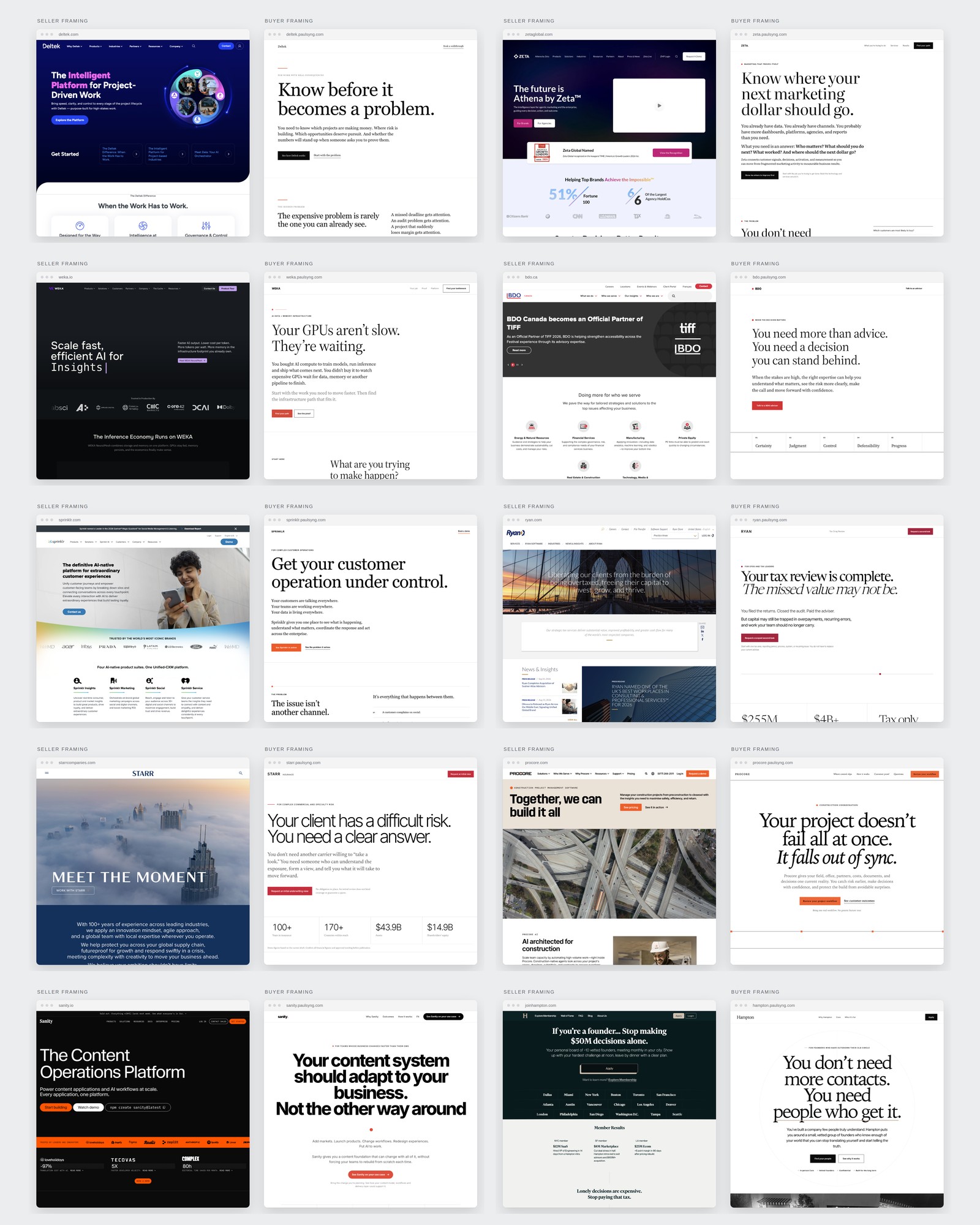
Ten B2B homepages, rebuilt from the buyer’s frame.
The left column shows each site exactly as it stands today. The right column is the same company, rewritten from the buyer’s side.
Eight of the ten headlines on the left are about the company or its product. A buyer has to work out where they fit before reading on.
“The intelligent platform.”
“The definitive AI-native platform.”
“Together, we can build it all.”
All ten on the right speak to the buyer first.
Your GPUs aren’t slow.
Your tax review is complete.
Your project doesn’t fail all at once.
Same companies, same products, and only the framing changed.
They sell construction software, tax work, insurance, a CMS and a founder network. Three of them are public companies. The category made no difference, and the pattern held every time.
People don’t buy when they understand you. They buy when they feel understood.
Find your own homepage in the left column. Then read the one on the right and decide which page you would rather buy from.
The market learns what you are from the decisions you keep paying for.
I think a lot of companies suck at positioning because their CEOs keep funding businesses that contradict the story they want the market to believe. They want to be known for simplicity. Then they approve another product, another exception, another feature that makes everything harder to use.
They want to be known for service. Then they cut the people who answer the phone.
They want to be known for expertise. Then they say yes to work they have no business doing.
Eventually, someone briefs an agency: “We need to sharpen our positioning or fix our brand strategy.” And every single time, the agency is asked to reconcile decisions it has no authority to make.
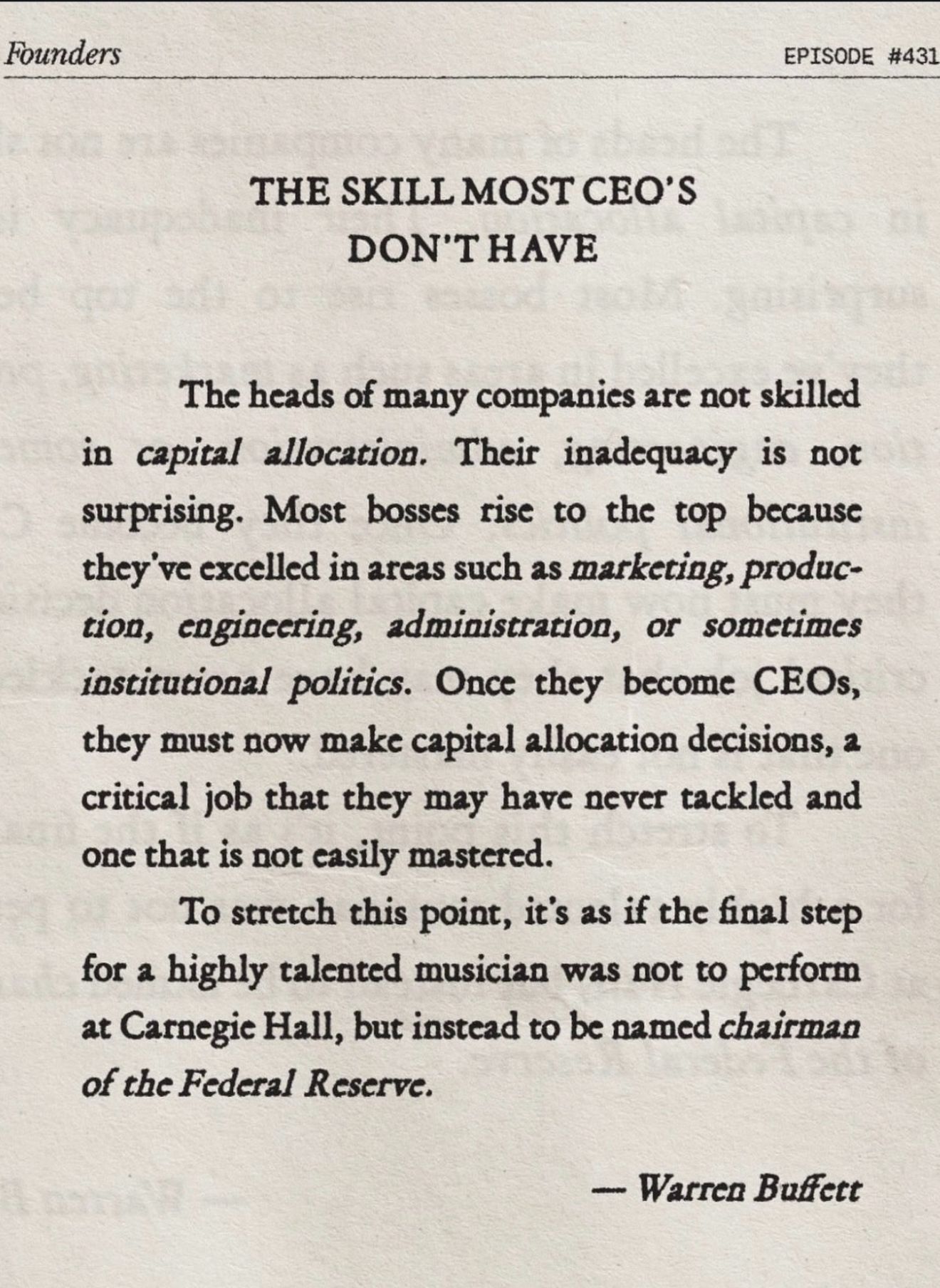
I came across a Warren Buffett passage this week that gets to the root of this problem. In his 1987 shareholder letter, he wrote that “the heads of many companies are not skilled in capital allocation.” His point was simple: being good enough at a function to become CEO doesn’t automatically prepare you to decide where the whole company’s money should go.
I think that gap explains a lot of what gets called a positioning problem.
Capital allocation determines what gets the resources to become real. Which product gets built. Which capability gets stronger. Who gets hired. Which acquisition gets approved. Which customer request gets a team assigned to it. Strictly speaking, hiring and day-to-day spending aren’t all capital expenditure.
I’m talking about the wider leadership decision: how you commit scarce money, talent and attention to the business you’re trying to build. And every commitment has an opportunity cost. Those people, that money and that time are now unavailable for something else. A disciplined no names the stronger yes it protects.
That’s why I find Steve Jobs’s return to Apple so useful.
In July 1998, Jobs described inheriting fifteen product platforms with countless variants. Apple’s response was to focus on four priorities: consumer and professional computers, each available in desktop and portable forms. He explained that this allowed Apple to put its strongest people on every product and to develop the next generations more quickly. Apple also halted development of Newton, despite protests from customers and developers.
The important part is where the freed resources went. Fewer commitments gave the remaining commitments a better chance of becoming exceptional. That is a leadership decision with consequences a customer can eventually experience. The range becomes easier to understand. The people building it have a clearer job. The experience has a chance to become coherent.
Early Tesla offers another useful example. Elon Musk described a sequence: begin with an expensive, low-volume car, then work towards more affordable cars at greater scale. The ambition was broad. The initial commitment was deliberately narrower. Some decisions were a “not yet.”
Then Tesla invested beyond the car. In September 2012, it unveiled six Supercharger stations that were already built. By the end of 2015, it reported 584 stations. Its annual filing explicitly connected the network to removing a barrier to electric-car adoption: concern about range and long-distance travel. Tesla’s launch announcement; 2015 annual filing.
Think about that from the buyer’s side. You’re considering a car, and you’re wondering whether you can take it on a long trip. A charging network gives you something concrete to assess. Money spent on infrastructure changes what the promise can mean in your life.
That’s the connection I’m interested in: a decision inside the company becomes evidence outside it.
Customers rarely inspect your budget. They encounter its consequences. The product that works. The repair that is possible. The person who knows how to help. The limitation you consistently accept because removing it would compromise something more important.
Over time, those experiences give people a reason to associate you with something. They also compare you with the alternatives. You can choose your commitments; you still have to earn their conclusion.
This is where the long view matters.
Take Hermès. In 2022, when production constraints were limiting sales, Axel Dumas said he would not reduce a bag’s production time from fifteen hours to thirteen just to raise output. The company was accepting a constraint even as its results disappointed the market. Reuters, February 2022. And it kept funding capacity through its chosen model. Its 2024 results reported a new leather workshop and training programmes extending across ten schools in France.
For me, those choices make craftsmanship credible. The company invests in developing the people and facilities that sustain it, while accepting that production cannot immediately meet every sale. Hermès is family-controlled and publicly listed. That matters to this argument: the ability to protect a long-term choice can exist inside a public company.
Patagonia gives us a more uncomfortable example of what a position can cost.
According to longtime executive Vincent Stanley, its 1994 decision to move its sportswear line to organic cotton required rebuilding supply relationships. The range went from 166 styles to fewer than seventy. Sales volumes and margins took a couple of years to recover.
You can see the choice in the products the company stopped offering, the sourcing work it took on and the commercial pain it accepted. Then, in 2022, Yvon Chouinard helped put protection for that purpose into the ownership itself. He rejected a sale or IPO and transferred voting control to the Patagonia Purpose Trust. The Holdfast Collective received the nonvoting shares, with excess profits distributed after reinvestment and reserves.
The ambition was to give future decisions a structure that could survive the founder.
This is why private and family-controlled businesses interest me. They can give leaders room to protect a choice through the period when it looks expensive, unfashionable or slow. But private ownership doesn’t make anyone a better judge of what to fund. A founder can be consistently wrong. A family can preserve a mistake. Public capital can also provide the money needed to build something a private business couldn’t afford.
The advantage worth looking for is patient control, backed by judgment and enough resources to execute. A leader needs room to disappoint someone this quarter for a reason that still makes sense years from now. That reason also needs testing. A long horizon becomes useful when the business keeps learning from what customers actually experience.
I use inside-out and outside-in to describe these two sides of positioning. Inside the business, you decide what deserves resources and what you will refuse. Outside it, people decide what those choices mean to them. Their response should inform your next decision.
Positioning is the work of making those choices coherent.
Your position is the place you earn in people’s minds.
Copywriting, messaging and advertising help people notice, understand and remember. Marketing can also bring customer evidence back into the business. It deserves resources too.
Jobs used Think Different during Apple’s turnaround. And Stanley says Patagonia had to explain its cotton decision: the shirt didn’t feel different just because the supply chain was. Communication helped people see the significance of a choice they couldn’t otherwise observe. But a campaign cannot give your service team time it doesn’t have. A headline cannot create a capability you chose not to fund. And a promise of simplicity gets harder to believe every time someone has to use your product.
The CEO remains accountable for the decisions that make the promise deliverable.
So before commissioning another positioning exercise, I’d look at the last twelve months of decisions. Where did the best people go? Which capability received sustained investment? What attractive opportunity did we decline? What did that refusal allow us to do? And what can a customer experience today because we made those choices?
Then I’d put the budget beside the story we tell the market. If they point in different directions, we’ve found the work. What are you still funding that makes your position harder to believe?
— Paul Syng
DIGEST