
♛
14.04.2026
The Shopify Paradox
Read Time: 12 Minutes
Hello
When What You Sell Isn’t What You Operate
Last week’s piece, The Verb Problem, made the case that Shopify describes itself in verbs (enable, simplify, arm the rebels) while its customers describe it with a noun they never name: becoming. The company talks about what it does. The customers talk about who they have become. The gap between those two descriptions is the most useful thing I found in several weeks of studying the company.
This week, I want to go one level deeper, from the linguistic gap into the operational one. Because the verb/noun gap doesn’t just live in the marketing — it’s architected into how the company is actually run. And once you can see it inside Shopify, you can see it inside your own company too.
Here’s where that gets uncomfortable.
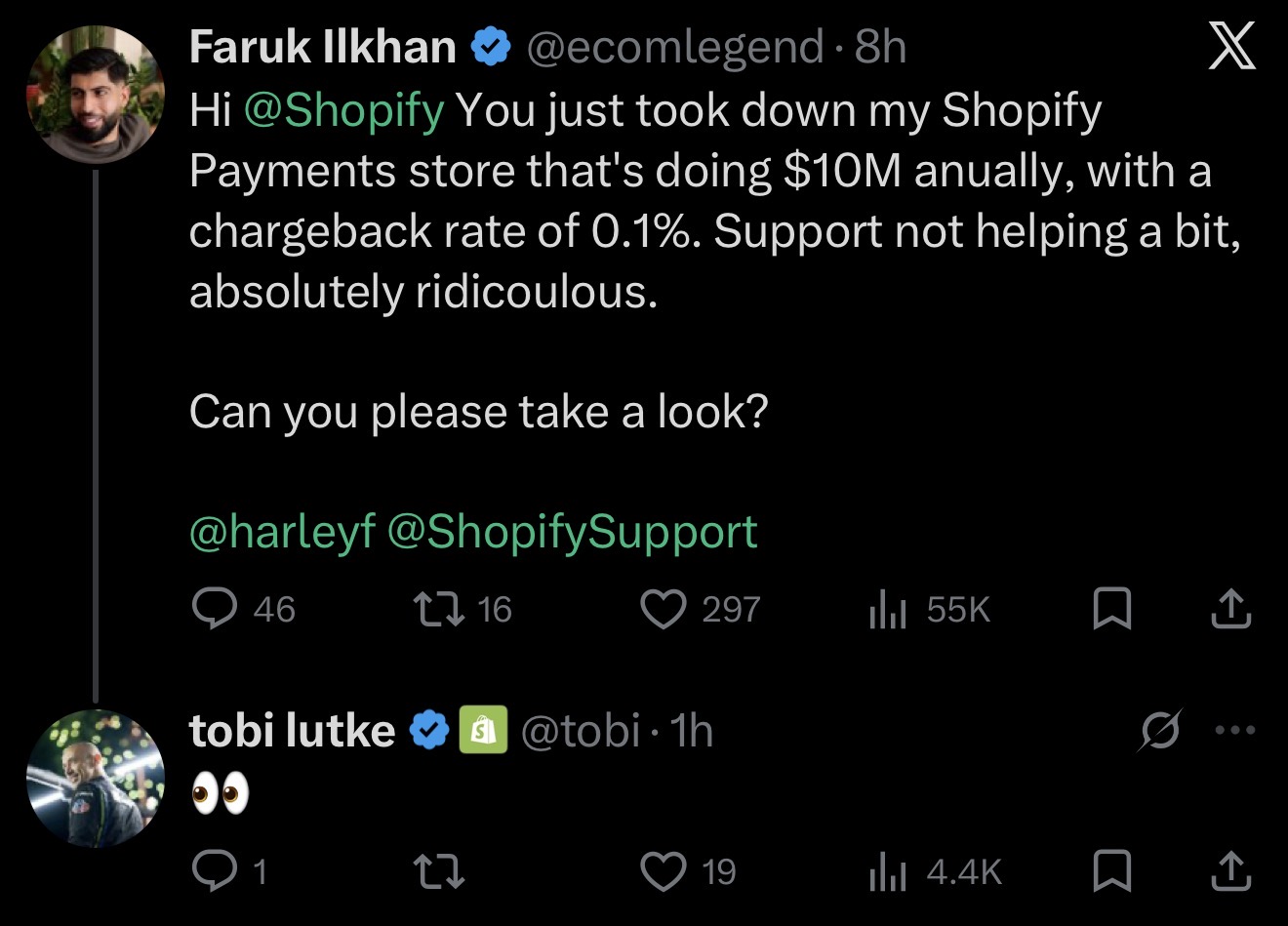
A week ago, an e-commerce operator named Faruk Ilkhan posted on X that his Shopify store, a multi-million-dollar business, had been shut down overnight. No warning. No explanation. Customer service ran him in circles for days. So he did the only thing left: he posted publicly, tagged Tobi Lütke, and waited.
The post went viral. Tobi noticed. Faruk got his store back.
Most of the commentary that followed focused on the wrong thing. People argued about Tobi’s emoji reply. About whether the escalation was fair to the internal team. About whether CEOs of $130 billion companies should or shouldn’t respond to tweets.
None of that is the story.
The story is that Faruk got reinstated, and most merchants in the same situation do not. The story is that the only difference between Faruk and the three operators in stores down the hall is audience size. The story is that a company whose entire identity is “we arm the rebels” just published, in real time, an exception procedure that reads: you have to humiliate us publicly to access your own money.
That isn’t a PR problem. It’s a diagnostic. And it applies to more companies than Shopify.
The wrong question
Most critiques of Shopify are operational. Chargeback policy. Support SLAs. Risk automation. These are all real problems, but they are not THE problem. They are symptoms.
The real question isn’t whether Shopify treats merchants well.
It’s whether Shopify is actually in the business it says it’s in.
This question sounds abstract. It isn’t. It’s the most consequential question a CEO can ask about their own company, and most never ask it.
Here is the test. If you asked Shopify’s executive team to describe the business in one sentence, you’d get something like “we help merchants run online stores” or “we democratize commerce” or, in Tobi’s more aspirational framing, “we arm the rebels.” These are declarations of what they sell.
Now ask a different question. If you looked at how the company actually operates — what it measures, what it protects, what triggers escalation, what gets a human involved — what would you conclude the company is in the business of?
The answer is: Shopify operates as if it sells software to customers who happen to be merchants, who are processed at scale with automated risk tooling, and whose edge cases are tolerable losses.
That is a completely different business than the one Tobi describes.
The gap between those two descriptions is the biggest unresolved fact inside Shopify. It is also the single most valuable diagnostic available to a CEO.
What Shopify actually sells
Start with $29.
Shopify’s entry-level pricing is $29 a month. For a product that handles payments, inventory, storefronts, and taxes across dozens of countries, this is almost absurdly low. A mid-market SaaS with a tenth of the surface area charges three times as much. A serious CRM charges ten times as much.
Why is $29 possible?
The standard answer is “because software is cheap to distribute, and they make the rest on payment processing and apps.” That’s true, but it’s a description of mechanics, not economics. It doesn’t explain why someone would pay $29 specifically, or why that number has held flat for years while every other input cost went up.
Here is the actual logic. $29 is not a software price. It is an identity subscription.
When someone signs up for Shopify, they are not primarily buying a checkout. They are buying the right to call themselves an entrepreneur. They are buying the version of their life where they run an online store, put “Founder” in their LinkedIn bio, and tell people at dinner parties that they have a business. The software is the scaffolding. The identity is the product.
This is not a rhetorical reframe. It is how the unit economics actually work.
Consider the counterfactual. Imagine Shopify raised the base price to $99. Rational analysis says they should — the software is worth it, competitors charge more, contribution margin would explode. But the entire flywheel would break, because $29 is the price at which trying on the identity is low-friction. At $99, the new user thinks, “Do I really need this?” At $29, they think, “For $29, why not call myself a founder?”
Shopify’s 4.8 million merchants, $292 billion in annual GMV, and 30% share of US e-commerce were not built on $29 worth of software. They were built on 4.8 million identity subscriptions. The software is what made the subscription feel real.
This is the becoming noun from last week, showing up in the pricing architecture. Shopify built the economics of identity while believing they were pricing features. The unit economics only make sense if you accept that what’s being sold is the right to call yourself a founder — and the software is the scaffolding that makes the claim feel legitimate.
This matters because it defines what “product failure” means. For a software business, product failure is when the software breaks. Churn is a business metric. Support gaps are opex. Frozen accounts are an acceptable error rate on the fraud-mitigation P&L.
For an identity business, product failure is something completely different. Churn is the product defecting. Support gaps are the identity dissolving. A frozen account is not an error rate. It is the product quietly telling the customer that the identity was revocable all along.
Shopify sells the first framing in its financial reports and the second in Tobi’s tweets. The company holds both at once and pretends the tension isn’t there.
The gap, quantified
None of this analysis requires a hunch. The distance between what Shopify sells and what Shopify operates is a measured number.
The Monopoly framework scores brands on the gap between what they claim and what customers experience. Shopify’s Claim-Experience Alignment score is 1.0 out of 5.
That is the lowest score on the entire Monopoly report. Not “low.” Not “worrying.” The lowest.
For context, Shopify’s overall Monopoly Score is 3.3 — “Contested.” They’re a real player in their category, but they don’t own the concept that defines it. They have scale without ownership. Dominance without meaning.
Put another way: Shopify owns 30% of US e-commerce. They process $292B a year. They are, by any conventional measure, dominant. And on the question that matters most for an identity-subscription business, does the lived experience match the promise? They score 1.0.
The corroborating number is public. Shopify’s Trustpilot rating is 1.3 out of 5. Trustpilot is an imperfect signal — it attracts motivated reviewers, not average ones — but what motivates a Shopify reviewer to sit down and type is disproportionately the thing that should never happen to an identity customer: the platform turning on them.
These numbers are not marketing metrics. They are defect rates.
When the product is software, a 1.0 Alignment score might mean the marketing is overclaiming the feature set. Uncomfortable, but fixable by rewriting the website. When the product is identity, a 1.0 Alignment score means the identity is not being delivered. The thing you paid $29 a month for — to be an entrepreneur on a platform that is on your side — is not actually showing up.
This frame is useful to every CEO, because the diagnostic works on any company. If you sell outcomes and operate on outputs, your Alignment score is low. If you sell transformation and operate on transactions, your Alignment score is low. If you sell partnership and operate on extraction, your Alignment score is low.
Shopify is a dramatic example. It is not a unique one.
The load-bearing contradiction
The sharpest evidence that Shopify isn’t operating the business it claims to run is not the Trustpilot score. It’s the fact that inside Shopify, two teams operate on completely opposite beliefs about the same customer.
Shopify Capital is a multi-billion-dollar lending business. It advances cash to merchants on a specific bet: this merchant is going to generate predictable revenue over the next 12 months, and we trust that revenue enough to write them a check today. That bet requires confidence — in the merchant’s business, in their underlying demand, in their operational competence. Shopify Capital would not exist if its risk models didn’t treat merchants as trustworthy counterparties.
Shopify Payments is the processor that handles the same merchant’s transactions. It operates on the opposite bet: this merchant might be running a scam. At any point our risk system might freeze their funds without warning, and we might hold those funds for months. Payments’ risk posture assumes the merchant is guilty until algorithmically cleared.
Read those two paragraphs again. Same merchant. Same company. Two incompatible beliefs about the same person.
This is not a bug. It is not a team-communication failure. It is architected in. Capital and Payments have distinct P&Ls, risk models, regulatory exposures, and chargeback incentives. Each team is individually rational within its own scope. The executive layer above them has not forced the contradiction to be reconciled, because reconciliation would require one team or the other to compromise its numbers.
So the merchant experiences the contradiction directly. In the same week, on the same dashboard, they see a notification from Capital: “Congratulations, you qualify for $50K based on your strong sales history,” and an email from Payments: “We’re holding your funds pending review.” Two messages from the same company, saying “we believe in you” and “we don’t trust you,” simultaneously, about the same twelve months of revenue.
From the outside, this looks unhinged.
From the inside, every division is hitting its KPIs.
Here is the causal logic worth noticing. If Shopify actually believed it was in the identity business, this contradiction could not exist. Someone in the CEO’s office would have forced the reconciliation years ago, because the contradiction is the product failing in slow motion. The fact that it persists is evidence — maybe the clearest evidence available — that Shopify’s operating assumption is that it sells software to merchants, not identity to entrepreneurs.
This is where the Shopify diagnostic becomes a CEO diagnostic. Every company of any meaningful size has two or more divisions operating on implicit beliefs about the customer. If those beliefs contradict each other, the customer experiences the contradiction as whiplash. Over time, the whiplash becomes the brand, regardless of what the marketing says.
The word change
Last week’s argument was that Shopify describes itself in verbs while its customers experience a noun. This section is the operational version of that same gap. The verb/noun split isn’t just in the marketing copy — it shows up in the words each function inside the company uses to describe the person paying them.
There’s a tell that makes all of this visible without access to internal metrics: the words each function uses to describe the customer.
Listen to Tobi for five minutes, and the words are founder, rebel, dreamer, builder, and entrepreneur. These are identity words. They describe who someone IS. You cannot ignore a founder’s ticket for three weeks, because ignoring a founder is not a tolerable error rate — it’s a violation of the promise that made them sign up.
Now read any Shopify risk policy, investor deck, or internal product doc. The word is merchant. Singular when the tone needs to sound caring. Plural when the slide is about GMV. Merchant is a functional word. It describes what someone DOES. A merchant transacts. A merchant is a line on a P&L. A merchant is fungible — lose one, onboard two, the metric survives.
The switch from entrepreneur in public to merchant in private is not a branding choice. It is a belief switch. And the belief determines what the system does when something goes wrong.
If you believe the person on the other end is an entrepreneur — someone whose identity and livelihood are wrapped up in this store — the right response to a chargeback alert is to pick up the phone. If you believe the person on the other end is a merchant — a unit of GMV with a risk score — the right response is to freeze and move on. Both responses are internally coherent. They just imply completely different companies.
Shopify is running two companies. Tobi’s marketing describes one. The operations department runs the other. The 4.8 million people in the middle pay for the first and receive the second.
The fix here is not changing the word “merchant” to “entrepreneur” in internal documents. That’s theatre. The fix is measuring the thing that would be obviously different if the company really believed the customer was an entrepreneur. Time to reach a human. How often a first-time escalation gets resolved without going viral. How fast a frozen account gets reviewed by someone with authority. None of those metrics appear on the investor deck.
The rule underneath this generalizes to every company: you become what you measure. Shopify measures GMV. Shopify is what it measures.
The app tax
One more number makes the economics undeniable. Shopify’s revenue splits roughly 28/72. Twenty-eight percent comes from subscriptions. Seventy-two percent comes from “merchant solutions” — payment processing, apps, ads, and Shopify Capital.
Put differently: 72 cents of every Shopify revenue dollar comes from somewhere other than the subscription the merchant thinks they’re paying for.
The apps are the most visible part of this. Shopify’s App Store lists more than 13,000 paid apps. Klaviyo for email. Gorgias for support. Recharge for subscriptions. Yotpo for reviews. ShipStation for fulfillment. Returns, CRO, inventory. A serious operator running a real Shopify store isn’t paying $29 or $299 a month. For scaled stores, the monthly app stack stops looking like software pricing and starts looking like a department budget.
This is not an accident. It is the architecture. The base product is deliberately complete enough to onboard a merchant, and deliberately incomplete enough that any serious operator has to buy their way to functionality. Shopify takes a revenue share on the way.
In a pure software business, this model is defensible. SaaS ecosystems are supposed to have marketplaces, and marketplaces are supposed to take a cut. Nothing here would raise an eyebrow if Shopify’s positioning were “we built the best commerce SaaS, and we take a fair cut.”
But Shopify’s positioning is “we’re on the merchant’s side. We arm the rebels. We help more people become entrepreneurs.” That positioning is incompatible with a business model whose growth depends on quietly keeping the base product incomplete so merchants have to keep paying to fill the gaps. You cannot arm the rebels while also taxing their ammunition.
The 28/72 split is not a scandal. It is a receipt. It is what you have to believe is true if you want to understand why $29 works as a price point. The subscription is the hook. The apps are the business. The identity is what makes the hook feel honest for as long as it’s still working.
Why Shopify probably does not fix this
A reasonable reader might ask: if all of this is visible, why doesn’t Shopify just fix it?
The honest answer is that fixing it would be expensive, slow, and growth-negative — and none of those things are tolerable inside a public company at Shopify’s scale.
A real fix would require four things. First, unifying Capital and Payments under a single merchant-advocacy owner with shared risk metrics and shared P&L. Second, redesigning the freeze policy from “freeze first, investigate later” to “freeze only after demonstrated fraud signal,” which would slow the risk function and raise short-term losses. Third, publishing service-level agreements on merchant reinstatement — measurable, external, enforceable. Fourth, dropping the App Store revenue share materially or expanding the base tier significantly, which would compress margin and spook the street.
Each of those changes is individually painful. Combined, they would visibly decelerate growth at exactly the moment Shopify’s valuation depends on maintaining growth.
So the most likely outcome is that none of them happen. Tobi keeps saying “arm the rebels.” The operating stack keeps operating as if merchants are fungible. The 1.0 stays at 1.0.
This is worth saying plainly because the Monopoly analysis also identifies the territory Shopify could own if it fixed the contradiction: Trusted Financial Partner. It is the most valuable piece of vacant land in e-commerce right now. Shopify has the rails, the reach, the relationships, and the data to take it. The only reason they don’t is because taking it requires admitting the current operating model is wrong, not just incomplete.
That territory will not stay vacant forever. Some competitor will take it. It probably won’t be a fintech or a challenger bank — those businesses start from financial rails and add the merchant relationship as an afterthought. The company that takes it will start from the merchant relationship and add financial rails to serve it. And they will operate on a single coherent belief about the merchant, not two that contradict each other.
The diagnostic every CEO should run this week
This analysis is useful to you only if it becomes a diagnostic you can run on your own company this week. So here it is, in two questions.
Question one: What are you actually selling?
Not the feature list. Not the value prop on the website. The thing the customer is buying when they write the check. Is it software? A tool? A result? A status? An identity? A transformation?
Be precise. “We help customers grow” is not an answer. “We sell the identity of being a data-driven company” is. “We sell peace of mind for founders who can’t afford to sleep badly” is. The answer should be specific enough that it implies how you’d operate if you actually believed it were true.
Question two: If that were really what you sold, what would change about how you operate?
This is the load-bearing question, and it is uncomfortable to answer honestly. If you sell peace of mind, what is your SLA on 2am support? If you sell identity transformation, how do you measure transformation? If you sell partnership, what does your legal team do the first time something ambiguous happens with a customer’s data?
The gap between the answer to question one and your actual operations is your Alignment score. Shopify’s gap is wide enough to score 1.0/5. Yours is probably smaller. But it probably exists. Most companies have a gap. The difference between companies that compound value over time and companies that eventually get quantified at 1.0 is whether the executive team is willing to make the expensive operational changes that would close the gap — or whether they just keep saying the marketing words and hoping the metric lags forever.
The metric does not lag forever.
Closing
Last week’s diagnostic was linguistic: count the verbs in how you describe yourself, then find the noun your customers use for you that you’ve never named. This week’s diagnostic is operational: compare what you say you sell to what you actually operate as if you sell. Run them together, and you have both halves of the same picture — the story on the outside and the machinery on the inside. Shopify’s picture doesn’t line up. Most companies don’t. The useful work is noticing the gap before a Faruk post does it for you.
Faruk got his store back because he went viral. The three operators in stores down the hall did not. The first number is a story. The second number is a policy. Shopify is running both at the same time and calling the combination a brand.
The CEOs reading this should not take the lesson that Shopify is doing something uniquely wrong. Shopify is doing something structurally common, visibly enough to be measured. The useful question is whether something similar is structurally common and sufficiently visible to be measured within your company.
If you are not sure, that is itself the answer.
DIGEST