
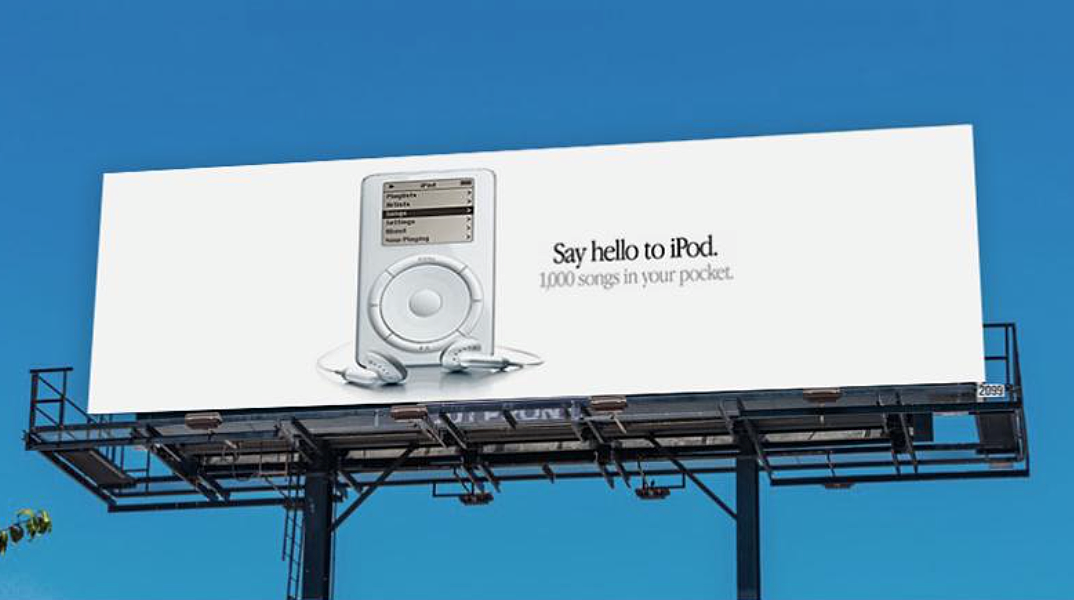

Most people believe the iPod won because of brilliant marketing, that iconic “1000 songs in your pocket” tagline. But here’s the problem: competitors had similar marketing. And better features. Double the storage. Lower prices. Longer battery life. Replaceable batteries. FM radio. Voice recording.
They all failed.
Creative offered 60GB for $400 versus iPod’s 30GB for $500. Microsoft spent millions on Zune’s “Welcome to the social” campaign. SanDisk ran aggressive “iDon’t” ads portraying iPod users as sheep. Sony invented portable music and sold 220 million Walkmans.

Market share after years of competition: Creative 3%, Microsoft 2%, SanDisk 9%, Sony 3%.
iPod: 78% for a decade.
The difference wasn’t framing (marketing, messaging, taglines). It was positioning. And here’s what most people miss: when I say positioning, I’m NOT talking about “product positioning.” There’s no such thing. Even Al Ries, who literally wrote the book on positioning, said this.
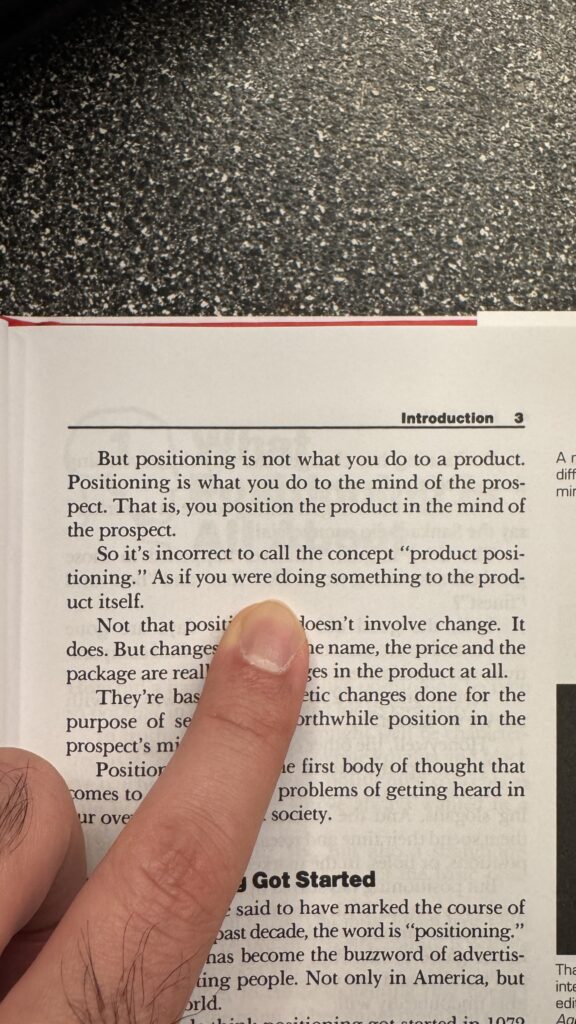
In the iPod’s case, it’s Apple’s position expressed through a music player.
Here’s the causal chain:
Apple owns a position in the market (simplicity, technology married to liberal arts, making complexity beautifully accessible). That position informs Apple’s choices; what they’ll make, where they’ll invest, how they’ll design and build something.
When Apple decides to make a music player, its position determines what that music player becomes. Of course, it’s going to be the iPod — seamless integration, minimal buttons, a sealed battery that prioritizes simplicity over repairability, premium pricing, and white earbuds.
The iPod isn’t “positioned.”
The iPod expresses (or is a manifestation of) Apple’s position in the portable music category.
You don’t have different positions for different products. You have different go-to-market strategies for different products. You have different framing for different audiences. But the position? That comes from the company.
Apple’s position was already established through framing campaigns, such as “Think Different” (1997), as well as products like the iMac (1998) and the Digital Hub strategy (2001). The iPod didn’t create a new position. It proved Apple’s existing position in a new product category.
“1000 songs in your pocket” wasn’t positioning. It was framing, tactical messaging that expressed Apple’s strategic position through this specific product. This distinction explains why competitors with better features and similar marketing failed. They had framing. They lacked positioning.
What Apple’s Position Actually Was
By October 2001, Apple had a clear concept in the minds of its customers: simplicity.
Not “simple to use” (an adjective describing a feature). But simplicity as fundamental mental territory. The idea that technology should serve humans, not the other way around.
This started with the position being expressed and framed through Think Different (1997). When Jobs returned, Apple had 90 days of cash remaining and 2.8% market share. The campaign celebrated “the crazy ones, the misfits, the rebels” who “see things differently” and “change the world.”
Jobs explained: “You always had to be a little different to buy an Apple computer… really think differently.”
The iMac (1998) manifested this. Jobs declared competitors’ machines “uhhh-gly” while the iMac looked “like it’s from another planet. A good planet. A planet with better designers.”
The Digital Hub strategy (January 2001) provided the iPod’s context. Jobs announced: “We believe the PC can become the digital hub of our new emerging digital lifestyle.” The Mac would be central, with peripherals syncing seamlessly, requiring “tight end-to-end integration” that “only Apple could do.”
Nine months later, the iPod launched.
Apple’s position was already clear: technology at the intersection of engineering and liberal arts. Simplicity over complexity. Design over specs. Human-centered over feature-centered.
The iPod expressed this position in portable music.
The Market Before iPod: Fragmentation Without Direction
By October 2001, approximately 50 MP3 players flooded the market. No dominant design had emerged. The landscape split into two inadequate camps:
Flash players: 32-128MB storage (8-40 songs) for $200-400
Hard drive “jukeboxes”: 4.8-6GB capacity but weighing 440g with 4-hour battery life and glacial USB 1.1 transfer speeds
Creative’s Nomad Jukebox took 30+ seconds just to boot and required hours to fill via USB, with software so buggy it crashed when managing 500+ songs.
Sony’s Network Walkman refused to play MP3s entirely, forcing users to convert everything to the proprietary ATRAC format through the painful SonicStage software — a strategic blunder by the company that had dominated portable music for 22 years.
The market had “taken off” in 2001 after Napster demonstrated massive demand (26.4 million users at peak), but no player successfully combined sufficient storage, acceptable size, good battery life, fast sync, simple interface, and integrated software.
Apple waited while competitors exhausted themselves trying to be first in an unready market.
Jobs later explained: “Things happen fairly slowly… These waves of technology, you can see them way before they happen, and you just have to choose wisely which ones you’re going to surf.”
By late 2001, the ecosystem pieces had aligned: broadband adoption enabled downloads, MP3s were widely available post-Napster, Toshiba’s 1.8″ hard drives existed, FireWire enabled fast transfers, and CD ripping had normalized.
Apple’s position was ready to be proven in a new category.
How Apple’s Position Manifested Through iPod
On October 23, 2001, Jobs began with why music matters: “We love music, and it’s always good to do something you love. More importantly, music is a part of everyone’s life. Everyone! This is not a speculative market.”
He framed Apple’s brand as “perfect fit for the market” and declared “no one has really found the recipe yet for digital music.”
Then he framed the problem bluntly. Existing players were “crap.” Flash players held only ~15 songs (a CD’s worth), while hard drive players were “comically big” with “brick-size beasts with impenetrable controls.”
After building this contrast, Jobs created a theatre of sorts: “I have this perfect product right here in my pocket.” He pulled the iPod from his jeans, revealing a 2.4″ x 4″ x 0.78″ device weighing 6.5 ounces.
The complete framing was multi-layered:
Core message: “1,000 songs in your pocket” and “your entire music collection in your pocket”
Technical proof: 5GB Toshiba 1.8″ hard drive, 10-hour battery, FireWire enabling “download an entire CD in under 10 seconds and 1,000 songs in less than 10 minutes. 30 times faster than USB”
User experience: “Apple’s legendary ease of use” with scroll wheel requiring “three button presses or less”
Revolutionary Auto-Sync: “Simply plug your new iPod into your Mac with the supplied FireWire cable, and all of your iTunes songs and playlists are automatically downloaded”
Design: Deck-of-cards size, weighs less than cell phones, premium materials
Jobs’ press release quote captured the framing: “With iPod, Apple has invented a whole new category of digital music player that lets you put your entire music collection in your pocket and listen to it wherever you go. With iPod, listening to music will never be the same again.”
Notice what this is: framing.
Tactical messaging expressing Apple’s strategic position through this specific product. Jobs had decided on the message (1,000 songs in a pocket-sized device) months before even naming the product. The framing came first, followed by execution. But the framing only worked because it expressed Apple’s established position: making complex technology beautifully simple.
The Four Levels: How Positioning Actually Manifests
My framework reveals how positioning works in practice:
SAYING IT (Framing – the tactical messaging)
- “1,000 songs in your pocket”
- “Listening to music will never be the same again”
- “Apple’s legendary ease of use”
- Silhouette campaign (October 2003) creating identity beyond product
- Jobs pulling device from pocket at launch
This is where most people stop. They think the tagline was the positioning. But saying it is just the surface level.
PROVING IT (Product – demonstrating the position through functionality)
- iTunes as free software (competitors charged for premium features)
- Auto-Sync requiring zero user configuration
- FireWire 30x faster than competitors (full library in 10 minutes vs. hours)
- Click wheel solving navigation through 1,000 songs via tactile, continuous scrolling
- iTunes Music Store launching legal 99-cent downloads (April 2003) when everyone else fought piracy
- Windows support opening to 95% of market (October 2003)
Each decision proved Apple’s position: simplicity over complexity, seamless integration over feature accumulation.
BEING IT (Operating Model – structural decisions aligned to position)
- Vertical integration controlling hardware, software, content, and ecosystem
- Premium pricing rejecting commoditization ($399 vs. $249 competitors)
- Design decisions prioritizing simplicity over features (removing on/off switch, three-button maximum, sealed battery)
- Refusing to license iPod OS or allow fragmentation
- $75 million advertising spend, outspending competitors 100:1
- Apple Stores controlling retail experience
- Free iTunes building user base for hardware sales (inverting razor-blade model)
These weren’t marketing decisions. They were operational philosophy manifested in every business decision.
OWNING IT (Market Perception – customer internalization)
- 78% market share sustained for a decade
- “iPod” becoming a generic term replacing “MP3 player”
- High school students saying “I want an iPod” not “I want a music player”
- White earbuds becoming independent cultural status symbols
- Survey finding iPod more popular on college campuses than beer
- Competitors positioning reactively (all defining themselves relative to Apple)
- Dr. Z. John Zhang (Wharton): “It’s a status symbol: You’re young, cool, and vigorous if you have one”
This is where positioning resides: in the minds of customers. Not in what you say about yourself, but in what customers associate with you.
Why Competitors With Better Specs Failed
Here’s where the positioning vs. framing distinction becomes critical.
Microsoft Zune launched November 2006 (five years after iPod) with WiFi music sharing, built-in FM radio, and positioning as “social” alternative with tagline “Welcome to the social.”
Framing: Strong. Different. Focused.
Positioning: Nonexistent.
Microsoft wasn’t known for simplicity, design, or human-centered technology. They were known for enterprise software, Windows complexity, and corporate culture. The “social” framing didn’t connect to any established mental territory Microsoft owned.
Market share peaked at 10% at launch, fell to 2% by discontinuation in 2011. Only 2 million units sold by May 2008.
Robbie Bach (Microsoft Entertainment & Devices President) post-mortem: “The Zune’s fate boiled down to multiple factors, including launching the product too late and failing to emphasize the reasons a music fan should choose Microsoft’s player over the iPod.”
Translation: they had framing, but no positioning to back it up.
Creative Zen/Nomad offered demonstrably superior specifications.
Nomad Jukebox Zen (2002): 20GB for $299 vs. iPod 20GB for $499 (40% cheaper for the same capacity).
By 2003, Creative offered 60GB for $400 vs. iPod 30GB for $500 (double the storage for $100 less).
Battery life was “at least double” with replaceable batteries (vs. iPod’s sealed design), 98dB signal-to-noise ratio (higher audio quality), FM radio with recording, voice recorder, on-device playlist editing, and both USB 2.0 and FireWire connectivity.
CEO Sim Wong Hoo “declared war” on iPod (November 2004) and invested $100 million in advertising, stressing functional superiority through feature-by-feature comparisons.
Framing: Clear. Competitive. Value-focused.
Positioning: None.
Creative was known for Sound Blaster cards in business/education markets. They had no established mental territory around design, simplicity, or consumer-focused experience.
Their software was “bloated and awkward.” Users resorted to third-party tools like “Notmad Explorer” to make devices usable.
Market share: 3%.
SanDisk Sansa competed on price. Generally 30-50% cheaper than an iPod with additional features (FM tuner/recorder, voice recorder, user-replaceable battery, microSD expansion slots).
Their “iDon’t” campaign (May 2006) portrayed iPod users as “iSheep” and “iDroid,” with manifesto: “Time has come to rise up against the iTatorship… resist the monotony of white earbuds and reject the oppressive forces of cultural conformity.”
Framing: Aggressive. Rebellious. Different.
Positioning: Absent.
The campaign backfired, coming across as “sour grapes from the runner-up” (Engadget). Observers discovered idont.com registered to SanDisk (corporate astroturfing posing as grassroots rebellion).
SanDisk wasn’t known for rebellion, counterculture, or authentic independence. They were known for memory cards and storage, i.e. commodity products competing on price.
Market share: 9%.
Sony. The most devastating failure.
Sony invented portable music in 1979. Sold 200 million cassette Walkmans. Maintained 50% U.S. market share for a decade. Produced 80% of iPod’s technical components through various Sony divisions.
Sony owned “portable music anywhere” in consumer minds.
Yet they captured only 3% market share by 2009.
What happened?
Sony’s proprietary format obsession. The Network Walkman supported only ATRAC3 format until 2004, refusing to support MP3, and required conversion through the unpopular SonicStage software. They prioritized protecting the legacy business (Sony BMG music division) over customer needs.
Sony had positioning: portable music. But their structural decisions contradicted that position. They prioritized internal politics over the simplicity their position required.
As the analysis noted: “Theoretically, Sony held all conditions for launching the new generation of portable players, but instead, a new company, Apple, completely changed the market.”
What None of Them Could Replicate
The Macworld (2006) analysis captured it perfectly:
“No other player made it so easy to get music (via CDs, online services, or, let’s face it, file sharing), and then get that music organized and onto your player. Even today, five years later, the iTunes-iPod integration remains the gold standard; everything else is still a distant second.”
Notice the language: “No other player made it so easy.”
Customers didn’t say “iPod has 1,000 songs.” They said competitors couldn’t match the simplicity.
More customer language from 2003-2005:
“I found that the iPod is so user-friendly and so upfront that one can learn to use it in about 5 minutes.”
“It just works.”
“Seamless.”
“Usefulness and simplicity make it a standout.”
This is what positioning sounds like in customers’ minds. Not your framing repeated back, but the concept you own expressed in their words.
By 2011, ten years after launch, iPod still held 78% market share despite dozens of competitors with superior specifications on paper.
Competitors offered:
- More storage
- Longer battery life
- Lower prices
- FM radio
- Voice recording
- Replaceable batteries
- Expandable storage
- Better audio quality
None of it mattered.
Why? Because they couldn’t replicate the complete system:
Hardware (simple, elegant, fashionable) + Software (iTunes easy management) + Content (iTunes Store legal purchasing) + Ecosystem (accessories, apps, integration) + Brand (established position) + Experience (“just works” versus competitor complexity)
More importantly, they didn’t own the mental territory Apple owned.
Nouns vs. Verbs: The Strategic Distinction
This distinction separates positioning from framing:
“1,000 songs in your pocket” = verb (measurable outcome competitors can match)
SIMPLICITY = noun (concept that becomes mental territory)
When a company owns a concept (noun), competitors are relegated to derivative positions:
- Creative could only claim “more storage for less money,” implicitly acknowledging iPod’s premium positioning
- SanDisk could only position as rebellion against “iTatorship,” acknowledging iPod’s cultural dominance
- Microsoft could only differentiate as “social” alternative, acknowledging iPod’s isolation
No competitor could claim “we make technology simple and beautiful” without consumers thinking “like Apple but…”
The mental territory was occupied.
Every competitor attempt to claim simplicity required defining against Apple; reactive positioning rather than owning positive mental territory.
The Through-Line: Apple’s Position Across Products
The iPod wasn’t an isolated success. It was Apple’s established position expressed through a new product category.
Jobs explicitly articulated this position at the iPad 2 launch (March 2011):
“It’s in Apple’s DNA that technology alone is not enough; it’s technology married with liberal arts, married with the humanities, that yields us the results that make our heart sing.”
This wasn’t new positioning.
It crystallized what had been consistent since 1997:
Think Different (1997): Celebrating “crazy ones” who valued simplicity and design over specs. Establishing Apple for creative non-conformists.
iMac (1998): “Excitement of the internet + simplicity of Macintosh.” Jobs declaring competitors “uhhh-gly” while iMac looked like “it’s from another planet with better designers.”
iPod (2001): Entire music library made simple. Beautiful industrial design. Seamless iTunes integration. “Listening to music will never be the same again.”
iPhone (2007): “Reinvent the phone… leapfrog product that is way smarter and super easy to use.” Multi-touch that “works like magic.” “Desktop class applications” in an intuitive interface.
iPad (2010): “Third category” device at “intersection of technology and liberal arts.” Jobs sitting in a chair holding a device: “It’s so much more intimate than a laptop.”
Three pillars remained constant:
- Simplicity (making complex technology accessible)
- Design (beautiful aesthetics enhancing function)
- Humanity (technology serving human needs, not requiring human adaptation)
Jobs consistently emphasized that products should “come to the user” rather than users having to come to them.
The Wayne Gretzky quote Jobs used, closing the iPhone launch, captured the strategic consistency: “I skate to where the puck is going to be, not where it has been.”
Apple didn’t compete where others were (incremental improvements). They created new categories and paradigms (revolutionary products), anticipating future needs rather than responding to the current market.
This forward-thinking, category-creating approach unified Think Different’s repositioning, iMac’s internet bet, iPod’s digital music creation, iPhone’s smartphone category definition, and iPad’s tablet category creation.
Same position.
Different products.
Different framing.
Same strategic foundation.
Implicit vs. Explicit: How Positioning Actually Communicates
Most people focus on what companies say (explicit). But positioning communicates more powerfully through what companies do (implicit).
Explicit (what Apple said):
- “1,000 songs in your pocket”
- “Listening to music will never be the same again”
- “Legendary ease of use”
- Product specifications and features
Implicit (what Apple did):
- Premium pricing ($399 at launch) signaling quality and status
- White earbuds creating visible membership markers
- Mac-only initially signaling exclusivity
- Sealed batteries rejecting user complexity
- Three-button maximum enforcing simplicity
- Free iTunes demonstrating customer-centricity
- Vertical integration enabling seamless experience
- Refusing to license OS or allow fragmentation
The implicit positioning was more powerful.
Apple never explicitly said “we own simplicity” or “we’re the status symbol.” They manifested it through every structural decision.
When Dr. Z. John Zhang (Wharton) said “It’s a status symbol: You’re young, cool, and vigorous if you have one,” that wasn’t reflecting Apple’s advertising claims, it emerged from design decisions (white earbuds), pricing strategy (premium positioning), ecosystem integration (seamless experience), and cultural penetration (silhouette campaign).
Customers internalized these values through experience, not messaging.
Academic research found that the iPod served as a “tool for building high self-esteem, impressing your friends, and being part of a semi-exclusive club.”
Customers weren’t buying storage capacity. They were buying identity. Personal sanctuary through “architecture of isolation.” Ability to signal taste and affluence.
This is what positioning creates. Associations far beyond product features. Mental territory that shapes how customers see themselves.
The Silhouette Campaign: Framing That Expressed Position
The first iPod commercial (2001) flopped. It featured a man transferring music from iBook to iPod, dancing, then pocketing the device. Some called it the “iClod” commercial. Only 125,000 units sold with this campaign.
The silhouette revolution changed everything (October 2003).
TBWA\Chiat\Day presented black silhouettes dancing against radiant backgrounds with white iPods and earbuds contrasting sharply. Jobs initially rejected it: “It doesn’t say what it is.”
Copywriter James Vincent saved the campaign by suggesting adding “1,000 songs in your pocket” as a tagline. Jobs approved, later claiming the famous commercials were his idea.
The campaign became defining: silhouettes dancing to Black Eyed Peas (“Hey Mama”), Jet (“Are You Gonna Be My Girl”), U2 (“Vertigo”), creating narrative-form advertisements that transmitted “a personality being promoted, a way of being as much as a thing to buy.”
Three months after launch, iPod sales jumped 50% over the previous quarter.
By December 2003, Apple secured 6,000 iPod and iTunes stories in major publications worldwide.
Advertising Age named Apple “marketer of the year” in 2004.
This was brilliant framing; tactical messaging expressing Apple’s strategic position through culturally resonant communication.
But it only worked because the position was already established. The silhouettes didn’t create Apple’s position around simplicity and design. They expressed it.
The white earbuds became the campaign’s secret weapon. Design chief Jony Ive made them white “simply because the iPod is white,” an accidental masterstroke.
By 2004, Jobs noticed “on every block, there was someone with white headphones, and I thought, ‘Oh, my God, it’s starting to happen.’”
The white cords became walking advertisements, status symbols, and fashion statements. Police in West Midlands warned users to hide white earbuds due to mugging targets. One observer said Apple had “stolen the colour white.”
This is positioning made visible; a design decision that creates cultural signalling, reinforcing mental territory ownership.
Strategic Decisions That Proved the Position
Apple’s structural choices created reinforcing advantages competitors couldn’t replicate:
iTunes, as free software (released in January 2001), removed adoption barriers and inverted the razor-blade model, using free software to drive hardware sales. Competitors like MusicMatch and RealPlayer charged for premium features, but Apple’s “everything free” approach created a superior user experience while building the user base for the eventual iTunes Music Store.
The iTunes Music Store revolution (launched on April 28, 2003) debuted with 200,000 songs at revolutionary uniform pricing: $0.99 per song, $9.99 per album, with no subscription fees.
Jobs convinced all five major labels (BMG, EMI, Sony Music, Universal, Warner) and over 200 independent labels to unbundle albums, marking the end of the “Album Era.”
The store sold 1 million songs in its first week and 13 million in six months.
Jobs negotiated by framing Apple as a small player (labels didn’t see it as a threat) and offering it as a piracy solution: “Consumers don’t want to be treated like criminals and artists don’t want their valuable work stolen.”
Windows support decision (October 16, 2003) showed strategic flexibility.
Jobs initially said Windows compatibility would happen “over my dead body,” wanting to preserve Mac ecosystem advantage. But lieutenants (Phil Schiller, Jon Rubinstein, Jeff Robbin, Tony Fadell) argued “Apple is no longer just about Macs” and the iPod opportunity was “too big to keep in the Mac universe.”
Jobs “ran the numbers” and determined declining Mac sales would never outweigh potential iPod sales.
iTunes for Windows launched with 1.5 million downloads in its first week. 5x Napster’s launch, 2.5x Mac weekly downloads. iPod sales jumped 50% in the quarter following the Windows launch, expanding the product’s reach to 95% of the PC market.
This decision could have diluted Apple’s position (simplicity through vertical integration). But Jobs made it on the condition that iTunes for Windows would be as seamless as iTunes for Mac (maintaining the position while expanding market access).
Vertical integration across the entire stack created the unbeatable moat.
Apple controlled:
- Hardware (iPod devices)
- Software (iTunes, iPod OS)
- Content (iTunes Music Store with label relationships)
- Distribution (Apple Stores, selective partnerships)
This enabled seamless user experience, faster innovation cycles, lock-in through purchased music libraries, and margin control.
As Jobs explained: “We do these things not because we are control freaks. We do them because we want to make great products, because we care about the user.”
Premium pricing strategy positioned iPod as a luxury item from launch.
At $399 for 5GB (2001), iPod cost $150 more than comparable competitors. This price skimming targeted less price-sensitive, design-conscious consumers who saw the iPod as a fashion accessory and status symbol.
Product line segmentation later covered market: iPod Shuffle ($99-$149), iPod Mini/Nano ($199-$299), iPod Classic ($299-$399), allowing “something for everyone” without diluting the premium brand. The Shuffle made Nano seem reasonable through price anchoring.
Design decisions weren’t aesthetic choices but strategic positioning.
The click wheel solved navigation through 1,000 songs via tactile, continuous scrolling. White earbuds created visible brand signals. Premium materials (stainless steel, polished surfaces) justified pricing. Apple secured 19 design patents, making it difficult for competitors to copy.
Jonathan Ive: “From early on we wanted a product that would seem so natural and so inevitable and so simple you almost wouldn’t think of it as having been designed.”
Each decision reinforced Apple’s position: simplicity, design, humanity. Making technology that came to the user rather than requiring users to come to it.
What This Reveals About Positioning
The iPod case study reveals five critical truths about positioning:
1. Positioning is company-level, not product-level
There’s no such thing as “product positioning” or “brand positioning.” There’s just positioning — the mental territory your company owns.
Different products express that position in different ways. Different framing communicates it to different audiences. But the position is singular and strategic.
Apple’s position (simplicity, design at the intersection of technology and liberal arts) expressed through:
- Computers (Mac)
- Portable music (iPod)
- Smartphones (iPhone)
- Tablets (iPad)
Same position. Different products. Different tactical execution. Same strategic foundation.
2. Positioning precedes products
Apple’s position was established 1997-2001 through Think Different, iMac, and Digital Hub strategy. The iPod manifested that existing position in a new category.
Jobs decided the message (“1,000 songs in a pocket-sized device”) months before naming the product. The positioning came first. Execution followed.
Most companies do this backwards. They create products, then try to “position” them. But positioning isn’t something you apply to products. It’s the strategic foundation from which products emerge.
3. Framing expresses positioning, but isn’t positioning
“1,000 songs in your pocket” was brilliant framing; tactical messaging that made Apple’s position tangible and memorable.
But it wasn’t the positioning itself. It was evidence of the positioning.
The positioning was SIMPLICITY as mental territory. The framing communicated that through a specific, measurable benefit.
Competitors could copy the framing (and many tried similar messages). They couldn’t copy the positioning because they didn’t own the underlying mental territory.
4. Positioning manifests through structural decisions, not messaging
Apple proved their position through:
- Free iTunes (customer-centricity over profit maximization)
- Auto-Sync (zero configuration simplicity)
- Vertical integration (seamless experience through control)
- Premium pricing (quality and status over commoditization)
- Design decisions (simplicity over features)
- Windows support (maintaining position while expanding access)
These weren’t marketing decisions. They were operational philosophy manifested in every business choice.
When customers said “it just works” and “no other player made it so easy,” they were responding to these structural decisions and not to advertising messages.
5. Own nouns, not verbs
Verbs are outcomes competitors can match:
- “1,000 songs in your pocket” (Creative offered 2,000)
- “Fast sync” (others had USB 2.0)
- “Long battery life” (competitors had longer)
Nouns are concepts that become mental territory:
- SIMPLICITY (Apple)
- SAFETY (Volvo)
- PERFORMANCE (BMW)
- FUTURE (Tesla)
When you own a noun, competitors must position relative to you. Creative could only say “more storage for less.” SanDisk could only rebel against “iTatorship.” Microsoft could only differentiate as a “social” alternative.
All acknowledged Apple’s mental territory while attempting to carve out derivative positions.
The Strategic Lesson
The iPod succeeded not because of “1,000 songs in your pocket.”
It succeeded because Apple owned SIMPLICITY as mental territory; established over years through consistent structural decisions, expressed through products that made complex technology beautifully accessible.
The tagline was framing. The position was a strategic foundation.
Competitors had similar framing. Better features. Lower prices. They failed because they lacked a clear position — no established mental territory from which to express their products.
Microsoft couldn’t claim simplicity (they were known for complexity). Creative couldn’t claim design (they were known for specs). SanDisk couldn’t claim rebellion (they were corporate astroturfing). Sony could have claimed portable music, but their structural decisions (proprietary formats, DRM restrictions) contradicted the simplicity that position required.
Apple won because positioning and execution aligned. Every structural decision reinforced the position. Every product expressed it. Every customer touchpoint proved it.
This is what positioning actually is: not what you say about yourself, but the mental territory you own through consistent action, manifested in structural decisions, proven through products, internalized by customers.
The iPod didn’t create Apple’s position. It proved it.
And that proof (sustained through design, pricing, ecosystem, experience, and structural alignment) created an unbeatable moat that superior specs and similar messaging couldn’t overcome.
Competitors sold storage and features. Apple sold liberation from technology that finally just worked.
That’s not framing. That’s positioning.
And positioning always wins.
Leave a Reply
You must be logged in to post a comment.