
Last week, I wrote about the brief you already know is wrong. The response told me something. Not the likes. The DMs.
Agency people didn’t push back on a single claim. They added to it. They told me worse stories. They named names — not publicly, but privately, the way people talk when they finally feel seen.
So let me go further. The problem isn’t just that the system is broken. The problem is that every fix the industry has developed makes it worse.
40% of creative rejections aren’t bad creative. They’re creative, aimed at the wrong target. Built on a brief that reflected the client’s self-image, not market reality. The work was beautiful. The foundation was wrong.
So the campaign gets killed. The client says, “That’s not us.” The market already sees them exactly that way. But there’s no proof in the room — so the work dies.
Here’s what happens next.
The creative team demoralizes. The best creatives, the ones who pushed for the brave idea, start looking elsewhere. Turnover from pitch fatigue runs at 50%. They don’t leave because the agency is bad. They leave because the system won’t let them be good.
The talent that replaces them is safer. Not less skilled, safer. The instinct shifts from “defend the idea” to “survive the meeting.” The work gets incrementally more cautious. The agency’s creative reputation declines. Which means fewer pitches won. Which means margins compress. Which means less room for bold work. A death spiral. And it started with a brief nobody checked.
Now watch the same cycle from the strategy side.
Your CSO commissions a perception study. $150K. Twelve weeks. By the time it lands, the pitch is over, or the strategy has already been decided. Someone asks her to justify the spend.
So next time, she doesn’t commission it. Too expensive. Too slow. The pitch is in four weeks. She patches together syndicated data, social listening, Google searches, and her own instinct.
The strategist on her team spends 44 hours assembling pre-pitch intelligence. Reddit. Glassdoor. G2. Earnings calls. LinkedIn. Brilliant work. Manual, exhausting, and ultimately commodity — because every other agency’s strategist did the same 44 hours with the same sources.
Ten pitches a year at 44 hours each. That’s 440 hours per strategist. Multiply across the team, and you’ve lost the equivalent of a full-time senior hire to manual research that doesn’t differentiate you.
80% of strategists say their discipline is at a crossroads. Not because strategy doesn’t matter — client demand for strategic thinking has never been higher. Because the infrastructure makes strategy impossible to deliver at the speed and cost the business requires.
62% say strategy is the first function cut when budgets tighten. The people best positioned to solve the intelligence problem feel least empowered to act on it.
So the CSO’s role erodes. Strategy degrades to a commodity, a deck of secondary research anyone could assemble. The role gets folded into account management. The agency loses the one capability that was supposed to make it indispensable.
And in the middle of all this sits the Account Director. The most dangerous position in the building. They see the perception gap every day. In client feedback. In campaign results. In the body language of CMOs during quarterly reviews. They know the client’s self-image doesn’t match market reality.
But their compensation depends on retention. Telling the client an uncomfortable truth risks the account. The account is 30% of revenue. Risking it means risking layoffs. So they write around it. They soften the QBR. They present the version of truth that survives the meeting.
The person closest to the gap has the strongest incentive to ignore it.
First-order effect: uncomfortable truths get buried. Second-order: strategy and creative build on false premises. Third-order: the campaign underperforms, the account goes to review, and the agency loses it anyway.
40% of agency switches are triggered by the exact misalignments the Account Director saw coming but never raised. They didn’t stay silent because they were cowards. They stayed silent because the system made silence rational.
Three cycles. Creative. Strategy. Account management. They look like separate problems. They’re not. They’re one cycle with three symptoms.
Brief arrives. Nobody checks it. Strategy builds on the client’s narrative. Creative aims at the wrong target. Work gets killed or watered down. Talent leaves or goes quiet. The agency sounds more like every other agency. Pitches are won on chemistry, not insight. Margins compress. Research budgets shrink. Less evidence next time. The next brief arrives. Nobody checks it. The cycle accelerates. It doesn’t plateau.
Here’s the part that should keep you up at night.
Your competitors are running the same cycle. Every agency in the holding company. Every independent in the pitch. Same sources. Same process. Same 44 hours of commodity research. Same brief-as-gospel assumption.
Which means the industry has commoditized itself.
Not deliberately. Structurally. When every agency claims to be “integrated, data-driven, client-centric” (and none of them can prove it), the words are meaningless. Differentiation defaults to chemistry and price. The holding company notices. The client notices. The pitch consultant notices.
The irony is excruciating. Agencies exist to differentiate their clients. And they can’t differentiate themselves.
The economics of running this cycle for one more year:
$204K per pitch × 10 pitches = $2M in pitch costs. At a 30% win rate, $1.4M is wasted.
$50K–$150K per commissioned study that arrives too late to use. Times, however, many of your CSOs quietly stopped commissioning because the ROI couldn’t be justified.
1,239 hours of senior talent time lost to pitches that don’t convert. One full-time strategist, gone.
40% creative rejection rate on bold work. Each rejection consuming margin the project was supposed to generate.
50% strategist turnover from pitch fatigue. Replacement cost. Ramp time. Institutional knowledge walking out the door.
And 40% of your clients are planning to switch — not because of bad creative, but because of the gap between what you knew and what you said.
Stack those numbers.
That’s not a budget line.
That’s an identity crisis priced in dollars.
74% of agencies say they want to be strategic partners, not executors.
None of them has the infrastructure to deliver it. Because partnership requires one thing the current system cannot produce: the ability to walk into a room and tell the client something they didn’t already know about themselves. Not a hunch. Not a repackaged insight from their own research. Something independent. Something evidence-based. Something the client can’t dismiss because it didn’t come from someone on their payroll.
That’s not a tool problem. It’s a permission problem. And every quarter you don’t solve it, the cycle runs again. Faster. More expensive. With less talent and thinner margins.
This is the second post in a series for agency leaders who recognize the cycle but haven’t found a way out. Post one was about the brief you already know is wrong. This one is about the system that guarantees you’ll never fix it — unless you change the infrastructure.
Next: what changes when you stop building on the client’s self-image and start building on reality.
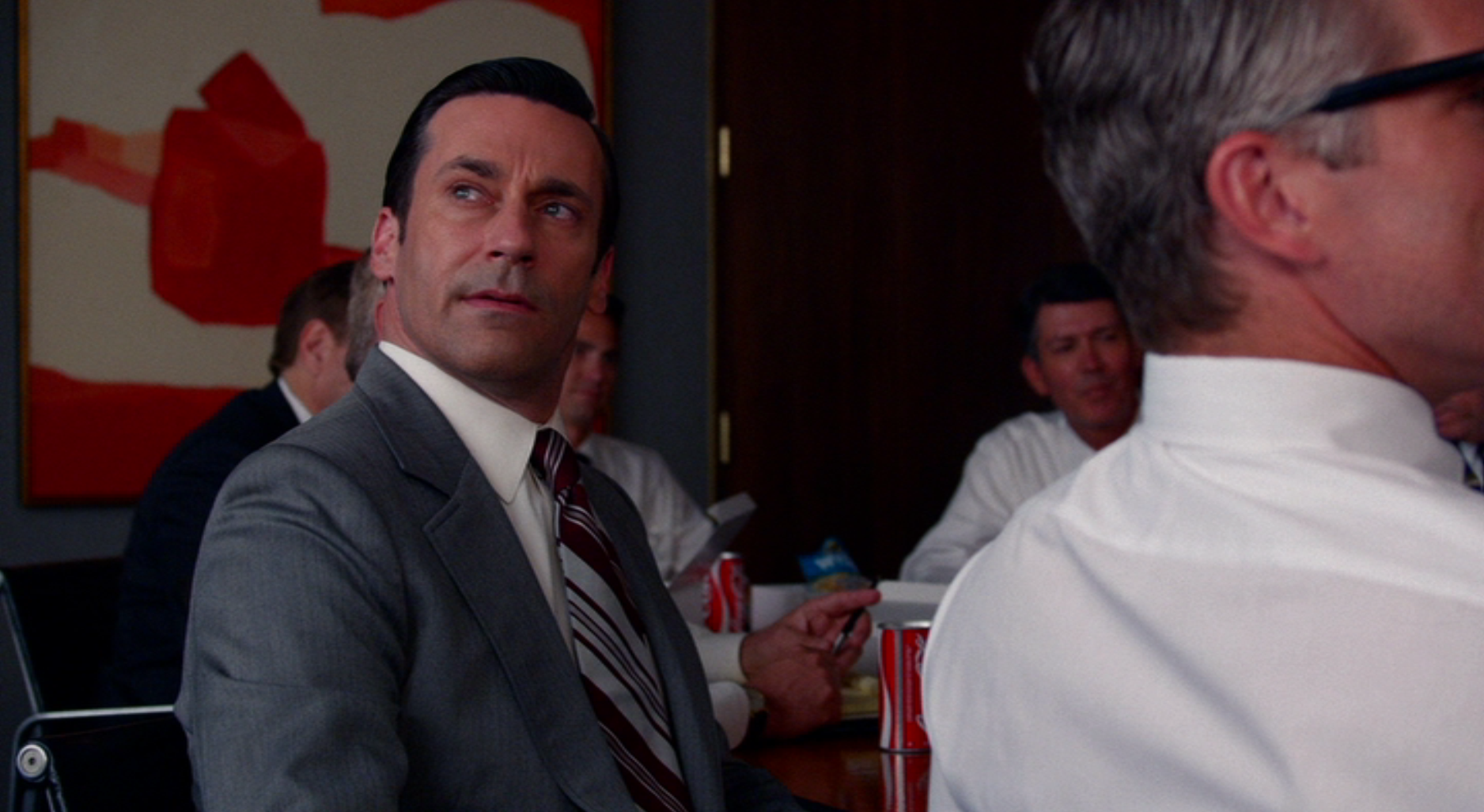
PS. In the final season of Mad Men, Don Draper joins McCann Erickson. His first meeting: a Miller Beer brief. Competent work. Professional room. Completely interchangeable with anything any other agency would produce. He looks around — rows of identical offices, identical people, identical output. Nobody’s wrong. Nobody’s brave. He looks out the window, sees a plane, walks out, and never comes back. He didn’t leave because McCann was bad. He left because the system wouldn’t let anyone be good.
Read The Room Shifts When You Walk In With Proof next.
Leave a Reply
You must be logged in to post a comment.