
♛
21.04.2026
One Crash, Millions of Flights, The Math Is Fine
Read Time: 6 Minutes
Hello
Imagine an Airline CEO: One Crash, Millions of Flights, The Math Is Fine
There is a sentence no airline CEO has ever said out loud, at least not while keeping their job:
“We only had one crash last year. Millions of flights landed safely. Statistically, we’re fine.”
The math is, in fact, fine. In 2025, commercial aviation operated around 40 million flights globally. A single fatal accident against that denominator produces a safety rate that looks stunning on a spreadsheet. A CFO staring at that ratio could reasonably conclude the system is working. A statistician would agree. An actuary would price insurance around it.
And yet, if a CEO ever delivered that line at a press conference (eyes steady, numbers correct), they would be unemployed by Tuesday. The board would fire them for being right in the wrong register.
This is the gap today’s essay is about. It is the gap between what is logically true and what is psychologically survivable. It is the gap between internal reality (the math, the dashboard, the averages) and market reality — what customers, employees, regulators, and the public actually experience and act on. It is the gap at the center of nearly every strategic decision that goes wrong in large organizations, and it is almost never the gap leaders are trained to see.
The Crash Is Not a Data Point
Start with first principles. Why is the airline CEO’s sentence unsayable?
The sentence is unsayable because a crash is not a data point. It is a category-defining event. It reconfigures how every subsequent flight is perceived — by the passenger boarding next Tuesday, by the regulator drafting next quarter’s audit, by the journalist searching the airline’s name for the next decade.
A passenger does not board a plane by integrating over the safety record. They board by recalling the last vivid image their brain produced when they thought about that airline. One crash overwrites a thousand safe landings because the brain does not weigh events by frequency. It weighs them by salience, emotional charge, and availability.
This is the operating system of human decision-making. Daniel Kahneman called it the availability heuristic. Amos Tversky called it representativeness. The marketing world calls it brand. The positioning world calls it mental territory. The airline CEO calls it the reason they cannot use the words that are completely defensible on a spreadsheet.
Here is the uncomfortable reframe: the math is fine is a confession, not a defence. It confesses that the speaker is operating in a register (averages, ratios, aggregates) that the market does not use. The market uses stories, images, and the most recent event. A leader who cannot translate between those registers has stopped leading a public-facing enterprise and started operating a statistical model that happens to have customers.
Two Views, One Company
Every company is actually two companies, running in parallel, almost never in sync.
The first company is what leadership believes about itself. This company is built from dashboards, board decks, quarterly reviews, employee survey summaries, and the selective memory of wins. It is the company that shows up in the all-hands meeting. It is the company whose CEO believes, with 80% probability, that they are customer-centric.
The second company is what the market actually experiences. This company is built on long hold times, broken promises, support tickets that close without resolution, review-site screenshots shared in WhatsApp groups, and the specific feeling a customer has when they try to close an account. It is the company where 8% of customers agree with the CEO.
The 80/8 gap is a structural feature of organizations that grade their own homework using instruments they control. Internal NPS is collected by the team whose bonus depends on NPS. Employee engagement is measured by HR, which reports to the CEO being engaged about. Brand tracking studies are designed by the agency that built the brand. The feedback loop is closed, insulated, and self-congratulatory by design.
The airline analogy applies here because aviation is one of the few industries in which the feedback loop cannot be closed. A crash cannot be dashboarded away. The FAA does not file the report inside the airline’s SharePoint. The regulator is an outside observer that the company cannot control. That single structural fact, the existence of an outside observer with authority, keeps commercial aviation honest in ways most industries are not.
Most companies have no equivalent of the FAA. They have no external body whose job it is to surface the gap between internal belief and external experience. So the gap grows unchecked until a crash (a product recall, a class-action suit, a viral review thread, a short-seller report) forces reconciliation all at once, usually at the worst possible moment.
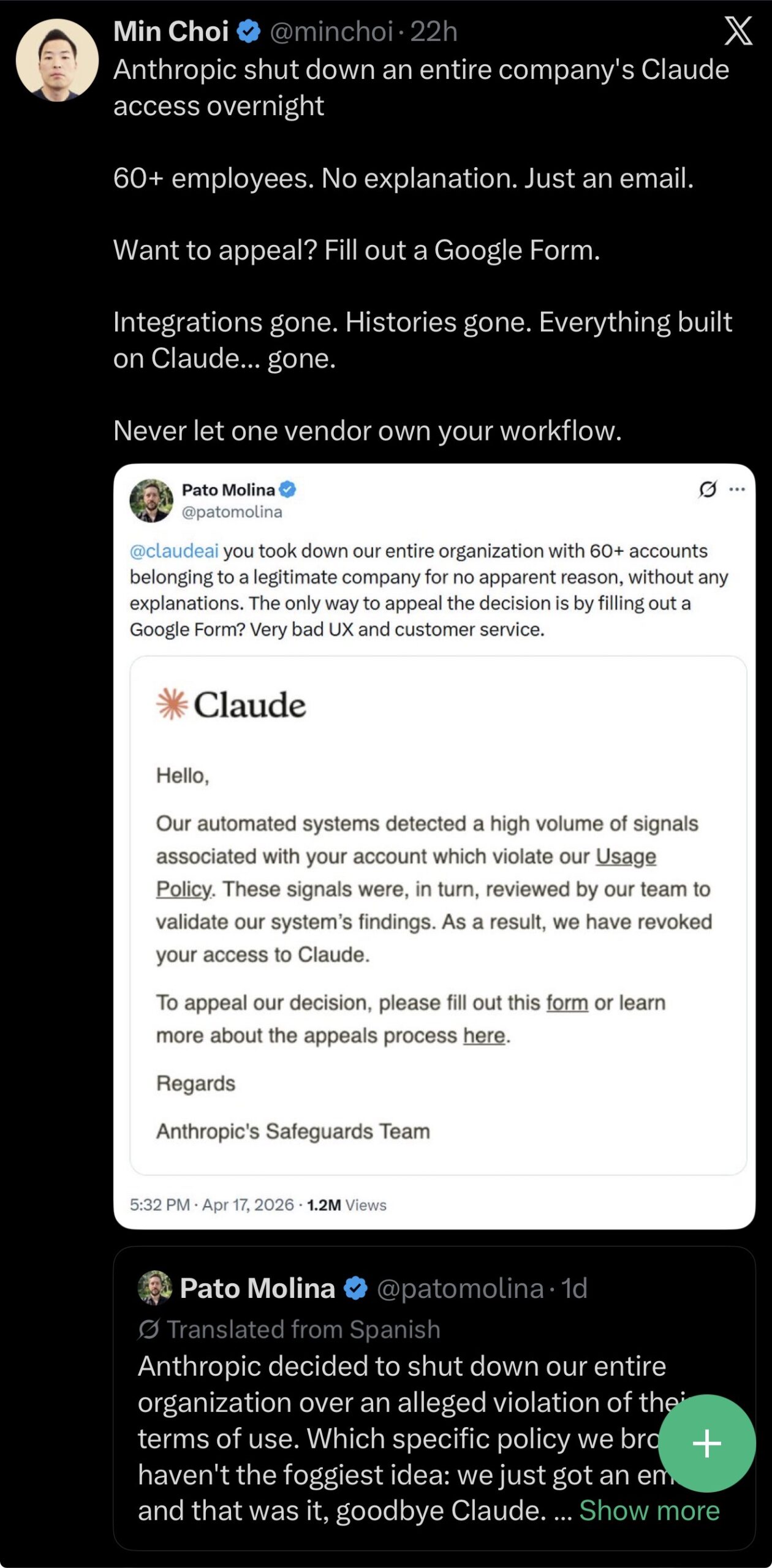
Now, this brings us to the Claude screenshot
On April 17, 2026, Anthropic shut down an entire company’s Claude access overnight. Sixty-plus employees. No explanation. Just an email. The screenshot went viral (1.2 million views in under a day) because its shape was instantly recognizable to anyone who has ever been on the wrong side of an automated system with no human on the other end.
Read the Anthropic email carefully. Every sentence is, on its own terms, defensible. Automated systems detected signals. A team reviewed those signals. A decision was made. An appeals process exists. A form is provided. The math, as it were, is fine.
This is the airline CEO’s sentence, rewritten for 2026. It is correct in the register Anthropic is using (policy enforcement, trust and safety, scaled moderation), and it is radioactive in the register the recipient is using, which is: we just lost sixty employees’ worth of work, our integrations are dead, our histories are gone, and the door back in is a Google Form. Two registers, one email, and a 1.2-million-view reputation event where Anthropic’s internal view (we ran the process correctly) conflicted with the market view (you erased a legitimate company without a phone call).
Notice what Anthropic’s internal dashboard probably shows today. A small number of enforcement actions relative to total accounts. A validated review step in the workflow. An appeals channel that exists and is being used. On every instrument Anthropic controls, the system is working. On the instrument Anthropic does not control (a developer with 1.2 million followers posting a screenshot), the system is, for this week, the story.
This is the gap in action, at the vendor layer most modern companies now depend on. And it surfaces a second lesson buried in Min Choi’s closing line: never let one vendor own your workflow. The reason this tweet resonates is the asymmetry it reveals. A single automated signal, a single human validation, a single email — and the customer’s side of the relationship is gone. The vendor’s risk is a PR cycle. The customer’s risk is their company.
The screenshot earns its place in this essay because it is the rare case where the gap between internal and market reality is visible on both sides in the same frame. The email is the internal register. The 1.2 million views are the market register. The distance between them is the entire subject of everything written above.
Anthropic is not uniquely bad here. Stripe has done versions of this. Google, Meta, AWS, Apple — every platform with scaled moderation has produced its own version of this email, and every one of them has, at some point, watched it go viral. The structural failure is not a specific company. It is the shape of any system where the scale of operations forces automated enforcement, the downside of false positives is borne entirely by the customer, and the recourse path is designed by the same team that designed the enforcement.
If you are a founder, an operator, or a CEO reading this, the question is what email does your company send that, if screenshotted, would read the same way? Every company has one. The account-freeze notification. The subscription-cancellation dark pattern. The support auto-response that closes the ticket. The “we’ve reviewed your feedback” template. Every one of those sentences is correct in the register the company is using. Every one of them is a grenade in the register the customer is using.
Edge Cases Are Not Exceptions
Here is the move most organizations make, and it is almost always wrong: they treat edge cases as exceptions to be handled separately from the main strategy.
The airline CEO treats the crash as a regrettable exception to a strong safety record. The bank treats the frozen account as a support exception to a strong satisfaction score. The SaaS company treats the outage as an infrastructure exception to a strong uptime number. Anthropic, presumably, treats the Pato Molina shutdown as a false positive exception to a policy system that otherwise works.
In every case, the exception is the system’s real shape. The exception is the shape of the system under stress; that shape is the one that matters.
Consider this from first principles. An organization is not a vehicle for producing its average outcome. It is a vehicle for absorbing its worst outcome. The customer who had a normal experience does not write a review. The customer whose funds were frozen for three weeks writes a review, which is read by 17 people considering the same bank, and 3 of them choose differently. The developer whose 60-employee company was erased does not stay quiet. They post the screenshot, and 1.2 million people read it, and some fraction of them now think twice before building their workflow on a single vendor.
The math of averages says the 997 normal experiences outweigh the three frozen accounts. The math of asymmetry says the three frozen accounts, if they are narratable, if they are emotionally charged, if they cluster around a failure mode that prospective customers can imagine happening to them, can swing more mindshare than the 997 silent successes.
This is the mathematical foundation of how reputation compounds. Reputation is a product of two things: the base rate of experience, and the variance of experience. Organizations obsess over the base rate. Markets care about the variance. The airline CEO saying the math is fine is saying “our base rate is great.” They are not answering the question the market is actually asking: “How bad can it get, and how often?”
The asymmetric work, the work that actually defends a position over time, is not at the average. It is at the tail. It lives in the question: what is the worst thing that can happen to a customer, and what have we done, structurally and operationally, to make that thing less likely or less severe?
A CEO who can answer that question with specifics (no slogans, no values statements, just line items on the P&L that exist because of the tail) has a defensible position. A CEO who cannot has a brand that works until the first crash.
IQ Versus EQ
The hardest thing for analytically trained leaders to accept is that logic does not win arguments. Logic justifies arguments that have already been won on other grounds.
The airline CEO’s “math is fine” sentence is logically airtight and psychologically radioactive. The senator’s “only 3% of the budget” line about a program is mathematically correct and politically fatal. The software executive’s “99.9% uptime” claim is engineering-accurate and customer-infuriating when the 0.1% hit the customer’s most important Tuesday. Anthropic’s “automated systems detected signals, our team validated” is procedurally complete and emotionally catastrophic when read by the developer whose sixty employees just lost access.
Why does logic lose? Logic operates in a register (aggregates, ratios, probabilities) that humans use for cold analysis and abandon for hot decisions. The moment a decision is emotional, identity-laden, or reputation-critical, the brain switches registers. It uses narrative. It uses analogy. It uses the last vivid image it produced on the topic.
This is economically rational. The human brain evolved in an environment where a single encounter with a predator meant death, and where spending cycles computing the probability of predator encounters was itself lethal. The brain solved the problem by weighing vivid negative experiences massively above their base-rate deserves. That weighting is still operating.
It is operating in your customers.
It is operating in your board.
It is operating in you.
The strategic implication is that the logical case for a decision is necessary and almost never sufficient. The case for any meaningful commercial action has to win on two tracks simultaneously:
- The logical track, which answers the question: Does this make sense on a spreadsheet?
– The psychological track, which answers the question: can this be said out loud without destroying the speaker’s standing, and can it be told as a story the listener will retell to someone else?
Leaders who win only the logical track get their proposal filed. Leaders who win only the psychological track get called hype merchants. Leaders who win both change the organization’s trajectory. The training system for executives (MBAs, consulting-firm frameworks, data-driven decision cultures) heavily overindexes on the logical track. Most strategic failures I have seen in twenty years of doing this work were failures of the psychological track.
The airline CEO who says “the math is fine” lost track of the psychological game before the sentence finished. The math is correct. The register is wrong.
The Register Problem
Here is the practical test. The next time you are about to send a notification, write a policy email, brief a board, or talk to a customer, ask two questions.
First: Is this true in the register I am using? If you are claiming 99.9% uptime, is that actually true? Is it weighted the right way? Are you including the outage that hit your biggest customer or excluding it because it was “infrastructure-adjacent”?
Second, and more importantly: Is this the register the listener is actually using? If the listener is a customer whose Tuesday was ruined by the 0.1%, telling them about the 99.9% is a provocation. You are answering a question they did not ask, in a language they did not choose, from a position that implies you do not understand the question.
The register problem is almost always the underlying issue behind “the math is fine.” The speaker is operating in a register (statistical, aggregate, average-weighted, procedurally correct) that the listener does not occupy. The listener occupies a register of specifics — my account, my Tuesday, my $400, my flight, my kid, my company, my sixty employees. Numbers and policies in the aggregate register do not translate into that register without a translator.
The translator is usually story. The translator is sometimes a specific concession (“here is what happened to you and here is the specific change we made because of you”). The translator is almost never a recitation of the aggregate numbers with a confident tone, or a link to a Google Form. Confidence in the aggregate register reads, in the specific register, as condescension. A form reads as contempt.
This is why “customer-centric” as a slogan is worse than saying nothing.
The slogan is in the aggregate register. The customer is in the specific register. The slogan is, in effect, saying: “We have, across our portfolio of customer interactions, optimized for customer outcomes.” The customer hears: “I am a line item in your portfolio, and my specific Tuesday does not exist in your model.” The 80/8 gap gets wider every time a company repeats the slogan.
What Actually Changes the Conclusion
Strip away the analogies. Strip away the frameworks. Strip away the inherited wisdom about brand, positioning, and customer experience. What is left?
What is left is a narrow and stubborn claim: the internal instruments an organization uses to measure itself are, in most cases, systematically biased toward the organization’s preferred narrative, and the gap between that narrative and external reality widens under stress, not under calm. The gap is invisible on the instruments the organization uses. The organization designed the instruments.
The only thing that changes this conclusion is exposure to an outside observer whose incentives are not aligned with the organization’s narrative. Aviation has the FAA. Public markets have short-sellers and SEC filings. Regulated industries have audit regimes. Platforms have viral screenshots and developer Twitter. Most companies, in most contexts, have nothing equivalent, no external observer, no independent instrument, no forced reconciliation between the internal story and the external experience — until the day the screenshot arrives.
The Anthropic email is instructive because it shows how thin the membrane is between “the system is working” and “the system is the headline.” On Friday, the enforcement workflow is a line on an internal dashboard. By Saturday, it is 1.2 million views and a lesson the industry is writing about. Nothing about the system changed. The only thing that changed is that an outside observer, a verified user with a camera and an audience made the internal reality legible to the market.
The conclusion that follows from the fundamentals alone is that leaders who deliberately, structurally, and, through outside observation, build it into their decision cadence will, over time, have fewer “math is fine” moments. Leaders who do not will have a growing reservoir of unreconciled gap, and the reservoir will eventually discharge in a single event they will call an exception, and the market will call a crash.
The Airline CEO Again
Return to the sentence.
“We only had one crash last year. Millions of flights landed safely. Statistically, we’re fine.”
Why can the CEO not say it? Every airline CEO has internalized, through forty years of industry scar tissue, that the public does not evaluate airlines on base rates. The public evaluates airlines on whether they seem like the kind of operation where a crash is a reason to rebuild the entire system, or the kind where a crash is a rounding error the spreadsheet absorbed. The first kind of airline keeps customers. The second kind becomes a case study.
Now ask: in your industry, which kind of company are you? Which kind does your leadership team sound like in the meetings when no customer is in? Which kind does your dashboard reward you for being? Which kind does your policy email, read aloud, sound like?
If the honest answer is “the spreadsheet kind,” the math may be fine today. The register is wrong. And the register, in the long run, determines whether you survive the first crash — the one that is not a data point, the one the system was never designed to absorb, the one that arrives while the math is still fine and ends the conversation about whether the math was ever the right thing to measure.
The work of leadership is not to produce the right average. It is to build an organization whose worst day is narratable as a recovery rather than a confession. That work is done before the bad day, in the register the market actually uses, on the edges where the system is stressed, against assumptions that no internal instrument will surface.
The math is fine. The math is always fine, until the crash. What comes after the crash is already decided — decided months or years earlier, in the rooms where someone either interrogated the edge cases or filed them under “exceptions” and called the spreadsheet a strategy.
DIGEST