


Why the winners in AI will own the path from trusted context to better decisions—not merely the data or the answer
Enterprise technology is approaching an uncomfortable moment. Companies have spent years centralizing data, connecting systems, building dashboards, and creating increasingly sophisticated models of their businesses.
Now they are adding copilots and agents on top. The volume of analysis is exploding. Answers that once took an analyst several days can appear in seconds. Reports can be summarized automatically. Plans, forecasts, briefs, and recommendations can be generated on demand.
Yet the evidence does not show that more AI output is automatically producing better business outcomes.
McKinsey’s 2025 global AI survey included 1,993 respondents in 105 countries. Only about one-third said their organizations were scaling AI programs, even as experimentation with agents spread. Practices such as redesigning workflows, embedding AI in business processes, tracking clear performance indicators, and improving systems from feedback were associated with greater value. The organizations pulling ahead were not simply using better models. They were changing how work and decisions happened. McKinsey, “The State of AI in 2025”
The same gap is visible in marketing. Gartner’s 2026 CMO Spend Survey covered 401 marketing leaders, mostly at companies with more than $1 billion in annual revenue. Respondents were allocating 15.3% of marketing budgets to AI. 70% said becoming an AI leader was critical, but only 30% reported mature or fully developed AI readiness. Overall marketing budgets were effectively flat at 7.8% of company revenue. Gartner, 2026 CMO Spend Survey
Those numbers describe more than an adoption problem.
They describe a decision problem.
Companies are being asked to make sharper choices with constrained resources while simultaneously funding a technology whose output is becoming abundant. They do not need an unlimited supply of possible actions. They need to know which action deserves money, attention, authority, and time. They need to know whether the action worked. And they need the organization to become more capable because the decision was made.
This is why the enterprise software market is moving through three stages: from ownership of data, to ownership of decisions, and ultimately to ownership of the learning loop.
The winners will not merely generate answers. They will establish trusted context, improve a consequential choice, help the organization act, observe the outcome, and make the next decision better.
The first era: owning the data
The modern enterprise software industry was built around systems of record.
The CRM owned the customer and opportunity record. The ERP owned finance, inventory, and transactions. The HR system owned employees. The marketing platform owned campaigns and leads. The project system owned work. The data warehouse promised to bring copies of these realities together.
Owning the record created enormous power. The system became difficult to remove because history, workflow, permissions, integrations, and organizational habits accumulated around it. It also became the place where other applications had to go for context.
This era solved a real problem: digitizing the state of the business. But it left three important gaps.
First, a company rarely has one coherent state. The same customer may appear under several identities. Finance and sales may define revenue differently. Marketing and sales may disagree about a qualified opportunity. A parent company, subsidiary, buyer, contract, campaign, and product can be represented differently across systems.
Second, recording what happened does not explain why it happened. A CRM can show that a deal was lost without capturing the real customer objection. A campaign platform can report a conversion without proving that the campaign caused it. A project tool can show that work is late without revealing whether the work still deserves investment.
Third, a system of record does not decide. It can preserve the objects involved in a choice, but the logic, alternatives, constraints, and authority often live in spreadsheets, meetings, presentations, and people’s heads.
This is the context in which data platforms, semantic layers, customer-data systems, and knowledge graphs became important. Their job is not just to accumulate information, but to establish what the organization means.
Quantexa, for example, makes entity resolution and graph generation central to its Decision Intelligence Platform. It brings together siloed sources, resolves customers and counterparties, and represents relationships in a contextual graph. The value is foundational: before an AI can recommend an action for a customer, supplier, account, or risk, it must know which real-world entity it is reasoning about. Quantexa Decision Intelligence Platform
Trusted context is therefore not a technical preamble to intelligence. It is part of the intelligence. If the entities, definitions, history, permissions, or relationships are wrong, AI simply produces a faster and more persuasive error.
But even a perfectly connected representation of the enterprise is not enough. A map is not a choice.
The second era: owning the answer
Business intelligence expanded the value of enterprise data by helping people ask what happened, where it happened, and sometimes why. Predictive analytics added what might happen next. Generative AI has now transformed the interface.
A user no longer needs to know which dashboard contains a metric or how to write a database query. A conversational system can retrieve documents, generate analysis, summarize calls, interpret a report, draft a forecast narrative, or recommend a next step. The interface increasingly resembles a capable analyst.
This is useful. It lowers the cost of access, expands who can work with complex information, and compresses the time between a question and a response.
It is also rapidly becoming common.
Microsoft, Snowflake, Databricks, Salesforce, ServiceNow, Adobe, Atlassian, and nearly every major software platform are embedding natural-language assistance. Specialist vendors are doing the same. Access to a powerful foundation model is no longer sufficient differentiation. The competitive question is what proprietary context surrounds the model, what tools it can use, what actions it can take, and what evidence comes back.
The risks of the answer era are visible in the safeguards vendors themselves are building. Snowflake now documents an evaluation framework for Cortex Agents that tests answer correctness, tool selection, tool execution, and logical consistency against expected ground truth. The important signal is that serious enterprise-agent deployment requires deliberate evaluation of both the final answer and the process used to produce it. Snowflake Cortex Agent evaluations
An answer can be fluent and wrong. It can be factually correct and strategically irrelevant. It can identify a risk without clarifying the available choices. It can recommend an action that nobody is authorized to take. It can optimize a metric that damages the broader business. And it can disappear into a presentation without changing behaviour.
This is the boundary between a system of intelligence and a system of decision.
The decision is the real unit of value
Gartner’s 2026 Magic Quadrant for Decision Intelligence Platforms describes a category that combines decision modelling, analytics, and AI to augment or automate decision-making and drive business outcomes. Its vendor set includes companies such as Aera Technology, FICO, IBM, Oracle, Pegasystems, Quantexa, RelationalAI, and SAS. The lineage matters. Decision intelligence did not begin with generative AI. It draws from business rules, optimization, operations research, machine learning, process automation, knowledge representation, and decision management. Gartner, 2026 Magic Quadrant for Decision Intelligence Platforms
The irreducible business problem is straightforward.
An organization has finite money, people, time, capacity, and attention. It must choose where to place them under uncertainty. The evidence is incomplete. Different functions see different parts of reality. Incentives conflict. The future cannot be known. A decision must still be made.
A useful decision system therefore needs to do more than answer a question. It must connect at least seven functions:
- Establish the relevant context.
- Interpret what is happening and why.
- Define the actual choice and available alternatives.
- Compare expected outcomes, assumptions, constraints, and risks.
- Recommend or support a decision.
- Turn the decision into an authorized action.
- Observe the outcome and update what the organization believes.
In shorter form: context, choice, action, outcome, learning.
Different products own different sections of this chain. Enterprise search products find evidence. Analytics products explain it. Predictive products estimate what may happen. Planning platforms compare scenarios. Decision engines apply rules or optimize choices. Agents execute tasks. Experimentation platforms estimate causal impact. Workflow systems coordinate action. Decision records preserve memory.
The market opportunity lies in connecting these fragments around a consequential decision.
The market is a stack, not a single category
“Decision intelligence” is a useful description of a destination, but it is not yet a clean buying category. A fraud platform, a corporate-planning system, a revenue forecast, and a next-best-offer engine can all improve decisions while solving different problems for different executives.
The landscape becomes easier to understand when mapped on two axes.
The horizontal axis is decision depth. On the left are products that find and explain information. In the middle are products that predict, simulate, and recommend. On the right are products that execute actions, observe outcomes, and learn.
The vertical axis is scope. At the top are horizontal enterprise platforms. Below them are planning and portfolio systems. Then come revenue and GTM applications. At the bottom are specialized marketing and customer-decisioning systems.
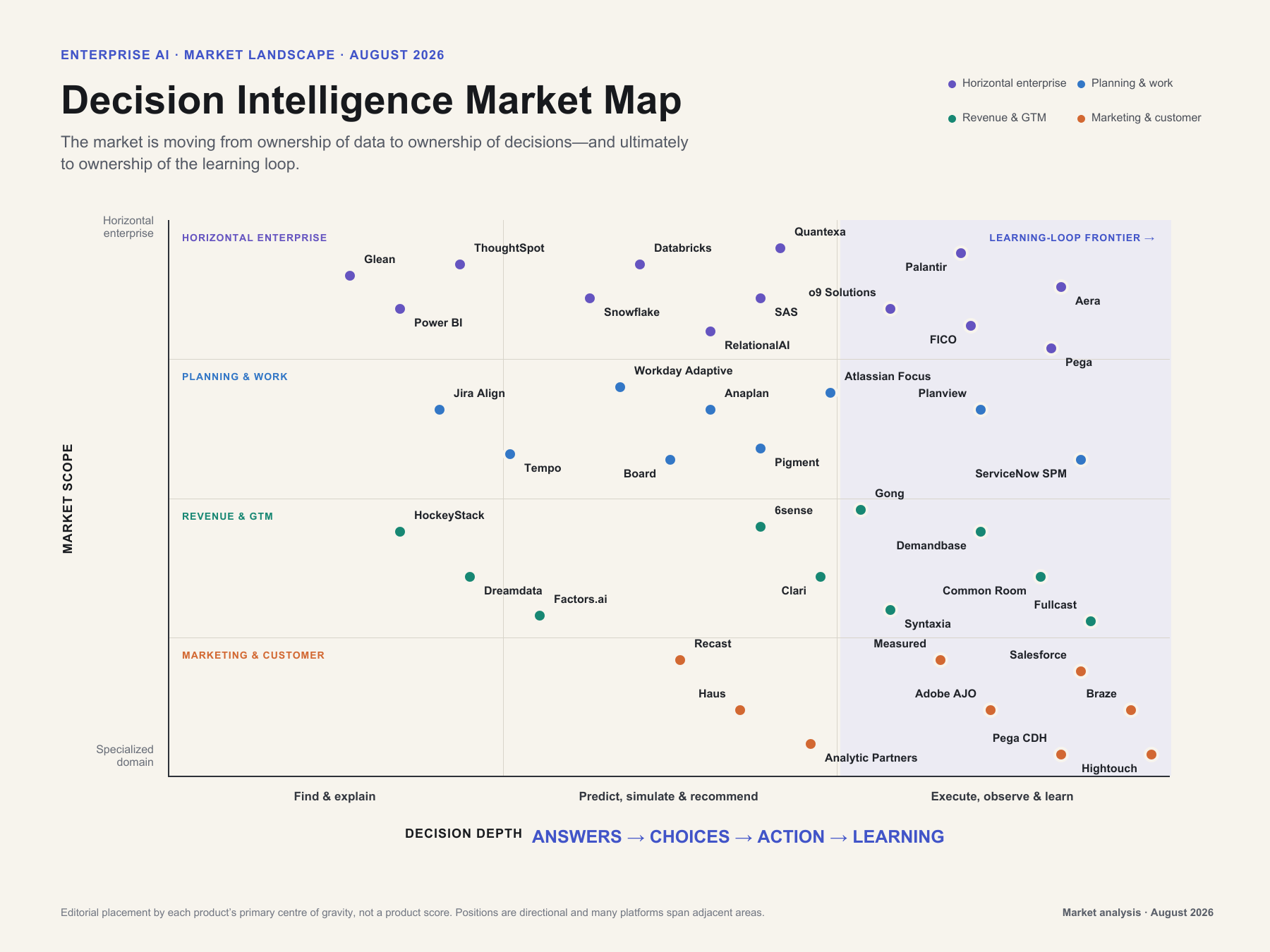
These are editorial placements based on each product’s primary centre of gravity, not fixed product scores. Most vendors span adjacent cells, and nearly all are trying to move to the right. Analytics vendors are adding recommendations. Planning companies are adding agents. Account-intelligence companies are adding orchestration. Customer-engagement products are adding adaptive decisioning. Data platforms are becoming agent platforms.
That movement is the competitive story. Every category is trying to own more of the distance between evidence and outcome.
What the different categories are actually solving
1. Enterprise knowledge and conversational analytics: “Help me understand the business”
Glean, Microsoft Power BI, ThoughtSpot, Snowflake, and Databricks reduce the friction between a person and organizational information.
Glean begins with permission-aware enterprise knowledge. Its underlying problem is that employees cannot find the right document, answer, expert, or context across dozens of systems. Its advantage is not simply search. It is the organizational context created by relationships among people, content, activity, and access rights. Glean is now extending that context into assistants and agents.
Power BI brings natural-language assistance to a vast installed base of dashboards, reports, and semantic models. ThoughtSpot similarly makes governed analytics accessible through search and agentic interfaces. Snowflake and Databricks go deeper into the data foundation, giving companies an environment in which they can build governed analytical and agent applications over structured and unstructured data.
These products make decisions easier by reducing the time required to assemble evidence. They are useful because a decision maker can ask a follow-up question rather than wait for another report. But their natural starting point is the user’s question, not the enterprise’s decision. The customer still has to define the objective, alternatives, constraints, authority, and success criteria.
Their path toward the learning loop is to connect their governed context to tools, workflow, evaluation, and outcome feedback. Snowflake’s agent-evaluation framework is an example of the necessary discipline: the platform tests not only answer correctness but whether an agent selected and executed the appropriate tools. The infrastructure leaders may provide the substrate for thousands of decision applications without becoming the final application used by every executive.
2. Context, graph, and horizontal decision platforms: “Help the enterprise reason and act coherently”
Quantexa, RelationalAI, Palantir, Aera, FICO, SAS, Pega, and o9 Solutions attack deeper structural problems.
Quantexa is strongest when fragmented records and hidden relationships make the subject of the decision uncertain. Entity resolution and knowledge graphs create a more trustworthy representation of customers, counterparties, suppliers, transactions, and risk. Its path to the loop runs from clean and connected entities to contextual insight, then to governed human and agent decisions.
RelationalAI supplies a relational knowledge-graph and reasoning layer. Its value is the ability to represent relationships and business logic that are awkward to express as isolated rows and dashboards. Like other infrastructure-oriented companies, it becomes most valuable when a domain application turns the reasoning layer into a repeated decision.
Palantir is positioned furthest toward operational decisions. Its Ontology connects enterprise objects, logic, actions, and security. That allows a user or agent to move from a live representation of the business to an authorized write-back into operational systems. Its advantage is not a generic chat experience. It is an operational model on which applications and human-agent workflows can run.
Aera makes the decision itself the primary record. Its public architecture explicitly captures decision context, recommended and executed actions, and outcomes. This is especially suited to high-frequency operational environments such as supply chain, procurement, and finance, where exceptions recur and results can be observed.
FICO demonstrates the durability of decision management in areas such as credit and fraud: repeated choices, measurable consequences, formal rules, scores, and strong governance. SAS brings analytical depth, model management, optimization, and decision flows. Pega combines decisioning with workflow and case management. o9 connects enterprise planning and operational decisions through a digital model of the business.
These companies are not selling better reports. They are selling consistency, scale, governance, and the ability to turn models into operational policy. Their challenge is implementation. A horizontal platform can be powerful, but the customer must still model the domain, change processes, establish ownership, and justify the cost.
3. Connected planning and portfolio management: “Help us choose what to fund and make the plan real”
Anaplan, Pigment, Board, and Workday Adaptive Planning turn assumptions into shared models. Planview, Atlassian Focus, Tempo, Jira Align, and ServiceNow connect strategy to investments, capacity, and work.
Anaplan and Pigment help leaders model possible futures across finance, sales, workforce, and operations. Their central product is not a forecast number. It is a shared model of how changes propagate. A hiring delay affects capacity; capacity affects sales coverage; coverage affects revenue. Scenario planning makes the assumptions visible before resources are committed.
Atlassian Focus operates one level closer to strategic alignment. It connects priorities to goals, work, teams, and funds and lets leaders rebalance as conditions change. Atlassian describes it as a strategy-planning hub, while its support documentation makes clear that Focus’s financial layer complements rather than replaces the ERP. That distinction is important: Focus does not need to own the authoritative ledger to own the executive view of how money and work support strategy. Atlassian Focus
Tempo approaches the problem from the work layer. It uses live Jira information to connect hierarchies, capacity, time, budgets, costs, and portfolio reporting. It is useful where the strategic question is constrained by delivery reality: Do we have the people? What does the work cost? Which commitment will slip if another is approved?
Planview has deeper strategic-portfolio heritage. Its model connects initiatives, investments, capacity, dependencies, delivery, and outcomes across heterogeneous work systems. ServiceNow Strategic Portfolio Management benefits from being part of a broad workflow platform. Jira Align connects enterprise strategy and agile delivery.
This category is moving toward a portfolio learning loop: state the investment thesis, allocate money and capacity, observe delivery and benefits, reallocate as reality changes, and preserve the reason for the change. Planview’s announced agent-resource-management capabilities show the next extension—managing human and AI capacity together, with costs, authority boundaries, audit trails, and accountability.
4. Revenue and GTM intelligence: “Help us know where revenue will come from and what to do next”
The revenue market is crowded because a company can improve commercial performance at many different points.
Gong captures customer conversations and revenue activity, then uses that context for coaching, deal inspection, pipeline management, and forecasting. Its current Revenue AI OS architecture includes a Revenue Graph for context, a Revenue Harness intended to govern how agents plan and act, and applications where revenue teams work. This is a credible path from proprietary interaction data to decisions and execution because Gong already sits inside recurring management rituals. Gong Revenue AI OS
Clari is centred on forecast confidence and pipeline inspection. It helps executives and managers determine whether the number is credible, where risk is accumulating, and which intervention is required. Its advantage is the weekly operating cadence: forecast calls and pipeline reviews are repeated decisions with visible outcomes.
6sense predicts buying stages and account propensity. Demandbase combines account identification, intent, buying groups, advertising, prioritization, and orchestration. The buyer is purchasing a better allocation of sales and marketing attention: which accounts matter, which people are involved, which signal changed, and what should happen next.
Common Room reflects a newer buyer-intelligence model. It resolves people and accounts across product usage, websites, communities, social activity, CRM records, and other signals, then operationalizes that context through workflows and agents. Its potential moat is the live identity-and-signal layer that traditional lead systems miss.
Fullcast connects territories, capacity, quotas, routing, forecasting, and compensation—the plan-to-pay chain. This is decision intelligence expressed through revenue operations. A territory decision becomes an assignment; an assignment changes capacity and pipeline; results affect the next plan.
HockeyStack, Dreamdata, and Factors.ai reconstruct B2B journeys, attribution, account activity, and pipeline performance. They make fragmented GTM evidence easier to interpret. Their movement toward the learning loop requires a careful distinction: showing that an account touched a campaign is not the same as showing that the campaign caused the outcome.
Syntaxia is an emerging company aimed at the contradiction problem inside fragmented GTM systems. Its proposed shared meaning layer, entity resolution, knowledge graph, history, and role-specific views are intended to create coherent context and recommendations. Its strongest potential wedge is a company with multiple CRMs, post-acquisition data fragmentation, or incompatible commercial definitions. Its public architecture is promising, but the load-bearing evidence will be whether its recommendations change important actions and whether outcomes improve future recommendations.
No vendor yet owns the complete GTM learning loop. Gong is strong in sales interactions and workflow. Clari is strong in forecast and pipeline management. Account-based platforms are strong in signals and activation. Measurement platforms are stronger in causal evidence. The category leader will have to connect these worlds without becoming another bloated front-office suite.
5. Marketing measurement: “Help us determine what caused growth and where the next dollar should go”
Marketing exposes the difference between reporting, attribution, prediction, and causality.
Attribution products reconstruct observed journeys and assign credit. They are useful for operational analysis, but a touchpoint that appears before a sale did not necessarily cause the sale. Demand-driven channels such as brand search and retargeting can receive credit for demand created elsewhere.
Haus focuses on incrementality experiments. It compares exposed and unexposed groups to estimate the causal lift from marketing. The product is valuable because marketing, analytics, and finance need an answer they can defend together.
Recast uses Bayesian marketing-mix modeling and optimization to estimate channel contribution, forecast outcomes, and recommend budget allocations. Analytic Partners combines long-standing commercial analytics, models, benchmarks, scenarios, optimization, software, and human advisory expertise.
Measured connects incrementality tests, test-calibrated marketing-mix models, scenario planning, and budget optimization. This is closer to a learning loop than static attribution: form a belief about a channel, test it, update the model, change the allocation, and measure again.
This market will increasingly compete on the quality of the counterfactual—what would have happened without the marketing intervention—not on the beauty of the attribution dashboard.
6. Customer decisioning: “Help us choose the best treatment for this customer now”
Adobe Journey Optimizer, Pega Customer Decision Hub, Hightouch AI Decisioning, Salesforce, and Braze operate at high frequency. They choose or orchestrate messages, offers, content, channels, timing, and journeys for individuals or accounts.
Pega Customer Decision Hub has a long history in next-best-action decisioning, using predictive and adaptive models, rules, and arbitration. Adobe Journey Optimizer combines profiles, journey orchestration, content, experimentation, and real-time decisioning. Salesforce can bring decisioning and agents into the CRM and broader front-office workflow. Braze combines real-time customer engagement, experimentation, and cross-channel execution.
Hightouch AI Decisioning offers one of the clearest modern examples of a direct learning loop. Marketers define an audience, goal, available content, and guardrails. Reinforcement learning selects the message, channel, and timing, observes outcomes such as purchases or clicks, and updates future choices. Holdout groups can measure incremental lift.
Customer decisioning can close the loop faster than corporate strategy because decisions occur frequently and feedback arrives quickly. But it also demonstrates the importance of objective design. A system optimizing clicks may make different choices from one optimizing margin, retention, or long-term customer value. The objective and guardrails are part of the product.
What an operational decision system looks like
Palantir’s Ontology offers one of the clearest examples of the market’s direction. Palantir describes the Ontology as integrating the data, logic, actions, and security of an enterprise. Data is represented as real-world objects and relationships. Logic can include business rules, machine-learning models, language-model functions, or more complex orchestrations. Actions are modelled explicitly and can write back to operational systems. Security governs both people and agents. Palantir Ontology
The distinction between “nouns” and “verbs” is useful. A customer, shipment, account, product, campaign, or work order is a noun. Approve, reallocate, contact, stop, launch, or escalate are verbs. Traditional data systems are good at storing nouns. Decision systems must connect nouns to governed verbs.
Palantir also documents action logs designed to capture submitted actions as data, including relevant context or motivation. That moves the system beyond showing the current state. It begins to preserve what was decided and done. Palantir Action Log
Aera Technology goes further in its public framing of decision memory. Its Decision Data Model is designed to record decisions together with their context, actions, and resulting outcomes. Aera says this history enables its system to learn and improve future recommendations. Its broader Decision Cloud combines real-time data, multiple decision engines, natural-language engagement, simulations, recommendations, and execution. Aera Decision Cloud
Disclaimer: These are vendor descriptions, not independent proof that every implementation achieves a perfect learning loop. But they show where serious product architecture is moving. The object is no longer merely the customer record, dashboard, or model output. The object is the decision itself.
That changes what must be captured: the trigger, objective, available evidence, assumptions, alternatives, authority, action, expected result, actual outcome, and lesson. Most organizations have abundant performance data but weak decision history. When results arrive, people reconstruct the rationale from memory. When leaders change, the reasoning behind earlier choices often leaves with them.
That is why decision memory can become a more defensible asset than another collection of documents.
Prediction is not the same as intervention
The move from answers to decisions also exposes a critical analytical distinction: predicting an outcome is not the same as knowing which action will improve it.
A model may predict that an account is likely to buy. That does not show that another sales touch will cause the purchase. The account may have bought anyway. A platform may show that converted customers encountered a campaign. That does not prove the campaign created incremental demand. A forecast may identify a likely revenue miss. That does not determine whether the correct response is more pipeline generation, better conversion, different coverage, a product change, or a revised target.
Business decisions are interventions. The organization is choosing to alter the world and expects a result. That requires causal humility.
Marketing measurement makes this difference especially visible. Haus uses incrementality experiments to compare groups exposed to an intervention with groups that were not, aiming to estimate causal lift. Measured combines experiments with marketing-mix modelling and optimization so a team can test impact, simulate scenarios, and allocate media based on incremental return rather than platform attribution alone. Haus Incrementality Experiments Measured Media Effectiveness Platform
Neither experiments nor models eliminate uncertainty. Experiments can be contaminated or underpowered. Historical relationships can shift. Some strategic effects take too long or spread too broadly to isolate cleanly. The answer is not to abandon measurement but to state assumptions, combine methods, declare expected outcomes in advance, and update confidence as evidence accumulates.
A learning loop does not require certainty. It requires intellectual honesty and a mechanism for revision.
Action is where economic value—and risk—appears
A recommendation sitting in a dashboard has no direct economic value. Value appears when it changes an allocation, priority, treatment, workflow, investment, or behaviour.
Agents matter because they can close the gap between analysis and execution. They can monitor a condition, assemble context, call tools, create or update records, launch a workflow, draft a response, or take an approved action. But the defining characteristic of an agent is not human-like language. It is delegated authority.
That authority creates a governance problem. Who approved the objective? Which systems can the agent access? What is it allowed to change? What budget can it spend? When must it escalate? How are its actions observed? Who is accountable when the action is wrong?
Planview’s 2026 announcement of agent resource management is evidence that this governance layer is becoming a product category of its own. The company says enterprises will be able to place humans and agents in the same portfolio view, associate agents with costs and strategic initiatives, set authority boundaries and budget ceilings, create escalation paths, and maintain audit trails of actions and approvals. The capabilities were announced for availability beginning in fall 2026, so they should be treated as a product commitment rather than a long-established deployment record. Still, the direction is notable: organizations need to manage agents as resources operating against priorities, not as unbounded digital assistants. Planview Agent Resource Management
The rational path is not immediate autonomy. It is an authority ladder:
- observe;
- explain;
- recommend;
- draft an action;
- execute after approval;
- execute within explicit limits;
- automate only after the decision is sufficiently understood and monitored.
The higher the consequence and the lower the reversibility, the more human judgment and oversight should remain.
The learning loop is the next moat
If powerful models are increasingly available to every vendor, where does durable advantage come from?
It comes from what surrounds the model. It comes from proprietary, permissioned context. From a semantic model that reflects how the enterprise actually works. From identity resolution and data quality. From integration into a recurring workflow. From rights to take action. From governance and trust. From causal evidence and domain-specific benchmarks. And, most importantly, from a history connecting context, decisions, actions, and outcomes.
Consider customer decisioning. Hightouch AI Decisioning uses reinforcement learning to select messages, offers, channels, timing, and frequency for individuals within goals and guardrails defined by marketers. The documented loop is explicit: deliver an action, record the outcome, and update future decisions based on what worked. Holdout groups can be used to estimate lift. This is easier to close than an annual corporate-strategy loop because customer interactions are frequent and outcomes can arrive quickly. But it demonstrates the principle. The system becomes more valuable when it learns from the consequence of its own decisions. Hightouch AI Decisioning documentation
The same architecture can appear elsewhere. A sales system learns which risks predict deal outcomes. A media system learns where spending creates incremental return. A supply-chain system learns which response resolves an exception. A portfolio system learns which resource patterns improve delivery.
The loop becomes defensible because competitors cannot reproduce it merely by licensing the same model. They would need the same historical context, decisions, action rights, outcomes, workflow position, and customer trust.
This is a stronger moat than raw data volume alone. Most enterprise data describes what happened. Learning-loop data explains what the organization believed, what it chose, what it did, and what followed.
The human role becomes more important at the boundary
The argument for learning systems is not an argument for automating every decision. Some decisions are frequent, narrow, observable, and reversible. Choosing the time or channel for a customer message may occur millions of times, generate rapid feedback, and be constrained by clear rules. These decisions are strong candidates for adaptive automation.
Other decisions are infrequent, ambiguous, political, and difficult to reverse. Entering a market, changing a company’s positioning, replacing a leadership team, resetting a marketing engine, or reallocating a major budget involves contested objectives and delayed outcomes. Historical data may be sparse. The organization itself changes because the decision is made.
In those situations, AI can assemble evidence, surface contradictions, challenge assumptions, model scenarios, preserve rationale, monitor leading indicators, and reduce analytical work. But senior humans still provide judgment, accountability, negotiation, and change leadership.
The winning design is neither “AI instead of people” nor “people using a chatbot.” It is a deliberate division of labour. Machines provide memory, speed, consistency, monitoring, and scale. Humans frame the problem, define values and objectives, interpret ambiguity, resolve conflict, assume responsibility, and decide when the rules themselves should change.
Services will therefore be compressed and reorganized, not simply erased. Routine research, reporting, production, and analysis will become less valuable as labour. Trusted judgment and responsibility for consequential transformation may become more valuable. The strongest firms will encode their methods and outcome history into systems while keeping humans where context and accountability matter most.
What the market could look like in three to five years
The category will not evolve into one universal “AI brain” that replaces every enterprise system. A more likely structure is a layered market with five forms of ownership.
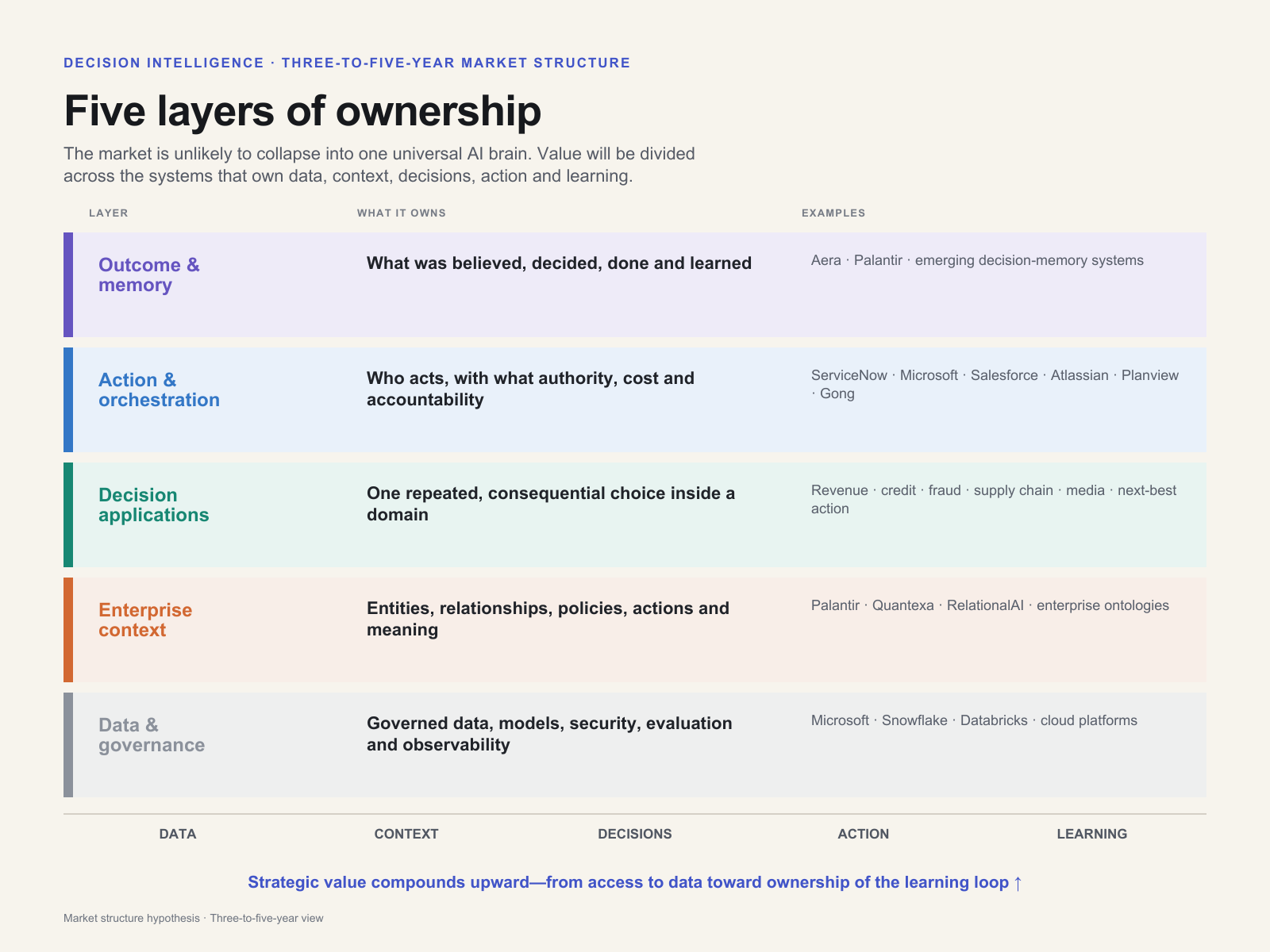
The data and governance layer
Microsoft, Snowflake, Databricks, major cloud providers, and established enterprise platforms will supply governed data access, model choice, agent tooling, evaluation, security, and observability. Natural-language analysis will become a standard interface rather than a category.
This layer will be powerful but mostly horizontal. Its leaders will make it easy to build and govern decision applications, but they will not automatically know which commercial, financial, operational, or customer decision matters. Their risk is becoming infrastructure underneath a more valuable domain application. Their advantage is distribution: they already hold data, security relationships, procurement approval, and developer attention.
The enterprise context layer
Semantic models, ontologies, entity resolution, and knowledge graphs will move from technical language into executive buying conversations. Agents need a reliable representation of customers, products, accounts, initiatives, relationships, policies, and actions.
Palantir and Quantexa are well positioned here from different starting points. Palantir connects context to operational action and security. Quantexa specializes in resolving ambiguous entities and relationships. RelationalAI can supply a reasoning layer. Enterprise incumbents will develop competing object and graph models.
The winner might not be the company with the largest graph in the abstract. In my mind, it would be most likely the company whose context improves an important decision quickly enough to justify implementation.
The decision application layer
Specialized applications will continue to outperform generic agents on consequential workflows. A revenue application with customer interactions, opportunity history, commercial definitions, and sales-manager workflow will be more useful than a general-purpose agent starting from a prompt. A marketing-allocation product with experiments and causal models will be more credible than a chatbot interpreting a dashboard.
This layer will remain fragmented by decision: credit, fraud, supply-chain exception, portfolio allocation, revenue forecast, account priority, media investment, next-best offer, and many others. The strongest businesses will begin with one repeated decision, prove value, then expand into adjacent decisions.
The action and orchestration layer
Agents will become less visible as characters and more visible as governed participants in workflows. Organizations will need to know which person or agent is doing the work, what it costs, which objective it supports, what authority it possesses, and who is accountable.
ServiceNow, Microsoft, Salesforce, Atlassian, and other workflow incumbents have an advantage because actions already pass through their systems. Palantir has an advantage where its Ontology models and governs the operational action. Planview is creating a portfolio view of human and agent resources. Gong is building a revenue-specific execution harness. The strategic fight will be over who governs the agent, not who gives it the most human-sounding name.
The outcome and memory layer
The least mature and most strategically valuable layer is the record of decisions and outcomes. Companies possess customer histories, transaction histories, and activity histories. Few possess a structured history of what was believed, which options were considered, who decided, what action followed, and what the organization learned.
That record can become a training asset, an audit trail, a governance mechanism, and an institutional memory. Aera makes decision memory explicit. Palantir captures decision actions and lineage. High-frequency customer systems learn from interaction outcomes. Planning and portfolio systems retain assumptions, versions, funding changes, and benefits.
Over the next three to five years, “system of record for decisions” may become a more meaningful position than “AI copilot.” The category leader will connect memory to action rather than offering it as another document repository.
Who could emerge as a category leader?
There is unlikely to be one winner across all decision intelligence because the decisions, buyers, data, and workflows are too different. Leadership will probably emerge at several layers.
Horizontal operational decision intelligence
Palantir has one of the strongest architectural positions because it combines enterprise context, logic, action, security, applications, and human-agent operations. If it can continue reducing implementation friction and broadening adoption beyond large, complex deployments, it could define the operational end of the category.
Aera Technology is unusually pure in its decision-intelligence thesis. Its explicit decision data model, multi-engine orchestration, action, and memory align closely with the complete loop. Its opportunity is to prove that the architecture can scale across more functions and buyers while maintaining time to value.
Quantexa can lead where trusted context is the binding constraint. Its entity-resolution and graph foundation are valuable in regulated, risk-sensitive, and complex customer environments. To lead the wider category, it must continue demonstrating the connection from contextual insight to repeated decisions and measurable outcomes.
FICO, SAS, and Pega should not be dismissed as legacy vendors. They have deep decision science, governance, and production experience. Pega is especially well positioned where decisioning meets customer workflow. Their challenge is making mature capability feel accessible in a market captivated by newer interfaces.
Planning and portfolio intelligence
Planview is a credible potential leader in strategy-to-outcome decisioning because portfolio management already connects funding, capacity, work, dependencies, and benefits. Its move into governed agent resources could make it an accountability layer for blended workforces.
Atlassian has exceptional distribution through Jira and Confluence. Focus, Jira Align, Talent, and Rovo create a path from strategic priority to work, people, funds, and AI assistance. Atlassian’s opportunity is to turn the existing system of work into a genuine strategy-and-learning system rather than simply a better visibility layer.
ServiceNow can use its enterprise workflow position to connect portfolio decisions to execution. Anaplan has connected-planning scale, while Pigment has product momentum and a modern collaborative experience. Their leadership will depend on whether AI merely explains models or materially improves and operationalizes the allocation decision.
Revenue and GTM decision intelligence
Gong has a strong claim because it owns differentiated customer-interaction context and recurring revenue-management workflow. Its Revenue Graph and execution harness point toward a revenue learning loop. To lead the broader GTM category, it must connect sales reality with more of the pre-pipeline, marketing, product, and customer context without losing focus.
Clari can remain a leader in the forecast and revenue-cadence decision. Demandbase and 6sense have scale in account intelligence, while Common Room has a compelling modern signal and identity layer. Fullcast is well positioned around the plan-to-pay operating loop.
The category remains open because no company clearly owns the complete chain from market evidence and demand creation through account prioritization, sales execution, revenue outcome, and learning. The likely leader may emerge by connecting specialist products rather than replacing them.
Marketing effectiveness and customer decisioning
Pega and Adobe have strong enterprise positions in high-frequency customer decisioning. Salesforce has distribution, CRM workflow, data, and agent ambitions. Braze is well placed in customer engagement.
Hightouch is a notable challenger because it combines warehouse-connected data activation with adaptive customer decisioning. Its success will depend on whether it can prove sustained incremental value and expand while preserving clear marketer control.
Measured can lead marketing investment decisioning if it continues connecting causal experiments, calibrated models, allocation, and ongoing learning. Analytic Partners has the advantage of deep analytical experience, benchmarks, enterprise relationships, and human advisory capability. Haus can own the experimental truth layer even if it does not own the full budget workflow.
The leadership criteria
The potential leaders share five characteristics:
- They possess differentiated context, not merely access to a language model.
- They sit inside a recurring and economically important decision.
- They can move a recommendation into governed action.
- They can observe an outcome with enough credibility to update the next decision.
- Their value compounds as decision history accumulates.
Distribution will matter. Data will matter. Models will matter. But none is sufficient alone. The category leader will be the platform most trusted at the moment when evidence becomes commitment.
A practical test for buyers and builders
The easiest way to see through decision-intelligence marketing is to begin with one sentence:
When this condition occurs, this person or agent chooses among these options to improve this outcome under these constraints.
If the sentence cannot be completed, the use case is probably still an analytics aspiration.
Then ask five groups of questions.
Context: Which sources and definitions are authoritative? How are identities, relationships, permissions, and history resolved? What evidence is missing?
Choice: What are the actual alternatives? What objective is being optimized? Which assumptions and constraints determine the recommendation? Is uncertainty visible?
Action: Where does the recommendation go? Who approves it? What can the system execute? Are actions logged, governed, and reversible where possible?
Outcome: What would have happened without the intervention? Which leading and lagging measures define success? Is the product measuring activity, correlation, incremental impact, or some combination?
Learning: Does the result update future models, rules, recommendations, or human playbooks? Can the organization reconstruct why the decision was made? Does knowledge compound beyond the individual who made it?
The economic questions are equally important. How frequently is the decision made? What is the cost of delay or error? Can the outcome be observed soon enough to improve the next cycle? Does the product alter a recurring management ritual or merely add another destination? Who is accountable for adoption?
These questions shift the evaluation from the impressiveness of an answer to the integrity of a system.
From intelligence theatre to institutional learning
Enterprise technology is full of intelligence theatre: beautiful dashboards nobody acts on, recommendations without authority, agents without governance, and productivity claims disconnected from business outcomes.
The next era will be judged differently.
A credible decision system establishes trusted context. It makes the choice explicit. It connects evidence and logic to a recommendation. It places the recommendation in a workflow where someone or something can act. It observes what happened. It preserves the rationale. And it changes the next decision.
This does not diminish the importance of data. It explains what data is for.
The system of record remains essential. The system of intelligence makes it accessible. The system of decision converts it into coordinated action. The learning loop makes the organization better over time.
The strategic contest is therefore moving beyond who owns the customer record, the warehouse, or the conversational interface. It is moving toward who understands the decision, who is trusted at the moment of consequence, who can connect insight to governed action, and who possesses the outcome history to improve the next choice.
The winners will not be the companies that generate the most answers. They will be the companies that help their customers learn faster than everyone else.
Leave a Reply
You must be logged in to post a comment.