

The word “positioning” describes two different disciplines. One is a language craft. The other is an operating model decision. They share a word and almost nothing else. The word alone is worth money: attach it to language work, and the price goes up without the work changing. I have watched CEOs spend six figures on the first while telling their board they bought the second.
The confusion is not the founders’ or CEOs’ fault. The word derives its value only from outcomes the second discipline produces: the owned noun, the price power. The machinery behind those outcomes is invisible from outside, which lets the visible layer, the words, pass for the whole discipline at the point of sale.
The ambiguity survives because it pays both sides at signing. The seller gets strategy pricing for language-deliverable work. The buyer gets a version of company change that does not require changing the company. Nobody who profits from an arbitrage volunteers to close it. The buyer walks in expecting a company change and walks out with a homepage and copywriting.
This is a walk-through so you can locate yourself, from the first email to the five-year mark, side by side, in both lanes. Every sign below is something you can check on paper: a cost center on an invoice, a calendar invite, a slide count, a P&L line. And every sign is the same two questions in different clothes: who in the room has the authority to change the company, and what changed after the vendor left.
Two lanes. Two decks that share a word and share nothing else.
You can sit in a room that produces a deck. Depending on what happens inside that room, the deck is a marketing brief or a plan to change the shape of the company. The word “deck” is the same. The two documents are on different altitudes, in different rooms, priced on different scales, and consumed by different people. Nobody who has read both would confuse them.
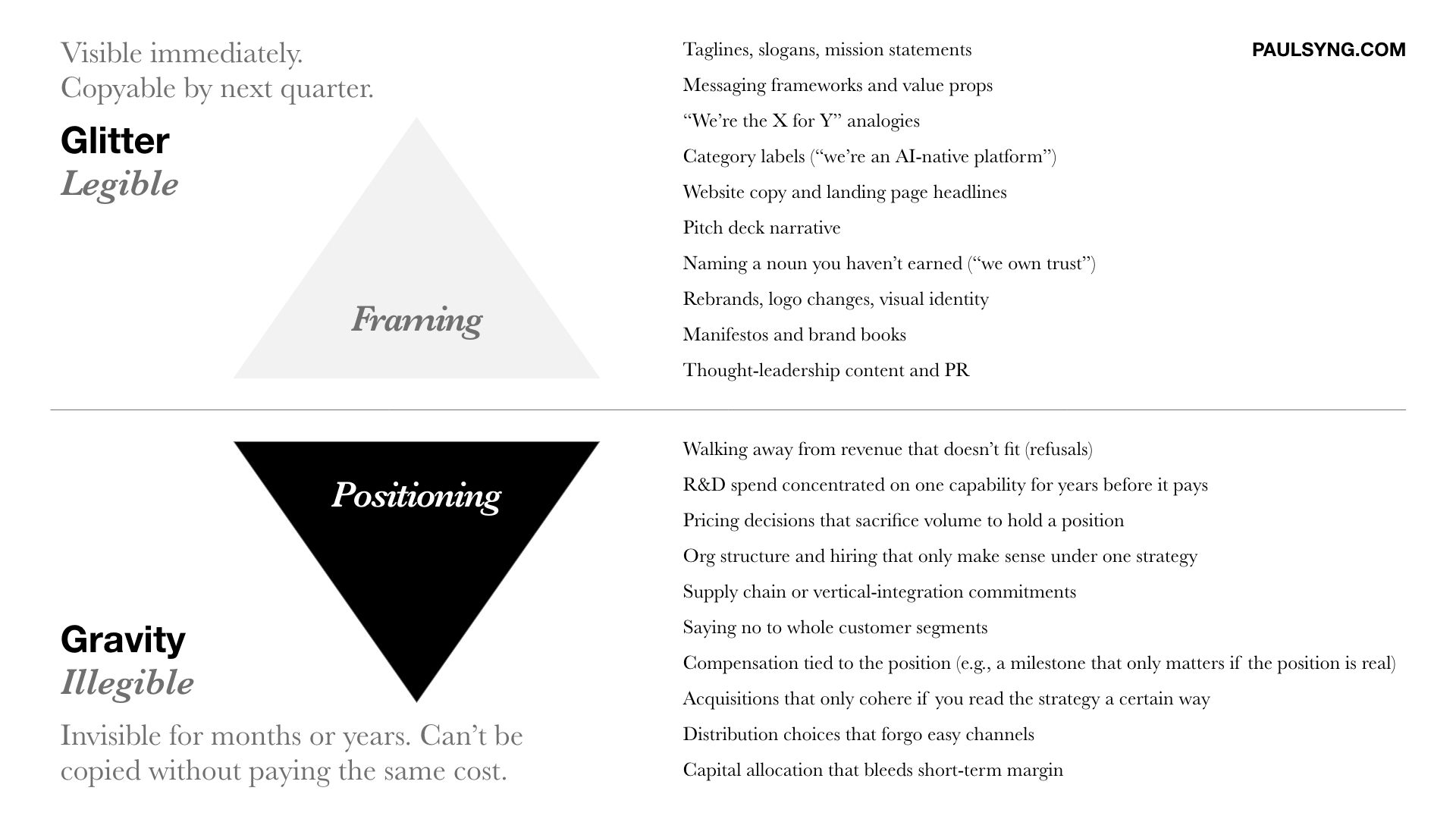
Walk the two journeys from the buyer’s chair.
The first email.
Copywriting lane: The pitch opens on your website. Your headline is vague, your category is buried, your differentiator is three clicks deep. The evidence attached is screenshots of your own words.
Positioning lane: The pitch opens on your business. The gap between what you sell and what the market files you under. The pattern in your win rates, your pricing, your public numbers. The evidence attached is behaviour, yours and your buyers’.
Sign: check what the first email quotes back to you. Your words, or your economics. What a vendor leads with is the altitude they work at.
Who signs the check, and from which budget line.
Copywriting lane: The engagement is scoped, approved, and paid for from the marketing or brand budget. Someone from marketing or brand is in the room by default. That person has a budget to spend for the year and a mandate to grow the pipeline. They have zero authority to refuse revenue. Nobody at that table can walk away from a customer segment, kill a product line, or exit a market. Not their seat. Not their mandate. Not their budget consequence.
Positioning lane: The engagement is scoped, approved, and paid for out of the CEO’s office. Sometimes routed through a Chief Strategy Officer or a board-approved strategy pool or an integration office during an M&A. The people paying are the ones with authority to refuse revenue and keep refusing it for years at a stretch. That is the definition of the seat. The price at this altitude is different, and the difference is not decoration. It clears for one reason: the buyer can act on what gets decided. Sell a refusal list to a CMO, and you have sold a PDF. Sell the same list to the seat that controls the P&L, and you have sold a change in the company. The seat is what the money buys.
Sign: pull the invoice and look at the cost center. If it hits the marketing budget, you are in the language lane no matter what the deck cover says. If it hits the CEO’s discretionary or a strategy pool that reports to the CEO or board, you are in the positioning lane. The budget line is the discipline. It is the single most honest signal in the entire engagement, because it names in advance who has the authority to change the company and who does not. The word can inflate an invoice. It cannot move a cost center.
The first call.
Copywriting lane: They ask what you do, who you sell to, what your customers say, what your competitors say, and what your homepage and sales material says. They will already be workshopping language on the call. It feels productive because words are moving.
Positioning lane: They ask what you refuse to sell, who you refuse to serve, what quarter you would take a revenue hit to own a noun, and whether your CFO is in the next conversation. It feels heavier because nothing is being written yet.
Sign: if the first call feels like a workshop, you are in the language lane. If it feels like an interview about your appetite for sacrifice, you are in the positioning lane.
The SOW.
Copywriting lane: Discovery workshops. Customer interviews. Competitive audit. A positioning statement. A messaging matrix. Writing a fill-in-the-blank sentence. A homepage and sales deck brief. Usually runs a week or two. Client pays in the low six figures. The deliverables are countable in words.
Positioning lane: A capital allocation review. A hiring criteria rewrite. A customer segmentation decision. An investment or acquisition decision. A pricing rebuild. A refusal list. Language is usually not even involved, or the very last line item, not the first. The deliverables are countable in dollars moved.
Sign: if the SOW deliverables are documents, you are buying documents. If the deliverables are decisions, you are buying decisions.
Who is in the room.
Copywriting lane: The CMO. A VP of Marketing. A brand lead. Maybe a PMM. The CEO drops in for kickoff and readout. The people in the room cannot commit the P&L. That is fine, because nothing in the room requires the P&L to move.
Positioning lane: The CEO. The CFO. The head of product. Sometimes the board chair. If the CMO is present, they are a witness, not a signatory. When I run them, CMOs are not invited. The people who can refuse a customer are the ones being asked to refuse one.
Sign: check the calendar invite. Seniority and who is not in the room determine the altitude of the work.
The questions being asked.
Copywriting lane: What is our category? What do our customers call us? How do we differentiate? What is the sharpest way to say what we do. Which words test best. Where does the story sit on the homepage? Legibility questions.
Positioning lane: Which customers are we walking away from next quarter? Which product line do we kill? Which capability do we concentrate until a competitor cannot afford to match it. Which price point do we hold when the sales team pushes back? Which market do we refuse to enter even though our investors want us to? Refusal questions.
Sign: if the room is deciding how to describe the company, you are in the language lane. If the room is deciding how to change the company, you are in the positioning lane.
The moment of decision.
Copywriting lane: The decision is which words to put on the page. It happens in the room. It is reversible. It costs nothing to unmake.
Positioning lane: The decision is which customer to refuse, which hire to cancel, which product line to sunset, which market to leave. It happens in the room. It is expensive to unmake. Somebody in the room has to swallow hard before they say yes.
Sign: if the hardest moment of the engagement is a wordsmithing debate, you are in the language lane. If the hardest moment is a CFO going quiet, you are in the positioning lane.
What leaves the room.
Copywriting lane: A marketing deck. Fifteen to thirty slides. Headline. Value props. Category claim. Differentiators. Elevator pitch. Messaging pillars. Homepage wireframe. Sales talk track. Objection handling. Audience personas. Your positioning statement. The deck is a set of words for the marketing team to execute against on Monday.
Positioning lane: An operating model deck. A different document at a different altitude. Capital allocation table. Customer segments retained and exited with dollar values. Product portfolio decisions with sunset dates. Pricing changes with margin impact modelled. Hiring plan with roles opened and cancelled. Refusal list with named accounts and market segments. Language appears on the last two slides, describing what the earlier 40 slides just committed to.
Sign: open the deck and count the slides that contain a dollar figure, a headcount change, or a named customer being exited. Zero means marketing deck. More than a handful means operating model deck. They are not comparable documents. They are not sold to the same buyer. They should not carry the same word.
Where the work goes next.
Copywriting lane: Marketing owns it. Sales gets a new pitch script. The homepage gets rebuilt. The rest of the company keeps operating exactly as it did before the engagement started.
Positioning lane: Finance rebuilds the model. HR rewrites job specs and cancels open reqs that no longer fit. Product retires features. Sales retrains around the refusals and updates qualifying criteria. Legal reviews contracts for the customer segments being exited. The engagement leaves the boardroom and rewires the company.
Sign: count how many departments changed something after the deck landed. If the answer is one, the deck was a marketing deck.
Next quarter.
Copywriting lane: A new tagline is live. The homepage reads sharper. Sales has a new pitch, and better words can move deals faster through the same funnel. What does not move is the shape of the business. The mix is the same. The margins are the same. No segment was exited, and no price was held against pushback, because nothing in the engagement had the authority to do either. Better words sell the same company faster. They do not make it a different company. The CMO tells the board the messaging is landing.
Positioning lane: Pipeline is smaller and pays more per deal. Customer segments have been exited. Product features have been retired. Hiring criteria have shifted. Roles have been cut and new ones created. The CFO tells the board the mix has changed.
Sign: pull the P&L for the next three quarters and look at the shape. Mix, margins, exits. If the shape is the same, the deck was a marketing deck.
Next year.
Copywriting lane: The CMO is replaced. A new consultant is hired to update the messaging. The cycle restarts because the operating model never changed and the language stopped matching whatever the company drifted into. Look at the business model inside that cycle. The customer’s drift is the vendor’s next engagement. Nobody selling language work has to be cynical for the cycle to repeat. The renewal is built into the product.
Positioning lane: A competitor tries to copy the words but cannot replicate the underlying operating model. The noun is starting to stick in the market. Buyers describe it back to sales without prompting.
Sign: if the language needs updating every twelve months, the operating model was never touched. You are updating a costume.
Why the two charts diverge.
The mechanism under the whole walk-through fits in one paragraph. A position lives in the buyer’s head. Both lanes agree on that much, and it has never been the dispute. The dispute is over who gets to write on it and how permanently. Anything a copywriter can install in the market’s mind, a competitor’s copywriter can write over by Thursday for the price of a retainer. A position installed through refusals sets a different price on imitation. The competitor has to make the same refusals, and their P&L gets a vote. They have quarterly reasons to decline, and they usually do. A copied tagline is a Tuesday. A copied operating model is a board fight.
Five years later.
Copywriting lane: Four language cycles deep. Nobody remembers what the noun was supposed to be. The company has drifted into whatever its sales team could sell that quarter. Or whatever the new CMO thinks is ‘relevant’ and ‘in’ right now.
Positioning lane: The company owns a noun in the market. Buyers use its words back to it. Competitors either specialized somewhere else or bled out trying to match. The P&L looks nothing like the one from five years ago, and everyone in the room can tell you exactly why.
Sign: five years is the only honest test. Anyone can look positioned at ninety days.
What the client says at the board meeting.
Copywriting lane: “We just wrapped our positioning work.” Meaning: we changed the words.
Positioning lane: “We just wrapped our positioning work.” Meaning: we changed the company, and the words followed.
Same sentence. Two different companies. Two different price points. Two different disciplines. Only one of them will still be recognizable in five years, because only one of them changed anything you could sell, hire, refuse, or defend.
The two lanes are one sequence.
Decisions first, words after. A company that has made its refusals, exited its segments, held its price, and concentrated its capability has earned the language layer, and at that point the language layer is craft. Buy it, pay the market rate, and expect it to be excellent. The same work sold before the decisions exist, or in place of them, is the purchase this whole piece has been describing. The product is real. The sequence is the con.
Price them like what they are.
Language work is execution. Price it the way you price production craft: against the marketing budget it hits, by the deliverable. Decision work moves capital. Price it the way you price anything that changes a P&L: against the dollars it reallocates, by the consequence. A vendor quoting deliverable work at consequence prices is the arbitrage from the top of this piece, caught at the proposal stage instead of a year later.
Why this gets ugly when you say it out loud.
Name this distinction in public and watch what comes back. It is rarely a counter-argument. The goalposts move instead, and the moves follow a pattern. The definition of positioning shrinks to the size of the speaker’s invoice. A new job title gets coined mid-thread. A moral shield goes up, defending the honesty of the work when the claim was about its altitude. A trade association forms in the replies. A word used ten posts earlier gets retroactively redefined. A third category appears that cannot be tested, priced, or delivered. And when the argument keeps losing on merit, the tools that helped assemble it get attacked instead. The moves are predictable because the ceiling of a practice is the ceiling of an identity, and identities defend themselves.
The standard cuts both ways, so here is what would kill my claim. The distinction dies the day someone shows me an engagement that was words alone, where no customer was exited, no market was left, no product was sunset, no open req was cancelled, no price was held against pushback, and the company’s revenue mix and margin structure changed anyway inside four quarters. I have been looking for that engagement for 15 years. The search stays open.
Look at your own current engagement.
Read the SOW. Check the calendar invite. Open the deck. If the slides are made of words about the company, you are in the language lane. That is useful work at the right point in the sequence. Pay for it as execution. Do not price it as positioning.
If the slides are made of decisions about the company, if the CFO is a co-author and not an audience member, if departments other than marketing are changing what they do because of what the deck says, you are in the positioning lane. That is the discipline. It is not the same craft. It does not cost the same money.
Both lanes end with something called a deck. Only one of them changes what happens after the deck lands on the table.
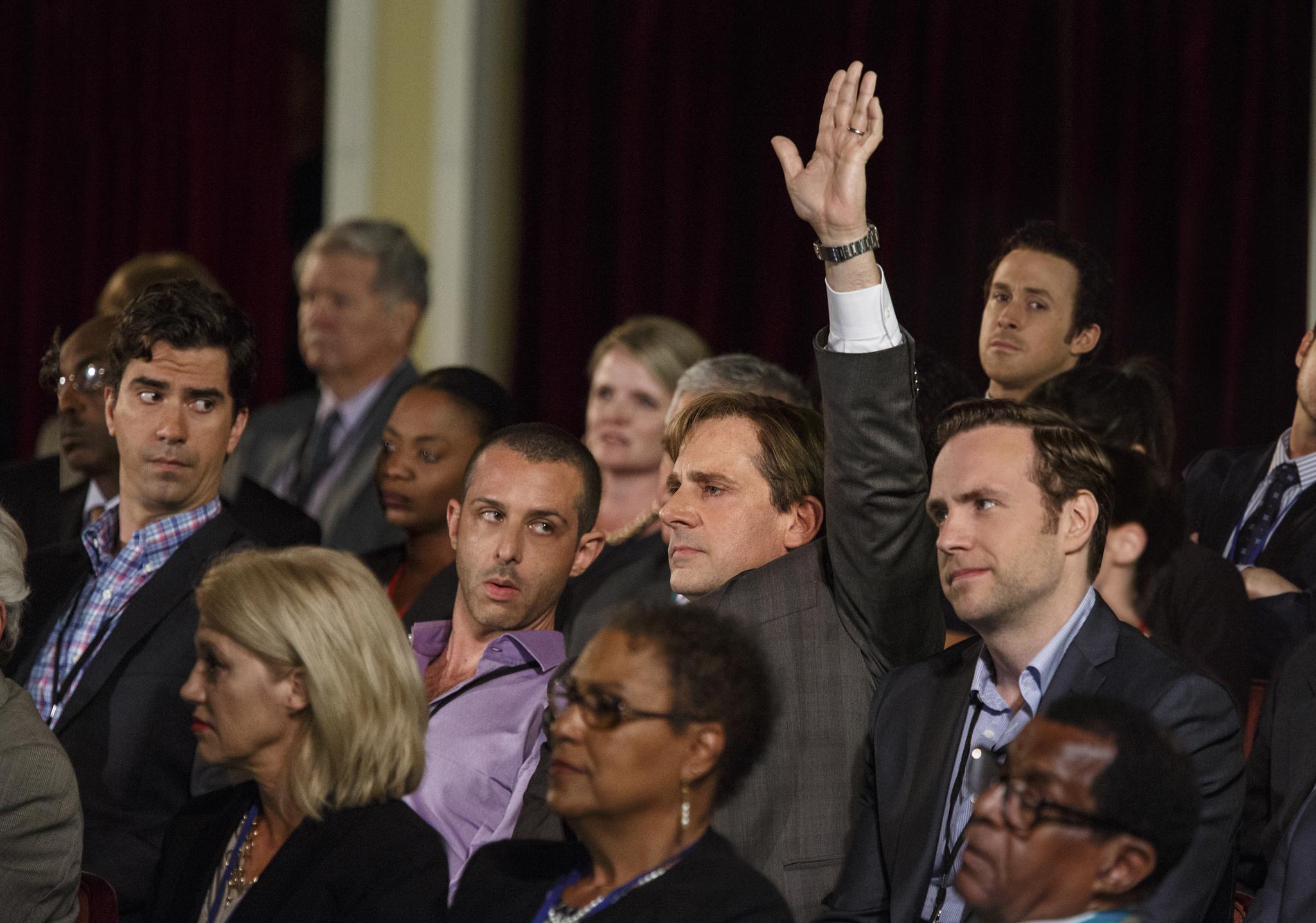
PS: Mark Baum is in the audience as a panel of ratings executives calmly and credibly explains that the mortgage market is fine. The room is warm. The suits are expensive. Everyone is nodding. Baum stops nodding. His face goes still. He is not angry. He is counting. He has just realized the entire room is selling each other a product they know is a costume, and that the composure of the panel is not evidence of anything except the fee structure that pays for it. That stillness is the mood of this essay. A founder reading this piece is the person sitting next to Baum, watching his face change, and beginning to do the arithmetic themselves. The panel is the positioning-consultant ecosystem, warm and credentialed and professional. The invoice already hit marketing. The CFO was never in the meeting. Nothing in the company changed. And somewhere between the third paragraph and the fifth, the reader’s face goes still the same way Baum’s does, because the math has started to resolve and the room they are sitting in is not built to answer the question they are about to ask.

Leave a Reply
You must be logged in to post a comment.