

The Positioning Delusion — On the Difference Between One Position and Two Disciplines
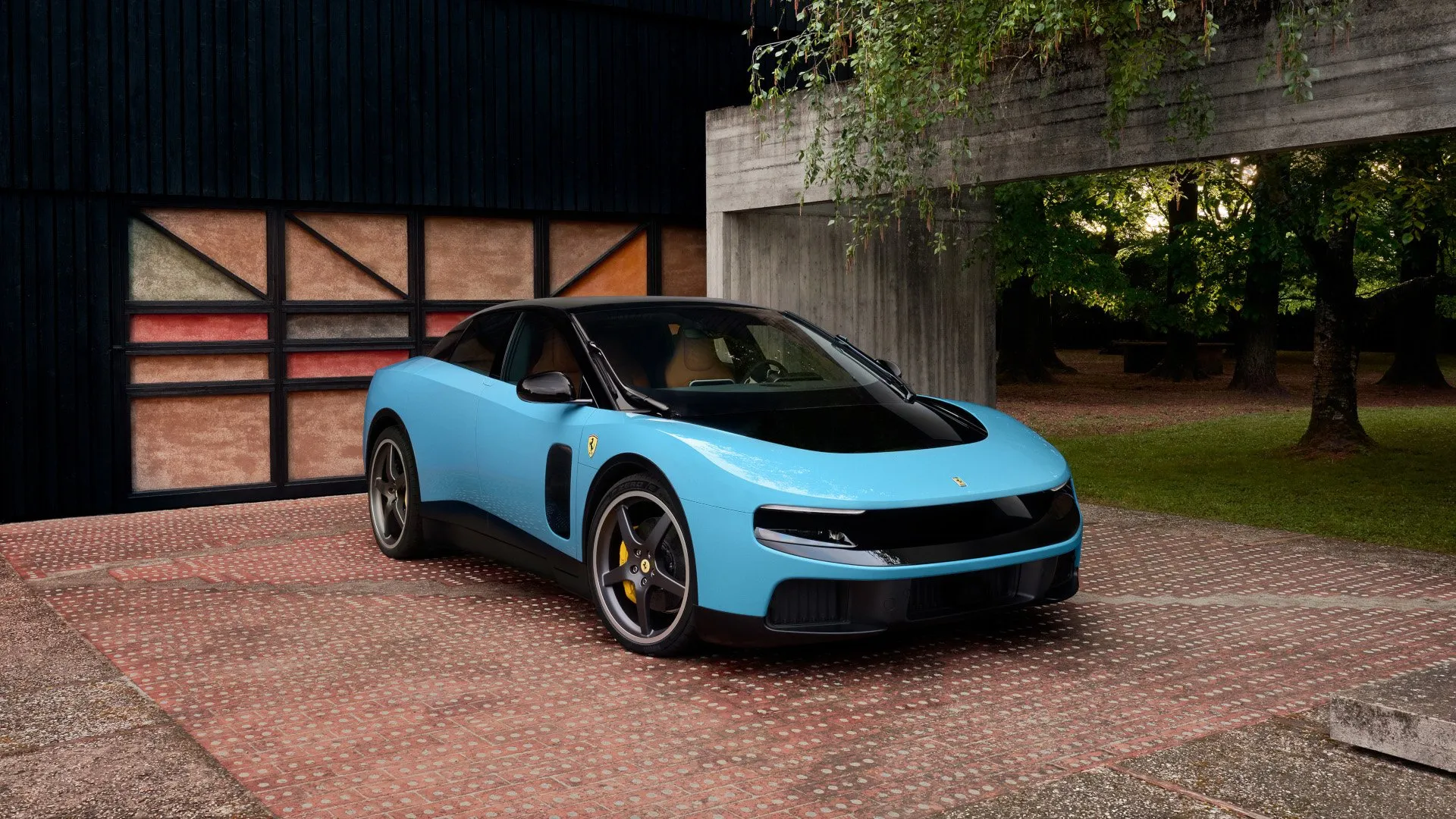
The question making the rounds this week is whether the Ferrari Luce is really a Ferrari. It is the wrong question, and the speed with which everyone reached for it is the symptom worth studying.
The popular answer, the one earning the most agreement, is that a brand is not its badge. It is what people expect of you, and Ferrari spent a hundred years teaching people to expect a loud, scarce, combustion dream, so a silent four-door with an interior co-designed by the man who shaped the iPhone breaks the expectation and the crowd revolts. That is true. It is also the easy half. It names the feeling and stops. The feeling is the result. The cause is everything Ferrari refused to do for a century to produce that feeling, and that is where the analysis has to go.
I have been reading this from the outside. Jaguar since the rebrand in November 2024, Ferrari since the Luce reveal in Rome on the 25th of May, 2026. Owner forums, dealer commentary, the resale market, the public record of board changes, agency briefs, and earnings calls. No inside access. No NDA. The pattern that emerges is not about electrification or generational handoff or design taste. It is about a word the entire profession uses without noticing what the word permits.
There is no such thing as product positioning. There is no such thing as brand positioning. There is positioning, the single position a company occupies in the customer’s mind, and there is everything else, which is messaging dressed up to look like strategy.
That is the whole argument. The cases exist to show what happens when an organization stops believing it.
I. The Position Is One Thing
In 1969, Al Ries and Jack Trout wrote that positioning is not what you do to a product. It is what you do to the mind of the prospect. They did not mean it as a creative principle. They meant it as a definition that excludes everything else.
A mind holds one position per brand. Sometimes none. Never two. The mind is a parking garage with very few slots, most of them already taken, and the customer is not going to valet a second car for you. Say Volvo and the position says safety. Say FedEx and the position says overnight. Say Patek Philippe and the position says you never actually own one; you are looking after it for the next generation. The position is the unit, and the customer’s brain assigns it, not the marketing department.
The obvious objection is the multi-brand house. Procter and Gamble runs Tide, Gain, and Cheer in the same category without confusion. LVMH runs more than seventy brands across categories the customer would otherwise blur. The objection answers itself. Those companies win precisely because they refuse to let any two brands share one position. Tide owns clean. Gain owns scent. Cheer owns color-safe. Three positions, three brands, none of them negotiated. One position per brand, each defended separately, is the discipline. What no brand survives is being asked to hold two positions at once.
The industry’s vocabulary refuses this. Open any current article on the subject and brand positioning is treated as a separate discipline from product positioning, owned by a separate function, producing a separate deliverable, often by a separate agency. The Product Marketing Alliance publishes a guide that splits brand, product, and market positioning into three specialties. Most software companies I have looked at run from two parallel documents that quietly disagree with each other.
Here is what the split does. If positioning is one thing, one person is accountable for it. If positioning is two things, the accountability fractures, and the single position, the only thing the customer’s mind actually holds, becomes a thing the building manages rather than protects. Sometimes that means nobody defends it. More often, and this is the worst case, the position stops being treated as the asset and starts being treated as a deliverable, something a competent team is hired to refresh on a normal review cycle, like a homepage or a deck.
A position is not a deliverable. It is what decades of refusals have made undeniable. The moment it goes on a roadmap as a thing to refresh, it is already gone.
II. Ferrari, or the Decision a Filter Would Have Stopped
Before the Luce, Ferrari’s position said something so plain it embarrassed marketers: combustion as theatre, scarcity as discipline, the noise of twelve cylinders firing in sequence as the proof of life. Every Ferrari since 1947 reinforced the same sentence. Enzo refused to let dealers buy more cars than he chose to allocate. In February 2016, on a Ferrari earnings call, when analysts pressed Sergio Marchionne on building an SUV to chase Porsche money, he said, on the record, “You have to shoot me first.” The waiting list was the proof. The noise was the proof. The refusals were the proof.
A position is not what a company says.
It is what decades of refusals have made undeniable.
On the 25th of May, 2026, Ferrari presented the Luce in Rome. Four doors. Five seats. Silent. Around €550,000, roughly $640,000. The interior co-designed over five years by Jony Ive and Marc Newson at LoveFrom, working with Ferrari design chief Flavio Manzoni, which is to say the design grammar of another category’s icon, imported whole. Ferrari framed the car as an addition to the range rather than a turn away from combustion, the kind of framing a company reaches for when it needs to reassure the existing client and the public market in the same breath. Shares fell as much as 8 percent on the Milan exchange the next day, settling closer to 6.
Then the former chairman spoke. Luca di Montezemolo, who ran Ferrari from 1991 to 2014, told Italian television that if he said what he truly thought, he would harm Ferrari, that the company risked “the destruction of a myth,” and that he hoped they would at least remove the Prancing Horse from that car. Discount him if you want; he joined McLaren’s board last year, and McLaren builds the cars Ferrari races against. So set him aside. Italy’s transport minister said a version of the same thing. Carlo Calenda, an opposition lawmaker who worked at Ferrari for five years, called it an insult to the people who love the brand. The owners said it on the forums. The market said it in the share price. The reading does not rest on one compromised voice. It rests on the chorus.
And this is the part the popular take never reaches. The Luce is not the absence of a decision. It is a decision, authored at the top, five years in the making, defended in public. Benedetto Vigna can state the old position in one sentence. He has the authority to override any function in the building. He used that authority to approve the car anyway. The bifurcated vocabulary did not leave Ferrari’s position unowned. It gave the owner a frame in which the position was one input among several, to be balanced against growth and the public market and the next generation, rather than the filter that overrides all three.
Trace it back and the path is clean: the 2015 listing on the New York Stock Exchange, which put a quarterly cadence on a company whose previous cadence was the racing season; the revenue targets that listing demanded, which cannot be met selling a few thousand combustion sports cars to purists; the 2022 Purosangue, the first four-door, sold on the logic that Ferrari needed to address what every rival had already addressed. Each decision was defensible on its own terms. Once the position is an input to be balanced rather than the constraint that wins, the violation is a management decision, not an accident.
Now grant the other side, because it is real and most of the people writing about the Luce are ignoring it. Ferrari is taking orders. Roughly sixteen hundred clients attended the Rome launch, buyers wired deposits within days, the order book reportedly filled past the start of deliveries, and the new interest includes wealthy buyers who never owned a Ferrari. The stock clawed part of the drop back inside the week. The Purosangue drew the identical “Enzo would turn in his grave” reaction and then sold out. The people protesting on the internet and the people writing the cheques are not the same people. Anyone declaring that the Luce killed Ferrari will look foolish by the next earnings call.
But the order book proves demand for the object. It does not prove the myth survived. The myth is the thing that lets Ferrari sell roughly fourteen thousand cars a year at supercar margins and carry a market value around $70 billion on that volume. If the badge slowly comes to mean expensive luxury electric grand tourer, the kind the Germans and the Chinese will build too, instead of combustion theatre you cannot buy on demand, the cost does not show up in Luce orders. It shows up years later, in the pricing power of every car that wears the badge. That is the bet. It may even be the right one. But it is a bet placed against the accumulated asset, by people who held a vocabulary that told them it was a strategy.
The tell came afterward. Vigna answered the backlash by saying that true innovation does not look for immediate consensus. That is the sentence of a leadership that has read a position violation as the market failing to appreciate its vision. It is the most expensive misreading in the discourse.
III. Jaguar, or the Brief Written Against a Persona
Jaguar’s position, before Tata, before Ford, before British Leyland, said grace, pace, and an aristocratic refusal of vulgarity. The leaping cat survived four ownership changes and seventy years of identity drift. In November 2024, an internal exercise killed it.
The “Copy Nothing” campaign, built by Accenture Song, launched without a car. Figures in saturated color walking through a studio. A minimalist wordmark. No leaping cat. The Type 00 concept followed weeks later in Miami, the production cars pushed toward 2026 and first deliveries to 2027. By April 2025, Jaguar’s European sales had fallen to 49 units, against 1,961 in the same month a year earlier, a 97.5 percent drop by the European manufacturers’ own data. Globally the brand sold under 27,000 cars for the year, down roughly 85 percent from its 2018 peak.
The defenders have a real point, and it deserves the strong version. Jaguar’s lineup was discontinued; a sales hole was coming no matter what. The target was deliberately not the existing Jaguar owner; it was a new buyer at $100,000 and up who had never considered the brand. Consumer research showed brand meaningfulness rising among younger affluent buyers even as familiarity fell among the traditional base. Rolls-Royce and Bentley were edging toward an electric luxury future too, the argument went, just less loudly.
The argument is internally coherent. It is also the argument of a brief written against a persona document rather than against an accumulated position. That is the failure point.
If your brief begins with “wealthy buyers who have not considered Jaguar,” you have already conceded that the existing position is not the asset. You have chosen to compete for a position the brand does not own, against rivals who do own it, with the budget that should have been protecting the position the brand did own. The leaping cat survived British Leyland because British Leyland’s failure was operational, not interpretive. It did not survive a brand exercise, because a brand exercise is interpretive by design. It exists to reinterpret the asset. Once the asset is reinterpreted, the only thing left to protect is the reinterpretation, and a reinterpretation is a tagline, not a position.
The 97.5 percent is not the headline.
The dealer reality is.
Jaguar cut its United Kingdom network to around twenty stores by design, part of a move toward boutique brand stores, and then left even those with nothing to sell while the new cars sat a year or more away. A position is what the dealer says about you when the website goes dark and the showroom floor is empty. The people closest to the customer were handed a brief they could not convert and a floor with no car on it. They had not lost faith in electric. They had lost the sentence that explained what they were selling.
The receipt arrived in stages, and the staging is the point.
In the first week of December 2025, less than a month after P.B. Balaji, the former Tata Motors group finance chief, took over from the retiring Adrian Mardell on the seventeenth of November, reports broke that Gerry McGovern, the design chief responsible for the rebrand and twenty-one years at JLR, had been escorted out of the building. JLR denied it, on the record, with the precise sentence “it is untrue we have terminated Gerry McGovern’s employment,” and refused to confirm whether he still worked there. Four months later, on the twentieth of March 2026, JLR confirmed McGovern would leave by month’s end to start his own consultancy, with cordial statements on both sides. He had remained on payroll the entire time. Like Ferrari, this was never a vacuum. The managing director defended the campaign as a complete reset and dismissed the backlash as a blaze of intolerance. The denial-then-confirmation is its own kind of receipt. People with authority looked at seventy years of accumulated meaning and decided the liability to manage was not the violation but the story about the violation. The vocabulary told them that was a strategy.
One difference separates Jaguar from Ferrari, and it is the difference between a verdict and an open question. Ferrari’s order book is filling. Jaguar’s was forty-nine cars. The bet looks the same from inside the boardroom. It does not land the same when there is no product on the floor and the position you abandoned belonged to someone who could still sell it back to you.
IV. The Pattern Is Not About Cars
The distinction is not carried by two automotive examples. It is carried by what happens in every category once the split is permitted, and the failure shows up in three modes that are worth naming.
Tropicana, 2009, is the first mode. Peter Arnell’s agency replaced the carton, the orange with the straw in it, with a generic minimalist redesign. Sales fell about 20 percent inside two months. The carton was back within weeks. The part the case studies skip is the mechanism. Arnell did not violate the position for lack of taste. The agency was hired for a brand refresh, a separate exercise from product positioning, with separate ownership and a separate review cycle. The position, fresh orange juice with a straw in it, was nobody’s deliverable. So nobody defended it. The position went unowned.
Bud Light, 2023, is the second mode, and the cleanest case in the modern record, because the marketer said it out loud. On the Make Yourself at Home podcast, Alissa Heinerscheid, then vice president of marketing, called the brand’s accumulated equity “fratty” and “out of touch,” a “hangover,” and said she had a “super clear mandate” to “evolve and elevate this incredibly iconic brand.” The Mulvaney partnership followed. The brand lost its position as America’s best-selling beer to Modelo by midyear, and the parent company shed roughly $20 billion in market value at the lows. The partnership is not the mechanism. The word “hangover” is. The phrase “evolve and elevate” is. Calling something iconic and a hangover in the same breath is the exact moment the position stops being the asset and becomes a deliverable to fix. The position was deliberately discarded, in plain terms, by the person with the authority to do so.
JCPenney, 2012, is the third mode, and it rhymes with Ferrari more than anyone noticed. Ron Johnson arrived from Apple, where he had built the Apple Stores, and launched “Fair and Square,” ending the coupons and constant sales that were the entire reason a JCPenney shopper walked in. Comparable sales fell about 19 percent in the first quarter and roughly 25 percent across the year, more than four billion dollars of revenue gone. He was fired in about seventeen months. Johnson mapped the Apple Store onto a coupon-driven department store. Ferrari mapped Apple’s designers onto a combustion myth. It is the same error in two industries: importing the grammar of a category you admire onto a position you already own, and discovering that the position does not travel. The position was overruled by an imported model.
WeightWatchers, 2018, is the purest version of all. The company renamed itself WW and dropped the word “weight,” the single noun it owned in the customer’s mind. The stock fell by about a third in a day and most of its value inside a few months. Drop the noun and you drop the position. There is no shorter way to say it.
Cracker Barrel, 2025, is the case that proves the position is the asset, because the company caught itself. In August, it stripped the man-and-barrel figure from its logo and modernized its interiors. The stock fell, the backlash was immediate, and the company reversed within a week. The walkback rescued the position. The market had priced the violation in days, which only happens when the thing being violated is the asset.
Boeing is the case that closes the argument, and it is the inside-out version of the same disease. In 1997, Boeing acquired McDonnell Douglas in a deal the business scholar Jim Collins, whose book Built to Last had used Boeing as a case study of sustained greatness, warned at the time was a reverse takeover of culture. Boeing’s position, accumulated since 1916, said if it ain’t Boeing, I ain’t going. McDonnell Douglas was a financial-discipline company, and its executives ran the merged entity. Headquarters moved from Seattle to Chicago in 2001 for $60 million in tax credits over two decades. Harry Stonecipher, the former McDonnell Douglas chief now running Boeing, said it on the record: when people say he changed the culture of Boeing, that was the intent, so the company would be run like a business rather than a great engineering firm. The 737 MAX, the MCAS software, the door plug that tore off the side of an Alaska Airlines jet, and 346 people dead across two crashes, all of it traces to the moment Boeing decided that engineering excellence and financial performance were two disciplines to balance rather than one identity to protect. By Harvard Business School’s own accounting, the choices made in the name of shareholder value have cost investors $87 billion since 2018.
Boeing did not keep two positioning documents. It kept two altitudes of the same split. The position lives in the customer’s mind; the filter that protects it lives in where the money actually goes. Boeing pointed the money at buybacks, and the position followed it down.
V. The Distinction the Industry Refuses
I have read enough of the field’s output to grant the charitable read. The case for separating brand positioning from product positioning is that a multi-product company needs to position individual products without re-litigating the corporate identity every quarter. A tactical statement for a Q3 launch should not require a board offsite. Product marketers and brand marketers carry different skills and different review cycles, and the split is administrative, not strategic.
The administrative argument is true and beside the point. Of course, an organization keeps documents at different altitudes. The question is whether they are subordinate to one accumulated position that overrides them when they conflict, or whether they are parallel disciplines that negotiate.
If the position is the operating filter, the brand document and the product document cannot disagree. They are the same constraint written for two audiences. If the position is not the filter, the documents will disagree, and the larger, better-resourced function will win. In a software company that is usually product marketing, because product marketing holds the cleaner delivery cycle. In consumer packaged goods, it is usually the brand team, because the brand team holds the agency relationship. In a public automaker, it is whichever function is most legible to the market that quarter. The winner of the negotiation chooses the violation.
There is a counter I have to grant, because it is real and it is the strongest objection to everything above. Some position changes work. Netflix abandoned the position it owned, mailing DVDs in red envelopes, and built a far bigger one in streaming. The difference is the direction of the move. Escaping a position that is dying, into one you can actually own, is survival. Spending the equity of a living position to rent a contested one you do not own, against incumbents who already own it, is the mistake in this essay. Netflix was escaping a dying position. Jaguar walked away from a living one to compete for a position Bentley already holds. Ferrari was the most profitable carmaker per unit on earth. The test is whether the old position was dying and the new one is yours to take.
So the distinction is not a system. It is a test. One filter, or two disciplines. A filter treats the accumulated position as the asset and overrides anything that contradicts it. Two disciplines treat the position as a deliverable and let the better-funded team refresh it on schedule. Every case in this essay is the second thing.
VI. The Filter, Not the Tagline
The mistake the field makes after reading an essay like this is to ask what tagline Ferrari should adopt, what Jaguar should have kept, what belongs on the Bud Light can. That is the wrong question, and it is the symptom of the split itself.
A position is not a tagline. It is the operating filter that decides what the company will and will not do. Volvo’s filter is not the word safety on the website. It is the engineering meeting where a feature dies because it adds a tenth of a second to the crash response. Patek’s filter is not the line about the next generation. It is the refusal to enter the smartwatch category. Costco’s filter is not a slogan. It is the refusal to raise the price of the food-court hot dog above $1.50 since 1985. When a Costco executive told the founder, Jim Sinegal, that they were losing money on the hot dog, Sinegal told him to figure it out. They did not figure it out with a price change or a brand campaign. They stopped buying from their supplier, built their own hot dog plants, and protected the price by remaking the supply chain. That is what a filter does. It forces operational excellence where a deliverable would have reached for a marketing fix.
The external expression of a position is mostly silent. It shows up in what the company ships and in what it refuses.
The exception is when the proof predates the claim by years. Volvo can say safety out loud because sixty years of crash engineering said it first. Most companies do not have that proof, which is why their stated positioning reads as a claim rather than a description, and customers can feel the difference between the two without being able to name it.
The filter is the asset. The tagline is the receipt.
VII. The Diagnostic
Here is the test, and it runs on one person. Find the most senior individual in your company who can state, in a single sentence, the position the customer’s mind already holds. If that person exists, ask the second question: do they treat that position as the asset to protect, or as a deliverable to evolve? Ferrari had a chief executive who could state the position and chose to evolve it anyway. Stating it is not enough. Then ask the third question: do they have the authority to override any function that arrives with a contradicting document?
State it. Treat it as the asset. Hold the authority to defend it. Three things, in one person. If they are present, the company is positioned, whatever the brand book and the product marketing wiki say. If any one is missing, the company is not positioned. It has positioning documents. Those are different things.
The test runs once. It needs no workshop, no canvas, no consultant, no deck. The answer is in the room, or it is not.
The companies here had the answer once. They lost it the moment they accepted that positioning was a portfolio of disciplines rather than a single accumulated position. The cost shows up in share prices, in shuttered showrooms, in sales charts that fall to double digits. At Boeing it showed up in a count of the dead. That is the version of this argument that should end the debate about whether positioning is a marketing function or a question of organizational identity.
So the real question was never whether the Luce is a Ferrari.
It is whether anyone in the room in Maranello could state the position that car had to honour, treat that position as the asset, and hold the authority to stop a decision that violated it. Find that person in your own company. Confirm all three. Or schedule the post-mortem now, and save the customer the trip.
Leave a Reply
You must be logged in to post a comment.