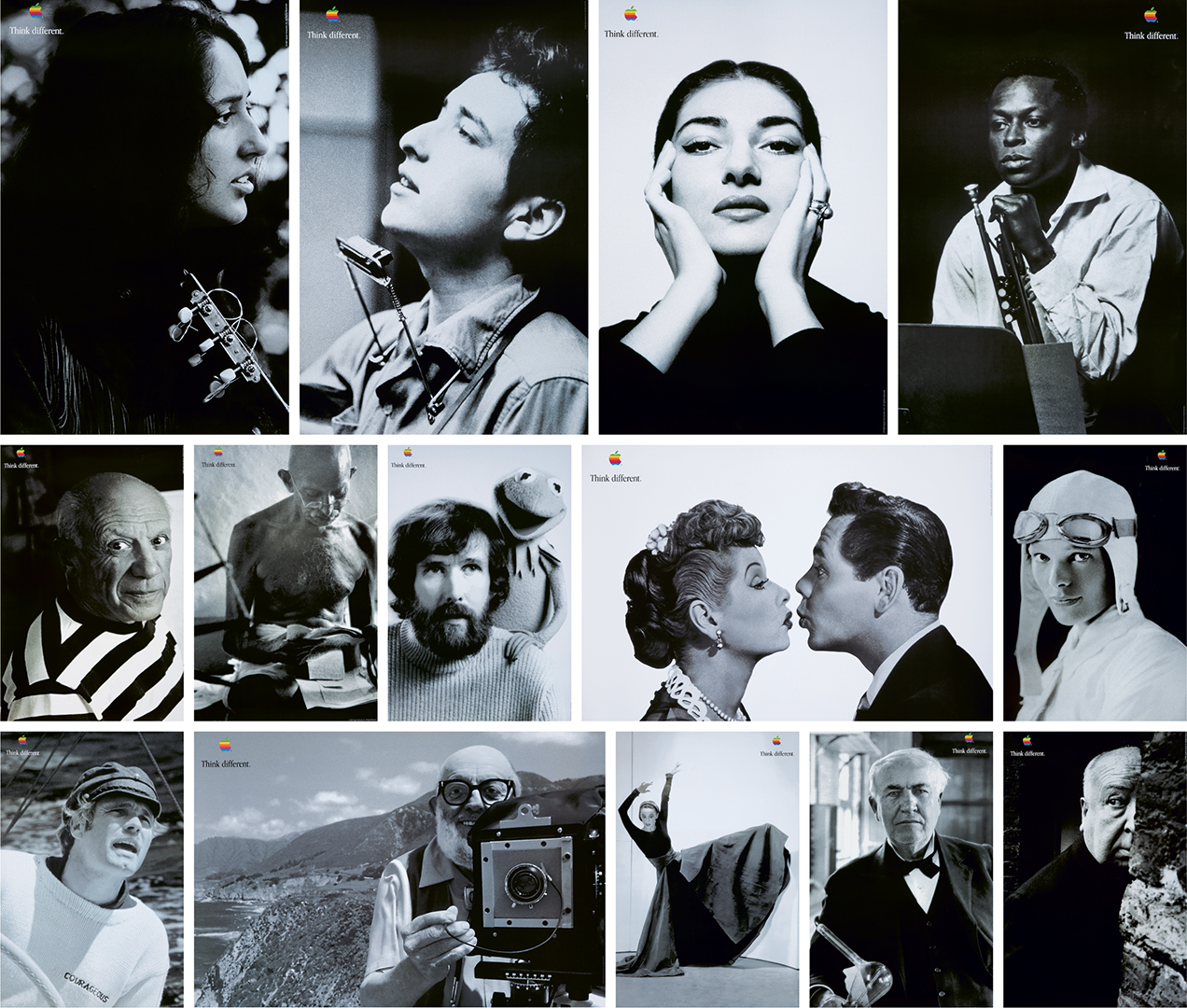

Think Different. Just Do It. Red Bull Gives You Wings.
Read them again. Notice what they’re about. Not one of these taglines describes a product. Apple doesn’t mention computers. Nike doesn’t mention shoes. Red Bull names itself but says nothing about energy drinks. Every one of them is about you. What you think. What you do. What you become.
I’m the kind of person who thinks differently. I’m the kind of person who just does it. I’m the kind of person who has wings. This isn’t clever copywriting. It’s the output of a very specific causal chain that almost everyone gets backwards.
The backwards version
Here’s how most people think positioning works. You sit in a room. You figure out what you do. You describe it well. You put those words on your website, your LinkedIn, your pitch deck. And then buyers read those words and choose you.
Packaging. That’s what this is. Choosing the right words to describe yourself.
There’s a slightly more sophisticated version, one I’ve written about before. Instead of packaging yourself, you package the problem. Frame the buyer’s pain in a way that makes your solution obvious. Connect the problem to a metric. Get invited to bigger budgets.
That version is better. It moves the emphasis from you to the buyer’s world. But it still starts from inside your head. You’re still the one deciding which words to use, which frame to apply, which metric to connect to. The arrow of causation still points outward, from you to them.
Both versions share the same foundational error. They assume you start with language and work toward perception. The actual direction of travel is the opposite.
What Apple actually did
Apple didn’t brainstorm “Think Different” in a vacuum and then hope it would land. The identity already existed in the customer base. People who bought Apple products were already self-selecting as creative nonconformists. They were designers, musicians, filmmakers, writers, and educators who saw themselves as people who didn’t follow the herd.
Apple observed this. Not through surveys. Not through focus groups. Those instruments are nearly useless for this kind of work because people can’t accurately report their own identity-level motivations. They’ll tell you they bought the Mac because of the screen resolution, the operating system, or the build quality. These sound like reasons. They’re post hoc rationalizations of a decision that occurred before the conscious mind was involved.
What Apple did was look at behaviour. Who keeps buying? Who evangelizes without being asked? Who pays a premium and doesn’t flinch? Who gets genuinely angry when you suggest they switch?
The answers reveal a pattern. And the pattern points to an identity transformation that’s already underway: an ordinary person becomes a creative rebel.
“Think Different” is the expression of that transformation. Not the cause of it. The identity existed first. The tagline came last.
And this wasn’t instantaneous. Apple spent over a decade making decisions that proved creative nonconformity before those two words ever appeared. The Macintosh. The 1984 Super Bowl ad. The refusal to license the operating system. The obsessive design choices that made engineers furious and customers loyal. By the time “Think Different” appeared in 1997, the position was already structurally in place. The tagline didn’t create it. The tagline named it.
Why can’t people tell you why they buy
This is the part that trips up founders, marketers, and strategists who are otherwise smart. They ask their customers why they buy, get articulate-sounding answers, and build their entire strategy around those answers.
The problem is well-documented in cognitive science. Nisbett and Wilson published a paper in 1977 called “Telling More Than We Can Know” that showed people routinely fabricate explanations for their own behaviour. They generate plausible stories after the fact. The stories feel true. They’re often wrong.
Kahneman later formalized this as the distinction between System 1 and System 2 thinking. System 1 is fast, emotional, and automatic. System 2 is slow, analytical, and deliberate. Most purchase decisions, especially identity-level ones, happen in System 1. But when you ask someone to explain a System 1 decision, they recruit System 2 to construct an explanation. The explanation is logical, neat, and frequently disconnected from the actual driver.
Ask a Nike customer why they buy Nike. They’ll say comfort. Durability. Style. Maybe the technology in the sole. These are System 2 reconstructions.
Watch what they actually do. They wear the swoosh visibly. They post their runs. They tell people about their marathon training. They use phrases like “just gotta get after it” without realizing they’re echoing a tagline. They’re performing an identity. The identity of someone who overcomes, who pushes through, who doesn’t make excuses.
That identity is the actual purchase driver. But the customer can’t see it because it operates below conscious awareness. It’s procedural knowledge, not declarative knowledge. It functions like a script that runs automatically without the person ever inspecting the code.
The observer’s advantage
If the customer can’t accurately report their own motivation, then the customer is not the right source for your positioning language. Neither are you. You’re inside the jar. You can’t read your own label.
The work requires an external observer. Someone who watches behaviour without an agenda. Not how you want customers to behave. Not what the internal PowerPoint says about the target persona. Actual behaviour. In the real world. Over time.
What an observer sees: people returning repeatedly. People paying premiums. People evangelizing to friends. People getting emotional when the brand is criticized. People incorporating the brand into how they describe themselves.
From these behavioural signals, the observer can infer the underlying identity transformation. Not guess. Infer. Because the behaviour is evidence, and the transformation is the most parsimonious explanation for the pattern.
Volvo owners don’t talk about safety in their purchase justification most of the time. They talk about the seats, the Scandinavian design, and the reliability. But an observer notices they have kids. They researched crash test ratings for three months. They visited the dealership twice before buying. They chose the model with every safety feature available. They mention, almost in passing, that they “just feel better” driving it.
The identity transformation: anxious parent becomes protector.
Volvo never says, “We make you a better parent.” But everything they build proves it. In 1959, Volvo gave away the three-point seatbelt patent, sacrificing a valuable IP monopoly. That single decision proved safety more than any campaign ever could. And the position emerged from decades of decisions like that one, not from a branding workshop.
The noun and the expression
There’s a distinction between the noun and the expression that most people collapse into one thing.
The noun is the concept you own in someone’s mind. It’s not something you claim. It’s something that fires automatically when people think about the category.
Apple owns creativity. Nike owns athletic achievement. Volvo owns safety. Red Bull owns human performance.
None of these companies says the noun out loud. Apple never runs an ad that says “We own creativity.” Nike doesn’t say, “We are athletic achievement.” Saying it would destroy it. Explicit claims trigger what psychologists call the Persuasion Knowledge Model. The moment someone realizes you’re trying to position yourself, they activate defences. Skepticism. Resistance. Counter-arguing.
The expression is different. The expression is how the noun manifests in language without directly stating the concept. “Think Different” is the expression of creativity. “Just Do It” is the expression of athletic achievement. “Red Bull Gives You Wings” is the expression of human performance. None of them names the noun. They point at the identity transformation instead.
The expression works because it’s aimed at the customer’s identity, not at the brand’s credentials. It says who you become, not what we are. And it’s the last thing you create, not the first.
Why copying the output fails
Every few years, some brand team sees what Nike or Apple did and tries to replicate the output. They hire an agency. They spend months crafting an identity-based tagline. They launch a campaign.
It doesn’t work.
It doesn’t work because they copied the last step of a long process and skipped every step before it. It’s the equivalent of watching a fit person cross a finish line and concluding that the secret to fitness is crossing finish lines. The finish line is the output. The years of training are the input.
Nike had been signing athletes, designing for competition, and sponsoring events since the early 1970s. The concept of human performance already lived in the minds of the people who chose Nike. Wieden+Kennedy didn’t invent the position in 1988 when they wrote “Just Do It.” They listened to what was already there and gave it three words. The tagline was a recognition event, not a creation event.
A company without that structural foundation running the same kind of campaign gets nothing. The tagline is a claim attached to air. Six months later, it’s forgotten. They hire another agency. They try again. The problem was never the campaign. The problem was the absence of a position the campaign was supposed to articulate. You can’t express something that doesn’t exist yet.
The sequence that 99% of people get wrong
Here’s the actual causal chain.
Reality comes first. A company makes decisions over time. Those decisions create patterns. The patterns attract people whose identity resonates with the underlying concept.
Behaviour reveals an identity transformation. Something is happening to people when they interact with the brand. They’re becoming someone. A hesitant person becomes decisive. An ordinary person becomes creative. An anxious parent becomes a protector. The transformation is observable in what they do, not in what they say.
An observer infers the underlying emotion. Not by asking people. By watching them. The emotion is the noun. It’s the concept that, once identified, explains the behavioural pattern.
The expression gets crafted last. Words are chosen that point to the identity transformation without naming the noun. The words describe who the customer becomes, not what the company does.
Decisions. Patterns. Identity resonance. Observable behavior. Inferred concept. Expression.
Almost everyone starts at expression and works backward. They workshop taglines. They brainstorm positioning statements. They test messaging. They polish their LinkedIn headline. They hire a copywriter to find the perfect words.
The words are empty because there’s nothing underneath them. No observed reality. No behavioural pattern. No inferred identity transformation. Just language aimed at a target that hasn’t been identified yet.
Why “package the problem” isn’t the final answer
I wrote previously about moving from packaging yourself to packaging the problem. That shift matters. When you package yourself, you hand the buyer a label, and they file you into a category with a ceiling on it. When you package the problem, you compete on insight rather than credentials. You connect your work to a metric the buyer is personally responsible for hitting. You get into a different budget. A different conversation.
That’s a real step forward. But it’s not the destination.
Packaging the problem still starts from inside your head. You’re the one deciding which frame to apply, which metric to connect to, and which budget you want to land in. The arrow still points outward, from you to them. It’s more sophisticated packaging, but it’s packaging.
The next step goes deeper. You stop choosing how to frame the problem. You start observing how the customer already experiences the transformation. You infer the identity shift from their behaviour. And you articulate words that describe who they become, not what their problem is.
When you frame the problem, you’re still talking about the problem. When you express the identity transformation, you’re talking about them. That’s why “Think Different” works and “We solve your creativity bottleneck” doesn’t.
The test
If you removed every word from your company, every tagline, every bio, every headline, every mission statement, every investor deck, what would your decisions prove? If the answer is nothing coherent, you don’t have a position. You have a positioning statement. Those are different things.
Patagonia stripped of its words still has recycled materials, repair programs, environmental lawsuits, donated profits, and anti-consumption campaigns. The pattern screams activism without a single word. Costco stripped of its words still has the warehouse format, the membership model, the limited selection, and the Kirkland brand. The pattern proves value without a word of advertising.
Now the second question. When your best customers describe themselves, not your product, but themselves, what identity are they performing? Are they protectors? Rebels? Pioneers? Craftspeople? Performers?
If you can answer that from observed behaviour, you’ve found the noun. Now, and only now, do you write the expression. The tagline is the last mile. Not the first. And it has to be about them, not about you. Everyone else is writing billboards and wondering why no one sees themselves in the mirror.
Leave a Reply
You must be logged in to post a comment.