

TL;DR: The 80/8 problem is the gap Bain & Company measured across 362 companies in 2005. Eighty percent of executives said their company delivered a superior customer experience. Eight percent of their customers agreed. The gap has not closed in the twenty-one years since. It persists because companies measure what they say rather than what customers experience, and because the standard tools for measuring perception — NPS, brand tracking, satisfaction surveys — systematically overstate real behaviour and protect leadership from the data that would correct them.
I keep coming back to this single statistic in client work because it does so much work for me on a whiteboard. The 80/8 problem is the baseline reading of the perception gap at scale. It is the empirical fingerprint of what happens when companies measure what they want to believe instead of what customers actually do. I want to put a complete account of it on the page, with the original study, the follow-up evidence that confirms the pattern, the structural forces that keep the gap open, and the named corporate failures it predicts.
The statistic and where it came from
In 2005, Bain & Company surveyed 362 companies and asked the senior executives at each one whether they believed their company delivered a superior customer experience. Eighty percent said yes.
Bain then went to the customers of those same companies and asked the same question. Eight percent agreed.
That is a 72-point gap. Inside the same company, looking at the same product, the people running it and the people buying it arrived at fundamentally different answers. The study was not benchmarking competitors against each other and was not comparing across industries. Each executive and each customer was reading the same company.
It gets worse. The same study found that 95 percent of management teams claimed to be customer-focused. Only 30 percent maintained working customer feedback loops. The confidence was near-universal. The infrastructure to justify it was not.
That is the original 80/8 reading. The number is now embedded in positioning literature as the canonical evidence that executive perception drifts from customer reality at scale.
Twenty-one years later, the gap has not closed
The instinctive reaction is to treat the 80/8 gap as a historical curiosity from 2005, before real-time analytics, customer success teams, and modern feedback infrastructure. The evidence says otherwise.
The McKinsey Global Survey, published in February 2026 and based on 1,257 executive interviews conducted in late 2025, found that most executives remain confident they understand what drives customer and investor choice. McKinsey described that confidence as “potentially misplaced as change accelerates.” Despite the confidence, most companies in the survey were not systematically monitoring whether their industry positions or competitive advantages were shifting.
McKinsey also produced one of the more useful comparative numbers I have seen. Organizations that track competitive advantage at the market level are more than 2.5 times as likely to outperform peers. The companies that actually watch the gap close it. The companies that do not, do not.
Twenty-one years. Trillions in customer experience investment. The pattern persists.
The gap persists because companies are not bad at execution. They are bad at seeing the gap itself.
Three structural forces that keep the gap open
I have spent enough time inside companies of different sizes to think the 80/8 pattern is not a coincidence. Three forces keep it open.
Confirmation architecture. Organizations are built to confirm their own narratives. Strategy documents become measurement frameworks. KPIs track the outcomes that leadership decided mattered. Customer feedback gets filtered through teams that are paid to present positive trends. By the time information reaches the CEO, the gap has been pre-closed on paper.
The Gartner Marketing Analytics Survey (2022) — 377 respondents — quantifies the dynamic. Marketing analytics influences only 53 percent of marketing decisions. A third of decision-makers cherry-pick data to align with positions they have already taken. Twenty-six percent did not review the analytics data at all. Twenty-four percent relied on gut instinct. Gartner predicted in 2023 that 60 percent of CMOs would cut marketing analytics departments in half by 2026. The feedback loops that could close the gap are being defunded.
The inside-out bias. Every company develops its positioning from the inside out, starting with what it wants to be known for and working outward toward the market. Customers form perceptions from the outside in, starting with what they experience and working backward toward the company’s intention. The two processes produce different conclusions.
Three cognitive biases make the inside-out view feel like the true one. The Illusion of Explanatory Depth (Rozenblit and Keil, 2002, Yale, twelve studies) showed that people believe they understand complex systems with far greater precision than they actually do, and the effect is strongest for explanatory knowledge — exactly the kind of knowledge strategic perception requires. The IKEA Effect (Norton, Mochon, and Ariely, 2012, Harvard/Tulane/Duke) demonstrated that people value what they build themselves approximately 63 percent more than identical pre-built versions, which means companies that build their own positioning frameworks overvalue those frameworks relative to their actual accuracy. The organizational Dunning-Kruger Effect (Nold and Michel, 2023, 374 organizations, approximately 20 years of data) found that executives consistently overestimate their own and their organization’s ability to adapt to change.
These are not individual failures. They are structural features of how organizations process self-knowledge.
Self-reported data dependency. The standard toolkit for measuring perception — NPS, brand tracking, satisfaction surveys — is built on stated preferences. Stated preferences systematically overestimate real behaviour.
The meta-analytic evidence is unambiguous. Schmidt and Bijmolt (2020) — 77 studies, over 45,000 subjects — found an average hypothetical bias of 21 percent. List and Gallet (2001) — 29 studies — found subjects overstate preferences by approximately a factor of three. Murphy and colleagues (2005) — 28 studies — documented a median overstatement ratio of 1.35 with heavy positive skew. De Corte and colleagues (2021), 25,187 subjects, found that intended behaviour exceeded actual behaviour by 30 to 41 percent.
Companies rely on data that tells them what customers want to believe, not what customers actually do. The 80/8 gap survives because the measurement tools designed to close it are structurally incapable of seeing it.
The NPS problem in particular
Two-thirds of the Fortune 1000 use some version of Net Promoter Score, and SAP paid $8 billion for Qualtrics largely on the strength of NPS-centric survey infrastructure. The academic record raises serious questions about the metric’s reliability.
Keiningham and colleagues (2007), published in the Journal of Marketing across 21 firms and more than 15,500 interviews, used longitudinal data from the Norwegian Customer Satisfaction Barometer and found that NPS was the best or second-best predictor in only two of five industries. The paper won the 2007 MSI/H. Paul Root Award for the most significant contribution to marketing practice. Morgan and Rego (2006) found no evidence that NPS was superior to other loyalty metrics. Fred Reichheld himself admitted in his 2021 HBR update that “self-reported scores and misinterpretations of the NPS framework have sown confusion and diminished its credibility.”
The deepest structural problem with NPS is non-response bias. Rob Markey, co-lead of NPS at Bain, confirmed the dynamic directly. “Experience shows that in any given population of customers, the most likely responders are drawn from the ranks of Promoters. The least likely to respond are the Detractors.” Bain’s own worked example demonstrates a potential 72-point swing, from a reported NPS of +50 to a true NPS of -22, at a 20 percent response rate. Typical NPS response rates run 4 to 13 percent in practice, well below the 40 percent minimum recommended for statistical reliability.
A metric with a potential 72-point error margin, used by two-thirds of the Fortune 1000 as a primary measure of customer perception, sitting on top of a 4 to 13 percent response rate. That is not a feedback loop. That is the infrastructure of self-deception, and it is one of the largest reasons the 80/8 gap has held for two decades.
What the gap actually costs
The 80/8 problem operates as a strategic risk multiplier rather than an abstract statistic. Every named corporate failure below shares the same root cause: leadership made decisions based on what they believed was true about perception, rather than what was actually true.
New Coke (1985). Coca-Cola ran approximately 200,000 blind taste tests at a cost of $4 million — one of the most exhaustive research programs in corporate history. Results showed consumers preferred the new formula 53 percent to 47 percent. In branded tests, preference widened to 61 percent to 39 percent. CEO Roberto Goizueta called it “the surest move we have ever made.” The consumer revolt was immediate. Seventy-nine days later, Coca-Cola Classic was reintroduced. The research measured sensory preference (System 2) while missing emotional attachment and cultural identity (System 1). Focus groups had provided warning signals, but management systematically downweighted qualitative data in favour of the quantitative taste tests. The single question that would have surfaced the gap — how would you feel if we replaced the original formula — was never asked.
Tropicana (2009). The US juice market leader, with roughly 30 to 35 percent market share and over $700 million in annual US sales, invested $35 million in a packaging redesign campaign. The iconic orange-with-straw image was removed. Within approximately two months, sales fell 20 percent, roughly $30 million in lost revenue. The total estimated cost crossed $50 million. PepsiCo reversed the change with a full-page ad reading “we hear you.” Visual attention analysis later showed the new design drew only 2.5 percent of attention to the logo, compared with 10.8 percent for the original. The research measured what internal stakeholders wanted the brand to become, not what customers associated with it.
Snapple (1994). Quaker Oats acquired Snapple for $1.7 billion and assumed it would work like Gatorade. They applied the same supermarket distribution playbook, destroying Snapple’s core value proposition of quirky independence. Three years later, Quaker sold Snapple for $300 million, a $1.4 billion loss. Triarc bought it, restored the original approach, and sold it to Cadbury Schweppes for $1.45 billion. The perception gap between what Quaker thought Snapple was (a beverage distribution play) and what customers actually valued (an identity brand) cost $1.4 billion in one direction and generated $1.15 billion in the other. Same brand. Same product. Different understanding of what it meant.
Gap (2010). Gap replaced its 20-year-old logo without consumer testing or a phased rollout. Within 24 hours, the new design had attracted more than 2,000 negative comments on a single blog, a parody Twitter account had 5,000 followers, and approximately 14,000 parody logo designs had been generated. Six days later, Gap reverted. Estimated cost: approximately $100 million.
M&A broadly. Clayton Christensen documented that companies spend more than $2 trillion on acquisitions every year, with failure rates between 70 and 90 percent. McKinsey data shows 92 percent of executives believe cultural fit is critical for M&A success, yet only 26 percent consider it during due diligence. Deloitte found that companies conducting thorough cultural due diligence are 30 percent more likely to achieve expected synergies. The perception gap between the target’s story and the market’s reality does not show up in due diligence. It shows up 18 to 24 months post-close.
Competitive displacement without awareness. Blockbuster CEO Jim Keyes publicly stated in 2008 that the company was “strategically better positioned than almost anybody out there.” In 2000, Reed Hastings had offered to sell Netflix to Blockbuster for $50 million. Blockbuster “laughed him out of the room.” By 2010, Blockbuster filed for bankruptcy. Netflix now has more than 260 million subscribers. The perception gap was not between Blockbuster and its customers. It was between Blockbuster’s leadership and reality.
In every one of these cases, the gap was measurable before the failure landed. None of the named companies measured it.
Why traditional research cannot close the gap
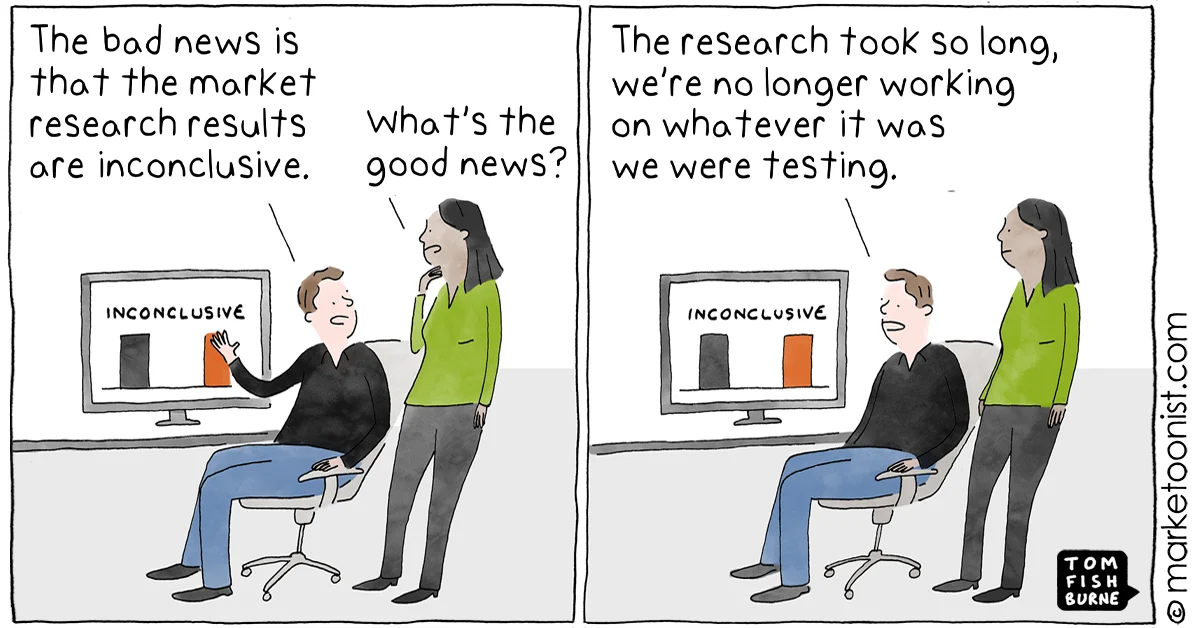
The problem with using surveys to measure a perception gap is the same problem with asking someone who is lost to describe the map. The gap exists precisely because internal perspectives cannot see it. Adding more internal perspectives, even customer-facing ones gathered through structured research, does not solve the problem. It refines the question while the answer stays hidden.
Brand tracking, the industry’s primary tool for ongoing perception measurement, is a $4 billion market that measures the rearview mirror. Standard enterprise studies cost $25,000 to $75,000 for hybrid quantitative/qualitative work. Multi-market strategic studies from McKinsey, Kantar, or BCG run $150,000 to $500,000 and more. They operate on quarterly or annual survey waves, creating a three-to-six-month lag before insights reach decision-makers. They measure explicit attitudes (System 2) while purchase decisions operate on implicit associations (System 1).
Daniel Kahneman established the framework. System 1 accounts for up to 95 percent of daily cognitive activity. Gerald Zaltman at Harvard Business School documented that what consumers actually believe, measured by unconscious physical reactions, regularly contradicts what they say when asked directly. Roughly 80 percent of new products fail within six months despite substantial research, because traditional methods access only the conscious 5 percent.
Closing the 80/8 gap requires a different approach: triangulating behavioural evidence from sources the company does not control. Customer reviews on platforms the company did not commission. Social media commentary the company did not prompt. Workforce sentiment the company cannot edit. Regulatory filings, legal records, and financial data that exist independently of the company’s narrative.
I have written separately about how this works in practice — the four-quadrant diagnostic, the use of uncontrolled sources, the operating principle that you observe evidence the subject cannot edit rather than ask the subject for self-report.
How the 80/8 problem connects to positioning
The 80/8 problem reads as more than a customer service finding. It is the empirical signature of weak positioning at scale.
The companies that produce the 80/8 gap are almost always sitting at the shallow levels of the 4-Level Positioning Canvas. They are claiming positions at Level 1 — saying it — that the operational structure underneath does not support. The customer experiences the underlying structure. The leadership team experiences the claim. The 72-point gap is the average distance between the two readings.
A company holding Level 3 or Level 4 does not produce an 80/8 gap. The customer experience aligns with the claimed position, because the operational decisions, the spending, the trade-offs all reinforce the same concept. The position is held the same way in all four mirrors. That is what positioning gravity looks like at scale, and it is the inverse of the 80/8 pattern.
The reflex move when leadership notices the gap is to claim better customer experience harder. That is a Level 1 response. It widens the gap. The honest move is to look at which level of the canvas has drifted, fix the operational layer, and let the customer experience catch up. That work is slower. It is the only work that closes the 80/8 gap durably.
The plain answer
The 80/8 problem is the canonical reading of the perception gap. Eighty percent of executives, eight percent of customers, one 72-point gap measured across 362 companies in 2005 and confirmed in 2026 by McKinsey at scale. It persists because companies measure what they say rather than what customers experience, because the cognitive biases that produced the gap also protect it, and because the standard tools for measuring perception systematically overstate real behaviour.
Closing the gap requires triangulating behavioural evidence from sources the company does not control, and using the diagnosis to repair the level of the canvas that has drifted. There is no shortcut. The companies that do this consistently produce positioning gravity. The ones that do not produce the 80/8 fingerprint.
That is the work.
Frequently asked questions
What is the 80/8 problem?
The 80/8 problem is the gap documented in a 2005 Bain & Company survey of 362 companies: 80 percent of senior executives believed their company delivered a superior customer experience, and only 8 percent of their customers agreed. The 72-point gap is one of the largest measured corporate perception disconnects in business research. The McKinsey Global Survey of 2026 (1,257 executives) confirms the pattern persists.
Who first identified the 80/8 problem?
Bain & Company, in their 2005 “Closing the Delivery Gap” study, which surveyed 362 large companies and the customers of those companies. The phrase “80/8 problem” is the shorthand I use in client work and writing to point at the gap. The underlying study is the Bain finding.
Has the 80/8 problem closed since 2005?
No. The McKinsey Global Survey of 2026, based on 1,257 executive interviews conducted in late 2025, found that most executives remain confident in their understanding of what drives customer and investor choice — a confidence McKinsey calls “potentially misplaced as change accelerates.” The pattern has held for at least twenty-one years.
Why does the gap persist?
Three structural forces keep it open. Confirmation architecture (organizations are built to confirm their own narratives). Inside-out bias (companies build positioning from the inside out while customers form perceptions from the outside in). And self-reported data dependency (the standard tools for measuring perception — surveys, NPS, brand tracking — systematically overstate real behaviour by 21 percent to a factor of three).
Is NPS a reliable measure of customer perception?
The academic record raises serious questions. Keiningham and colleagues (2007) found NPS was the best or second-best predictor in only two of five industries. Reichheld himself admitted in 2021 that self-reported scores have “sown confusion and diminished” the framework’s credibility. The deepest problem is non-response bias: detractors are less likely to respond, which can produce a potential 72-point swing between reported and true NPS at typical response rates.
What are the most famous 80/8 failures?
New Coke (1985), Tropicana (2009), Snapple under Quaker Oats (1994), Gap’s logo redesign (2010), and Blockbuster’s decline (2000 to 2010). In each case, leadership made decisions based on what they believed was true about customer perception rather than what was actually true. The cost across these five cases alone runs into billions.
How does the 80/8 problem relate to the perception gap?
The 80/8 problem is the baseline reading of the perception gap at scale. The perception gap is the general phenomenon. The 80/8 problem is the canonical measurement of that phenomenon across 362 companies.
How does the 80/8 problem relate to gravity vs glitter?
Companies that produce an 80/8 gap are usually producing glitter, surface claims that the operational structure does not support. Companies with gravity do not produce the 80/8 fingerprint, because the position the customer experiences and the position the company claims are the same position. See gravity vs glitter for the full framing.
How do you close the 80/8 gap?
Not with better marketing. The repair lives in the operational layer of the 4-Level Positioning Canvas, at Level 2 (proof) or Level 3 (lived commitment), not at Level 1 (language). Companies that try to close the gap with messaging tend to widen it inside two years. The durable repair is to align operational behaviour with the claimed position, then let the customer perception catch up.
Where can I read more about the underlying research?
The original Bain study is Closing the Delivery Gap (2005). The follow-up McKinsey work is the Global Survey on Corporate Strategy (February 2026). The meta-analytic evidence on stated versus revealed preferences is Schmidt and Bijmolt (2020), List and Gallet (2001), and Murphy and colleagues (2005). For the strategic implications, see what is a perception gap and the 4-Level Positioning Canvas.
Leave a Reply
You must be logged in to post a comment.