
Post one: you know the brief is wrong.
Post two: every fix makes it worse.
So what breaks the cycle?
Not motivation. Not courage. Not a better strategist or a bolder CCO. The system punishes all of those.
One thing breaks it: proof that doesn’t come from you.
Think about the last time you challenged a client.
You probably hedged. Softened. Buried the insight in a footnote. Framed it as “something we noticed” rather than “something that’s true.” Not because you lacked conviction. Because your conviction was all you had.
When the agency says “your brand perception is off,” the client hears an opinion. A threat. A political move from someone who needs their business. Defence mechanisms activate. The meeting gets polite. The insight dies.
When independent evidence says the same thing (drawn from regulatory filings, customer language, workforce sentiment, competitor data, and public records), the client hears the market. Not an opinion. A fact that exists whether or not the agency is in the room.
That’s the shift. Not a better presentation. Better permission. Truth-telling stops being a political act and becomes a professional service.
Watch what changes at every level.
The CEO stops accepting misaligned briefs. Not because they got braver. Because the risk calculus flipped. The account was 30% of revenue — too dangerous to challenge. Now there’s evidence the client’s own board will ask about. Silence went from safe to negligent. Candour went from risky to required.
The CSO stops patching together commodity research at 3am before a pitch. Instead of 44 hours of Reddit and LinkedIn and social listening that every other agency also did, they walk in with something nobody else in the room has: an independent view of how the market actually perceives the client. Not what the client thinks. Not what the agency thinks. What thousands of customers, employees, regulators, and competitors reveal through their own words and actions. The strategy changes. The pitch changes. The win rate changes.
The CCO stops watching brave work die. When the client says “that’s not us,” and the evidence shows the market already sees them that way, the conversation inverts. The creative isn’t the risk; the client’s self-image is. For the first time, the CCO has ammunition that doesn’t require the CSO to spend $150K and twelve weeks to produce. The bold idea survives the boardroom because it’s backed by something the client can’t dismiss as agency ego.
The Account Director stops burying uncomfortable truths. The quarterly review becomes the moment they add the most value, not by presenting the version of truth that survives the meeting, but by presenting the version that saves the account. The same Account Director who was structurally incentivized to stay silent is now structurally incentivized to speak up. Because the evidence makes them indispensable instead of dangerous.
The Strategist stops losing. Not just pitches. Time. Meaning. The 44 hours of manual research become 44 hours of strategic thinking applied to intelligence that actually differentiates. The gap between research and insight (the one 80% of strategists say defines their crisis) closes. Not because they work harder. Because the infrastructure changed underneath them.
The industry has a word for what happens next. It’s not adoption. It’s irreversibility.
Air conditioning. You survived without it. You didn’t know what you were missing. Now try spending August in a building without it. The idea isn’t a trade-off. It’s absurd.
Figma. Designers made beautiful work in Photoshop for decades. Nobody goes back. Not because Figma is slightly better. Because collaboration became structural instead of manual. The old way isn’t just slower — it’s incompatible with how work gets done now.
This is that kind of shift.
Once a strategist discovers that 5,000 consumer discussions contradict the client’s core positioning claim, they don’t go back to desk research. Once a CCO defends a killed campaign by showing that the market already associates the brand with that exact emotional territory, they don’t go back to relying on gut instinct alone. Once an Account Director brings a quarterly insight that the client’s own team hadn’t seen, they don’t go back to managing comfort. They manage truth.
The moment it becomes permanent isn’t when you run the first report. It’s when you use it to win something you would have lost without it. A pitch. An account review. A campaign the client was about to kill. After that, the old way no longer feels like an option. It feels like malpractice.
74% of agencies say they want to be strategic partners. Not executors. The gap between those two things has never been about desire. It’s been about infrastructure.
An executor takes the brief and makes it brilliant. The client’s narrative is the foundation. The agency’s job is to build something beautiful on top.
A partner interrogates the brief and makes the strategy real. The brief is a hypothesis to be tested. The client’s narrative is a claim to be verified. The agency’s job is to determine whether the foundation is solid, then build something brilliant on top of that.
Every agency says it wants to be the second. The entire industry is structured to produce the first.
The difference between the two isn’t willpower. It’s evidence. Specifically, evidence that’s fast enough to use before the pitch, independent enough to survive a CMO’s scrutiny, and cheap enough to run as standard operating procedure instead of a special occasion.
Here’s where I’ll be direct.
This series wasn’t written for every agency leader. It was written for those who recognized themselves in every post, who didn’t push back on a single claim because they’ve lived through all of them.
Two versions of your agency exist.
Version One trusts the brief. Builds from the client’s narrative. Patches together commodity research. Wins on chemistry. Loses on insight. Watches brave work die for lack of evidence. Sounds like every other agency in the pitch.
Version Two interrogates the brief. Builds from market reality. Walks in with something nobody else has. Wins because the client can’t get this anywhere else. Tells the truth — not as a risk, but as a service.
Version One is the default choice.
Version Two is a choice you make on purpose.
The cycle described in these three posts doesn’t stop on its own. Unchecked briefs. Commodity pitches. Killed creative. Compressed margins. Talent leaving. It accelerates. Every quarter you run it is a quarter your competitor might not.
The agencies that move first don’t just gain a temporary edge. They gain something the rest can’t replicate by catching up because the first movers already used it to win the accounts that matter.
This is the end of the series. Not the end of the conversation. If you’ve read all three posts and the question in your head is “how,” that’s the right question. It means you’ve stopped defending the cycle and started looking for the exit.
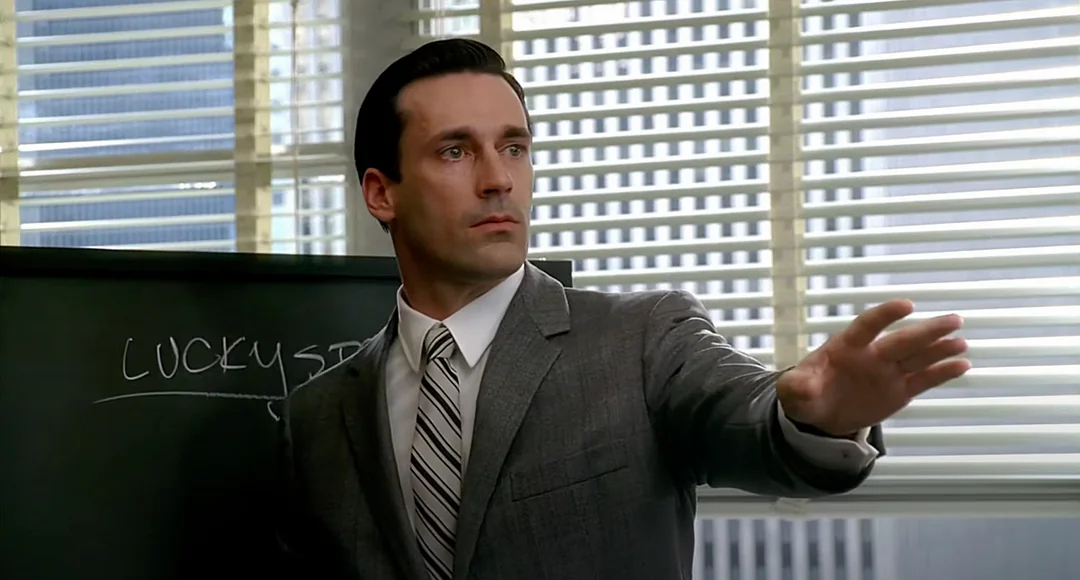
PS. In Mad Men, there’s a moment in the pilot that defines the entire show. Don Draper is stuck on the Lucky Strike pitch. Every rational argument for cigarettes has been eliminated by the Federal Trade Commission. The science is against him. The claims are gone. He has nothing.
Then the Lucky Strike executive says one line about his tobacco being toasted. Don doesn’t invent a new claim. He takes a truth that was already there, one the client couldn’t see because they were too close to it, and makes it the entire strategy. “It’s toasted.”
Every other cigarette was also toasted. But Lucky Strike owned it first. Because someone in the room had the proof and the permission to say it out loud. That’s what this series has been about. Not better creativity. Not better strategy. Better proof. And the permission that comes with it.
Read Monopoly Moves: Agency Edition next.

Leave a Reply
You must be logged in to post a comment.