

You know. You know the brief is curated. You know the client’s positioning describes who they want to be, not how the market sees them. You know the competitive set they handed you is the one that makes them comfortable, not the one that keeps their customers up at night.
You know. You just can’t say it.
Only 1 in 10 agencies rate client briefs as good.
One in ten.
That means 90% of all strategy, all creative, and all media planning in this industry are built on a foundation that the people building them don’t trust. You’re not starting from insight. You’re starting from a client’s self-image. And then you’re spending $204,000 per pitch to make that self-image sound brilliant.
Here’s what the pitch process actually looks like from the inside.
The brief arrives. Your strategist spends 40 hours on pre-pitch research. Reddit threads. Glassdoor. G2 reviews. Social listening. Earnings calls. LinkedIn deep dives. She’s good. Maybe the best you have.
She walks into the pitch with the same information as every other agency in the room. Because the intelligence isn’t the differentiator. It’s a commodity. Four agencies. Same public data. Same deck structure. Same client narrative repackaged with different fonts.
It comes down to chemistry. Again.
And you absorb another $204K loss, wondering what would have happened if you’d walked in with something the client didn’t already know about themselves.
The numbers, when you stack them, are brutal.
$204K to pitch. $406K to defend an account under review. Three agencies in a typical review means the total cost exceeds $1M. Win rates hover at 30%.
That’s 177 hours of senior staff time per pitch. Ten pitches a year at a 30% win rate means 1,239 hours of your best people — gone. The equivalent of a full-time senior strategist doing nothing but losing.
Meanwhile, the research that could actually differentiate you, an independent perception study, costs $50K to $150K and takes 6 to 12 weeks. The pitch is in four. So you go without. You build a strategy on the client’s narrative. You present what they expect to hear. And you wonder why 40% of clients are planning to switch agencies anyway.
This isn’t a talent problem. Your people are sharp. It’s not a creativity problem. Your CCO has a shelf of awards. It’s a fear distribution system. Watch how a single decision at the top cascades through an entire agency.
The CEO won’t challenge the client’s narrative because the account is 30% of revenue. Losing it means layoffs, scrutiny from the holding company, and personal career damage. So the misaligned brief gets accepted.
Because the CEO accepted the brief, the CSO can’t challenge it either. A proper perception study costs $150K and takes three months. The pitch is next month. So the strategy gets built on the client’s self-image. 62% of strategists say strategy is the first function cut when budgets tighten. They know what that means.
Because the strategy mirrors the client’s narrative, the CCO has nothing to fight with. The bold campaign, the one that actually reflects how consumers see the brand, dies in the boardroom. The client says, “That’s not us.” The market already sees them exactly that way. But without proof, the work gets killed.
Because the work got killed, the Account Director rewrites the brief to be safer. The next round is blander. The strategist’s 40 hours produce incrementally less value. The junior planner learns that insight doesn’t matter — survival does.
One act of structural silence at the top.
Waste at every level below.
And the beliefs that hold it in place feel like natural law. “The client knows their business best.” They know their P&L. They don’t know how the market perceives them. Those are different things.
“Good research takes time and money.” This was true in 2015. The belief that serious intelligence requires six-figure budgets and multi-month timelines is now the barrier, not the standard.
“Challenging the client is too risky.” Here’s the paradox every agency leader already knows: if you challenge the brief, you risk being fired for being difficult. If you don’t challenge it, you produce work that fails, and you get fired for poor performance. Both paths end the same way. At least one gives you a shot at work that actually works.
“Our job is to take the brief and make it brilliant.” This is the master belief. It frames the agency as an executor (sophisticated, talented, creative) but an executor. The brief is the starting point. The client’s narrative is the foundation. Build something beautiful on top of whatever you’re given.
This belief is why 40% of clients are switching. Not because of bad creative. Because of the gap between what the agency knew and what the agency said.
Here’s what it’s actually costing you. Beyond the pitch losses. Your CSO commissions research that arrives after the strategy has already been decided. Then gets asked to justify the spend.
Your CCO watches 60% of the agency’s boldest work die in approval — not because it was wrong, but because nobody could prove it was right.
Your best strategists are leaving. Turnover from pitch fatigue runs at 50%. The ones who stay learn to stop fighting. The ones who leave take your intellectual capital with them.
Your differentiation is evaporating. When every agency claims to be “integrated, data-driven, client-centric,” the words mean nothing. You sound identical. You compete on price and chemistry. Margins compress. The holding company notices.
And every quarter you don’t close the gap between what you know and what you can prove, the gap closes your options. There’s a quote from Ellie Bamford, CSO at VML, that should be framed on every agency wall:
“We are hiding behind mountains of data and research, and we’re not coming out strongly enough with our point of view. And that’s diminishing our value.”
She’s describing the entire industry in two sentences. Not a lack of data. A lack of proof. Not a lack of intelligence. A lack of permission.
The agency that figures out how to walk into the room with something the client doesn’t already know (something independent, evidence-based, and impossible to dismiss) doesn’t just win more pitches. It becomes the agency that clients can’t replace.
This is the first post in a series for agency leaders who are tired of building on briefs they don’t trust, losing pitches to chemistry, and watching brave work die for lack of evidence.
If what I’ve described sounds familiar, you’re not failing. You’re operating inside a system designed to make silence feel safer than truth. The question is whether you want to keep building on the client’s self-image — or start building on reality.
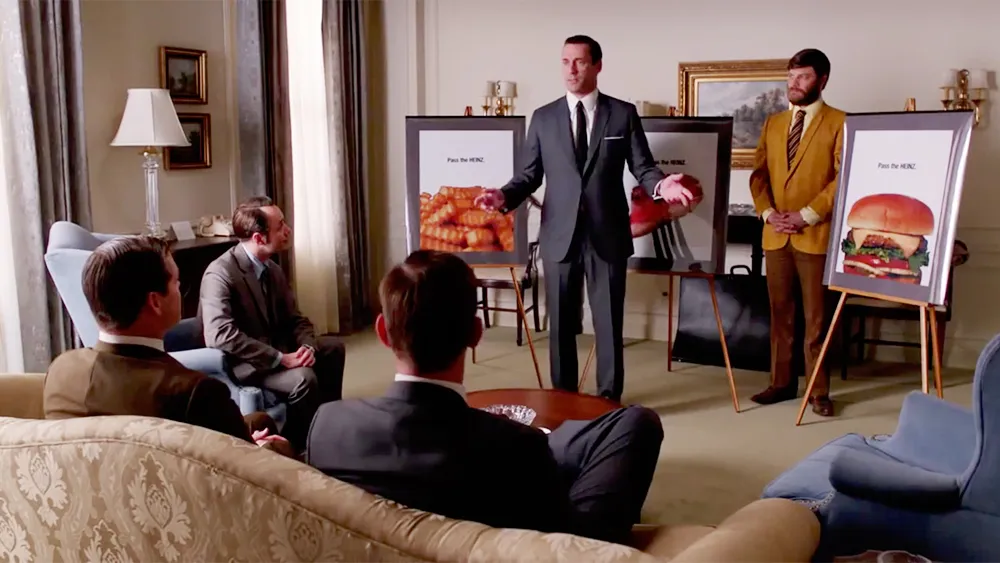
PS. In Mad Men, Don Draper pitches Heinz a campaign: just food, no bottle, just the words “Pass the Heinz.” The client kills it. “Where’s the product?” The agency knew it was right. They couldn’t prove it in the room. In 2017, Heinz actually ran the campaign. Word for word. The agency was right all along. It just took 50 years and a different room to say it out loud.
Read the next essay in the series: The Cycle Nobody Built, but Everyone Runs.


Leave a Reply
You must be logged in to post a comment.