
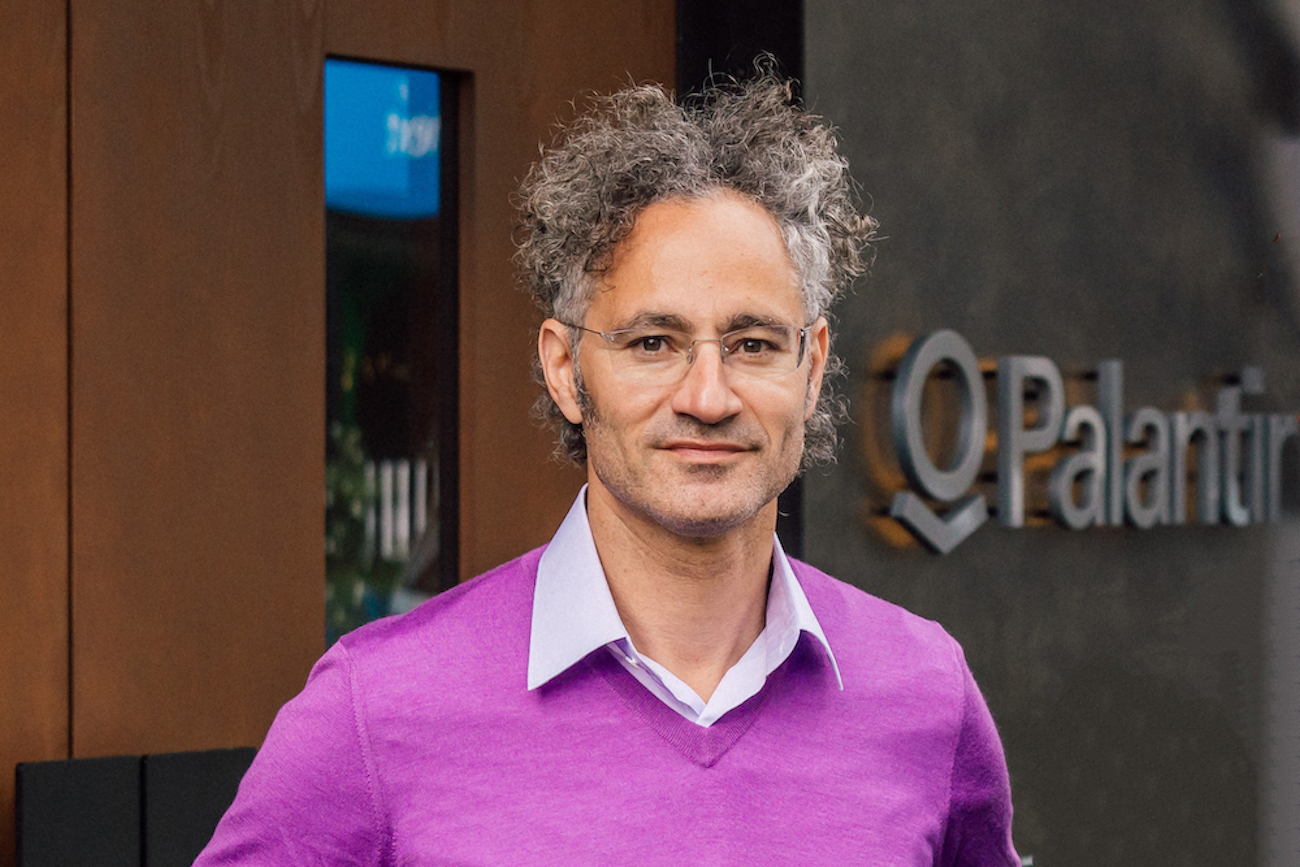

From Clarity to Gravity: Palantir Technologies
A positioning analysis of Palantir Technologies and CEO Alex Karp
A Note Before We Begin: I have been watching Palantir closely for a while now. The work Alex Karp and the team have built over twenty-two years is genuinely remarkable, and so is the way Karp talks about it. His shareholder letters, his earnings calls, his public appearances. There is a depth of conviction there that most CEOs never reach. I find it fascinating.
I write these analyses because I love looking deeper into what makes a business connect to identity. Not the marketing. Not the tagline. The underlying structure — the pattern of decisions that reveals what a company actually means in the minds of the people it serves.
This entire article exists to answer one question: What business is Palantir in?
Not what they say they’re in. Not what they think they’re in. What their decisions, over twenty-two years, prove they’re in.
I have done my level best to get the most accurate information possible, drawing from public filings, earnings transcripts, analyst reports, customer data, and competitive intelligence. If anything here is incorrect, my intention is not to misrepresent. I am trying to read the label because no one can read their own. Alex, if you’re reading this: you have your own data, your own evidence, your own lived experience building this company.
You may disagree with parts of this analysis. That is expected and respected. This is one lens. It is offered with admiration, not authority.
The 4-Level Canvas: A Quick Orientation
This analysis uses my 4-Level Positioning Canvas — a diagnostic framework for understanding where a company actually sits in customer minds, not where it claims to sit.
The four levels, from deepest to surface:
Level 4 — POSITION (Own the Noun). The company owns a singular concept so deeply that customers associate it automatically, without thinking. This is procedural knowledge. It fires before deliberation. Think: Volvo → safety. When competitors cannot discuss the concept without mentally referencing you, you own the noun.
Level 3 — LIVE (Structural Embedding). The company’s resources, decisions, and operating model are structurally aligned with the position. More than 70% of what the company actually does, not says, reinforces a single concept. The position is embedded in the business, not bolted onto it.
Level 2 — EXECUTE (Prove with Verbs). The company can demonstrate specific, measurable proof of its claimed position. Real actions. Real outcomes. Verifiable by the customer before purchase. This is where claims become evidence.
Level 1 — FRAME (Articulate). The company can clearly articulate what it is. The framing uses nouns (concepts that establish territory) rather than adjectives (superlatives that trigger skepticism). Strong framing stems from Level 4 ownership. Weak framing is just marketing.
Most companies operate at Level 1 — they can describe themselves clearly, but lack structural proof underneath. The few companies that reached Level 4 did not do so through better messaging. They got there through consistent decisions over time that wired a concept into customers’ minds so deeply that it became automatic.
The question this framework answers is simple: Is the position real, or is it just words?
There is a company trading at 84 times revenue that almost nobody can explain in a sentence.
Ask a defence analyst what Palantir does, and they’ll say “battlefield intelligence.” Ask a commercial buyer, and they’ll say “AI platform.” Ask a retail investor, and they’ll say “data operating system.” Ask a critic, and they’ll say “surveillance.” All four are correct. None of them captures what Palantir actually owns.
This is the paradox at the center of one of the most interesting positioning stories in technology: a company that has spent 22 years building one of the strongest implicit positions in enterprise software, while simultaneously undermining it with increasingly loud explicit claims. A company operating deeply at Level 3, claiming loudly at Level 4, and accidentally doing the most important thing right for reasons its own CEO would probably misdiagnose.
Most companies in this series are building framing without a foundation. Palantir has the opposite problem. The foundation is extraordinary. The framing is getting in its own way.
Remove all the words. What remains?
Part 1: The Story They Tell
Alex Karp tells a civilizational story. He doesn’t frame Palantir as a software vendor. He frames it as a philosophical project, a necessary instrument for the survival of Western democracy in an era of authoritarian technological competition. His shareholder letters quote St. Augustine, Jürgen Habermas, and Samuel Huntington. He references his doctoral work at the Frankfurt School. He positions the company’s founding not as a business decision but as a moral response to September 11th.
The explicit narrative has escalated in recent years. In earnings calls, Karp now regularly deploys superlatives: “the most important software company in the world,” “crushing it,” “bombastic numbers,” “scaring the bejabers out of our adversaries.” The company’s investor relations materials describe Palantir as “the operating system for the modern enterprise in the era of AI.”
Run the linguistic analysis. The hierarchy is revealing.
Nouns Karp uses: Ontology. Republic. Operating System. Moat. The West. Revolution. These are concept-level words — attempts to establish mental territory, to define what the company is rather than what it does.
Verbs Karp uses: Crush. Scare. Build. Win. Prevail. Transform. These are proof-of-capability words — what the company does as evidence.
Adjectives Karp uses: Most important. Greatest. Baller. Bombastic. These are superlatives — the “-est” claims that trigger defence mechanisms.
The three registers coexist uncomfortably. In shareholder letters, Karp operates at the noun level (philosophical, conceptual, anchored in category ownership). On earnings calls, he shifts to adjectives (performative, superlative, and confidence-signalling). Commercial buyers encounter the adjective-heavy version first. Many never reach the noun-level framing underneath.
The metrics Palantir obsesses over tell their own story: Rule of 40 (127%), net dollar retention (139%), revenue per employee ($1.01M), GAAP profitability streaks (thirteen consecutive quarters). These are proof metrics; evidence of structural advantage. The company knows its execution is extraordinary. The question is whether the explicit framing helps or hurts.
Here is the first signal that something interesting is happening: Palantir’s implicit proof is among the strongest of any technology company operating today. Its explicit claims are growing louder. And the gap between them is widening.
Part 2: The Hidden Position
Apply the Remove All Words test. Strip away every tagline, shareholder letter, Karp speech, and earnings call. Ignore “operating system,” “AI platform,” and “Western civilization.” Examine only what Palantir has done with its money, its talent, and its time over 22 years.
The pattern is unmistakable.
Government-first for eight years (2003–2011). Zero commercial revenue. Thirty million in personal Thiel funding. Every Silicon Valley VC rejected them. The company was built for the CIA, the NSA, and the DoD before earning a dollar from the private sector.
The FDE model, elite engineers embedded at customer sites. Not a support team. Not implementation consultants. The best engineers Palantir has are physically present at the customer’s location, working on their problems. Lower margins than pure SaaS. Roughly $1 million in revenue per employee is needed to sustain it.
The Ontology architecture. Complex, slow to deploy, years of R&D investment. A semantic layer that maps raw data to real-world objects: facilities, supply chains, patients, and targets. Once built, it captures so much institutional knowledge that removing it means rewiring the organization, not swapping an API.
Refused the Chinese market entirely. Forfeited over $100 billion in the addressable market. Karp frames it as a civilizational conviction: “Either we win, or China will win.” Whether you agree with the framing or not, this is a costly signal that competitors cannot replicate by changing a slide deck.
Maintained the ICE contract through three rounds of internal protest. When Google dropped Project Maven under employee pressure in 2018, Palantir doubled down. Employee attrition followed. Brand damage among progressive constituencies was real. The ICE contract has since grown from $41 million to over $1 billion through the DHS blanket purchase agreement.
Operated at a GAAP loss for twenty years. Two and a half billion dollars in cumulative losses before the first profitable year. Platform depth before monetization. No other enterprise software company has sustained this level of patient investment.
IL-5 and IL-6 classified certifications. Multi-year, multi-million-dollar engineering investments that grant Palantir a near-monopoly in software deployment to classified environments. No competitor can update classified software at Palantir’s speed.
Built Apollo, continuous delivery for air-gapped environments. Enormous engineering complexity to solve a problem most companies don’t even attempt: shipping code improvements to disconnected, secure networks at cloud speed.
No data monetization. Palantir does not sell customer data. In a world where most tech companies treat data as the product, this is a structural refusal that builds trust in classified and regulated environments.
No mass layoffs (2022–2023). Only 2.7% headcount reduction versus Meta at 13%, Amazon at 6%, and Salesforce at 8%. Preserving FDE institutional knowledge over short-term cost optimization.
Now read the list again. Every decision optimizes for the same outcome.
Not “make our software good.” That’s a verb.
Not “be the best AI company.” That’s an adjective.
The noun is indispensability. The state of being so deeply embedded that removal would cause institutional failure.
This is the concept Palantir actually owns. Not “operating system.” Not “AI platform.” Not “Western civilization’s software.” The pattern of costly decisions, accumulated over 22 years, proves a single concept without ever needing to state it: once you’re in, you cannot get out.
The 139% net dollar retention rate is not a metric. It is the financial signature of indispensability.
The $10 billion Army enterprise agreement (consolidating 75 separate contracts into one) is not a procurement decision. It is what happens when an institution has wired Palantir into its decision-making so deeply that splitting it apart would be more expensive than giving the company a decade-long blank check.
Would this position survive if every piece of marketing disappeared tomorrow?
In government, yes. If Palantir’s entire marketing department vanished overnight, the U.S. Army would still consolidate 75 contracts into a $10 billion deal. The UK Ministry of Defence would still expand from £75 million to £750 million. The CIA would still use Gotham. The structural embedding is the position. No words required.
In commercial, not yet. The bootcamp model and Karp’s public rhetoric are still doing significant positioning work in commercial markets. The commercial position depends partly on explicit framing, “operating system for AI,” not yet on structural inevitability alone. This is the split that defines the company’s next chapter.
Palantir knows the concept it owns. Whether it trusts that concept enough to let the proof speak, that is the open question.
Part 3: The Level Diagnostic
Level 4 — POSITION (Own the Noun)
Palantir claims “Operating System.” This is a strong noun — infrastructure-level, implying that everything else runs on top of you. It appears unprompted across analysts (“AI OS”), investors (“data OS”), and military users (“mission OS”). Competitors are increasingly evaluated relative to Palantir, not the other way around. FDE job postings are up over 1,100% as AI startups copy the model. Startups pitch as “like Palantir but for X.” Microsoft named a product “Microsoft Foundry.” Nobody says “like Snowflake but for X” or “like Databricks but for X.”
But here is the split. In defence and intelligence, the noun is approaching procedural. The Army’s decision to consolidate 75 contracts into one is System 1 behaviour — automatic, no RFP needed. “Nobody gets fired for buying Palantir” has organic traction. This is approaching Level 4.
In commercial markets, the noun is still declarative. Buyers compare. They evaluate. They run bootcamps before committing. They weigh Palantir against Databricks and Snowflake. Selection requires conscious deliberation. This is Level 2 at best.
The perceptual monopoly test is instructive here. Can competitors discuss “data integration for government” without referencing Palantir? No. Competitor analyses define themselves against Palantir. Alternative guides are titled “8 Best Alternatives to Palantir Foundry.” Even critics use it as the reference point: “Just use Databricks — it’s Palantir with less evil.” When the comparison frame defaults to you, the mental territory is occupied even if the universal noun isn’t yet locked in.
Level 4 Assessment: Approaching in defence (7/10). Developing in commercial (4/10).
Level 1 — FRAME (Articulate)
Karp’s framing is philosophically sophisticated, CEO-level, and anchored in noun ownership. His shareholder letters don’t describe products. They define categories. “The operating system for the modern enterprise in the era of AI” is concept-level framing, not feature-level marketing.
The weakness: the register varies sharply. Earnings calls are superlative-heavy: “crushing it,” “most important,” “bombastic.” Shareholder letters are nuanced and philosophical. Commercial buyers encounter the performative version and may trigger defence mechanisms before reaching the conceptual framing underneath.
Level 1 Assessment: Strong (8/10). The framing is right. The delivery channels create friction.
Level 2 — EXECUTE (Prove with Verbs)
Apply the Five Execution Questions:
- What specific action does this enable? Integrates fragmented data into real-time operational decisions — from battlefield targeting to hospital bed optimization to predicting supply chain failures.
- What baseline are we comparing against? “A military targeting operation that required 2,000 people in 2003 now needs just 20.” Failed ERP systems costing over a billion dollars. Airbus saving one aircraft per day from downtime.
- What’s the measured improvement? 33% faster A350 production at Airbus. 75% faster bed capacity calculations at the Cleveland Clinic. $40,000 per day in savings at General Mills. 100-to-1 personnel reduction in targeting.
- How can customers verify? The AIP bootcamp — five days on your own data, working system, before signing. 70-75% conversion rate proves customers see verifiable value before committing.
- What’s the timeline to value? “Days, not years” is the official value prop. Bootcamp median is five days. Full deployment follows in weeks to months. Land-and-expand has taken accounts from $7 million to $31 million in three quarters.
All five questions answered with specific, measurable evidence. The verbs prove the noun.
Level 2 Assessment: Strong (8/10). This is the company’s most robust level.
Level 3 — LIVE (Structural Embedding)
Does 70% or more of resources flow to positioning-critical capabilities?
R&D at $558 million plus sales and marketing at $1.057 billion equals $1.615 billion out of $4.475 billion in revenue. But the true positioning-critical investment is the FDE model, which is booked simultaneously across R&D, sales, and cost of revenue. Palantir’s entire operating model is a positioning investment. Every FDE deployment deepens the ontology, creates switching costs, and generates product improvements. The 82% gross margin at the platform level proves the leverage is real.
“If competitors had your P&L, what would shock them?” The Rule of 40 at 127%. Revenue per employee is $1.01 million. 82% gross margins with embedded engineers. These numbers shouldn’t coexist in a services-heavy model. They prove the platform leverage is structural, not operational.
The $1 billion DHS blanket purchase agreement awarded in February 2026 provides further Level 3 evidence: a five-year contract that streamlines procurement across CBP, ICE, and other agencies, bypassing competitive bidding entirely. When an institution designs its procurement infrastructure around your platform, that is structural embedding at the institutional level; the organization’s buying process has been rewired, not just its technology stack.
Level 3 Assessment: Very Strong (9/10). This is Palantir’s strongest level. The embedding is deep, financially validated, and compounding.
The Gap
Palantir lives at Level 3 but claims Level 4. The gap is noun ownership in commercial markets. The blocking level is the transition from structural embedding (which they’ve mastered) to automatic mental association (which requires time and consistency, not volume).
Part 4: The Identity and Cognitive Layer
What identity does choosing Palantir enable?
For a defence customer: “We are serious about national security outcomes and operate in the hardest environments.” This is an identity of competence, clearance, and mission gravity.
For a commercial enterprise buyer: “We have data problems at scale that generic tools can’t solve. We are AI leaders in our industry.” This is an identity of sophistication and willingness to pay for depth.
For an employee: “I chose mission over comfort. I work on problems that matter at the highest technical level.” This is an identity of meritocratic sacrifice. Palantir’s internal culture reinforces this through what they describe as “ideological gravity.”
For a retail investor: “I believe in the AI revolution, and Palantir is the platform play.” The “Hobbits” flair on Reddit for IPO-era buyers. Holding through 50-80% drawdowns. This is identity investment, not rational portfolio allocation.
Each segment has a tribe. Each tribe signals something specific by choosing Palantir. This is the emotional architecture that undergirds the position.
Notice what’s absent from these identities: nobody chooses Palantir to signal efficiency or cost savings. The identity is always about gravity: seriousness, mission weight, institutional consequence. This is consistent with the hidden noun. Indispensability is not a feature benefit. It is an identity claim. “We chose the platform that cannot be removed” is a statement about the chooser as much as it is about the chosen.
Procedural or declarative?
In defence: procedural and strengthening. The Army doesn’t deliberate. It consolidates. It’s automatic. This is twenty-two years of Hebbian learning: consistent decisions, consistent experiences and consistent wiring.
In commercial: declarative and converting. The bootcamp model is the mechanism. Five days of hands-on experience with your own data creates the kind of consistent, repeatable experience that Hebbian learning requires. But three years of boot camps is not twenty-two years of defence embedding. The commercial signal is real but not yet deep enough.
Among retail investors: strongly procedural. “PLTR holders” is a tribal identity. Holding through massive drawdowns is identity-level behaviour — System 1, not System 2. The Lord of the Rings naming convention (the company itself named after seeing stones, offices named after Middle Earth locations, IPO-era buyers calling themselves “Hobbits”) created a mythology layer that accelerated tribal formation. This is unusual. Most enterprise software companies do not generate tribal retail investor behaviour. Palantir did, because its identity operates at a deeper register than its product category.
The Hebbian learning assessment clearly reveals the timeline gap. In defence, twenty-two years of consistent decisions (government-first, classified-capable, mission-aligned, refusal to compromise on controversial contracts) have created automatic neural wiring. The association is not conscious. It is reflexive. A military procurement officer encountering a data integration need does not open a spreadsheet of alternatives. The pattern fires before deliberation begins.
In commercial, the bootcamp model is creating the right kind of consistent experience (five days, your own data, working AI at the end), but it has only been operating at scale for three years. Hebbian learning requires repetition over time. Three years of high-quality repetition are building the wiring. It is not yet deep enough for the association to become automatic across the market. The commercial signal is directionally correct and accelerating, but it is still being assembled, not yet hardened.
Are explicit claims triggering defence mechanisms?
Yes, selectively. Five distinct skepticism patterns recur in market commentary:
“They claim software; they’re really consulting.” Michael Burry raised this. Reddit echoes it. The FDE model looks like consulting from the outside. Counter: 82% gross margins and million-dollar-per-employee revenue disprove it.
“They claim AI; they’re just wrapping other models.” The concern is that AIP is a thin layer over third-party LLMs. Counter: the ontology is the value, not the model. Palantir’s contribution is structured context, governance, and operational deployment.
“They claim neutrality; they’re a surveillance company.” The ACLU, AFSC, and progressive critics maintain this frame. Counter: Karp doesn’t deny it; he reframes. “Are we building a database for surveillance? No. But could legally surveilled data be put into our product? Yes.” The candour keeps the frame alive.
“They claim Western values; their contracts say otherwise.” Saudi Arabia, ICE, Trump-era expansion. Counter: none. Karp does not apologize. He reframes: “I refuse to apologize for supporting the U.S. government.”
“Their tech isn’t unique.” Reddit: “essentially a GIS company operating behind secrecy.” Counter: the technology may not be categorically unique. The willingness to deploy it in the hardest environments is.
Each skepticism pattern is a defence mechanism triggered by explicit claims. The louder Karp gets, “most important software company in the world,” the more System 2 activation occurs in audiences who haven’t experienced the product. The implicit proof (twenty years of decisions) doesn’t trigger these defences. The explicit framing does.
Part 5: Success Mechanics
What’s actually working, including what’s working accidentally?
The AIP bootcamp model is the most important go-to-market innovation in enterprise software since Salesforce’s AppExchange. It compressed sales cycles from 12-18 months to five days. It converted at 70-75%. It drove U.S. commercial revenue from $77 million per quarter to $507 million per quarter in three years.
But here is what makes the bootcamp positioning critical, not just commercially effective: it is the mechanism for converting declarative knowledge into procedural knowledge. Five days of hands-on experience with your own data creates the neural wiring that no amount of marketing, analyst coverage, or Karp speeches can replicate. The bootcamp doesn’t sell Palantir. It wires Palantir into the buyer’s decision architecture.
This is the thing Palantir is doing right, possibly by accident.
The company talks about bootcamps as a sales tool. A way to reduce cycle times. A way to “show, not tell.” All true. But the deeper mechanism is cognitive: the bootcamp creates the Hebbian repetition (consistent experience over time) that converts a conscious evaluation (“should we buy Palantir?”) into an automatic association (“we need an operational AI layer” → Palantir).
The FDE model works the same way, at a deeper level. When your best engineers live inside the customer’s problem for months or years, they don’t just solve technical issues. They build institutional knowledge that becomes part of the customer’s decision infrastructure. The ontology is the artifact of that patience, not the cause of the moat, but the record of it. The FDE creates the embedding. The ontology captures it. The switching cost is not the technology. It is the institutional knowledge encoded in the technology.
This is the contradiction Palantir is doing right accidentally: they claim to be an “AI company” and “operating system,” noun-level positioning. But what actually drives retention is something they rarely articulate. They are the only company willing to embed in your ugliest data problems and stay. The FDE model, not the platform, is the true source of the moat.
Position-market resonance
Something remarkable is happening in the competitive landscape, providing independent evidence of the position’s strength. The “Palantirization” phenomenon is documented and accelerating. FDE job postings across the AI industry are up 800-1,165% in 2025 as companies copy the model. Startups pitch as “like Palantir but for X.” D.AP markets itself as “the ontology-driven alternative to Palantir Foundry.” C3.ai is evaluated relative to Palantir in every analyst report. Microsoft named its AI tool “Microsoft Foundry.”
Here is the positioning test that matters: nobody says “like Snowflake but for X” or “like Databricks but for X.” They say “like Palantir but for X.” When competitors and startups define themselves in relation to you, you own the reference point. You may not yet own a universal noun, but you own the mental anchor. This is the clearest evidence of emerging Level 4 status.
IQ/EQ alignment
In defence, strongly aligned. The world needs decision-making infrastructure for complex, classified environments. Palantir is structurally the only company that can deliver it. Capability meets need perfectly. This is the sweet spot.
In commercial, partially aligned. The IQ is strong. The platform works. Bootcamp results prove it. But the EQ is contested. Enterprises emotionally need “AI transformation.” Palantir’s identity as a defence company creates cognitive dissonance in commercial procurement. The “surveillance company” frame dampens EQ even when IQ is obvious.
In Europe, misaligned. Only 26% of revenue is international. European data-sovereignty concerns, GDPR friction, and Thiel’s political associations pose significant EQ barriers. The IQ may be strong. The emotional resistance is stronger.
In healthcare, mixed. The NHS Federated Data Platform contract demonstrates strong IQ. The platform works. But fewer than 25% of NHS trusts are actively using it, and the British Medical Association’s opposition reveals an EQ failure: healthcare workers emotionally resist a “defence contractor” managing patient data. The capability is proven. The identity is rejected. This is the classic Strong IQ / Weak EQ failure mode — can deliver, but the audience doesn’t want it from this company.
The IQ/EQ map reveals a clear pattern: Palantir’s alignment strengthens in direct proportion to the stakes of the environment. The higher the consequence of failure (battlefield, national security, critical infrastructure), the more IQ and EQ converge. The lower the stakes (routine enterprise analytics, European commercial, healthcare administration), the wider the gap. This is not a technology problem. It is an identity problem. The company’s gravity works best in environments heavy enough to need it.
What’s missing
The signal-to-talk ratio is approximately 70/30 — highly costly signals, moderate explicit claims. This is a strong ratio. But the “talk” component is growing faster than the “signal.” As the company expands from defence (where implicit proof dominates) to commercial (where positioning is still being established), the risk is that explicit claims outpace the implicit proof in audiences who haven’t yet experienced the product.
The bootcamp solves this problem by creating implicit proof at scale. The question is whether Karp’s increasingly loud public rhetoric helps or hurts that process.
Part 6: The Coaching Moment
Palantir is an unusual case. Most companies in this series are operating at Level 1 and claiming Level 4 (all framing, no structural proof). Palantir has the opposite problem. It is deeply embedded at Level 3, with extraordinary execution at Level 2, strong framing at Level 1, and approaching Level 4 in its strongest segment. The structural work is done. The gap is cognitive, not operational.
Here are the level-specific observations.
The Level 4 transition in commercial requires quieter execution, not louder claims.
Palantir’s defence position was built over twenty-two years of consistent, costly decisions. No one announced it. No one claimed it. The Army didn’t consolidate 75 contracts because Karp called Palantir “the most important software company in the world.” They consolidated because two decades of structural embedding made the alternative unthinkable.
The commercial transition needs the same patience. The bootcamp model is the mechanism that creates the consistent, repeatable experience that wires procedural knowledge. Three years of bootcamps have already produced extraordinary results. But procedural knowledge requires repetition over time. The current explicit framing, “crushing it,” “revolution,” “scaring enemies,” triggers defence mechanisms in commercial buyers who are still in System 2 evaluation mode.
The strongest positions are never explicitly stated. They are implicitly proven. Palantir knows this in its bones; its entire defence position was built this way. The coaching moment is applying the same discipline to the commercial expansion.
The noun they should own is not “Operating System.” It is “Operational AI.”
“Operating system” is strong but carries baggage. It implies infrastructure: important, invisible and unglamorous. It is also contested by Microsoft, which named a product “Microsoft Foundry” and is building its own narrative around AI infrastructure.
“Operational AI,” the concept that AI must be embedded in operations to create value, not just deployed in experiments, is a vacant noun that Palantir’s decisions have already proven. Every bootcamp, every FDE deployment, every ontology built from messy enterprise data proves this concept. The word “operational” draws a bright line between Palantir and every competitor selling AI as a science project. Snowflake does storage. Databricks does experimentation. Palantir does operations.
The noun is available. The proof already exists. The transition is from claiming “operating system” to owning “operational AI,” letting the bootcamp and FDE models wire that association into the market’s procedural memory.
The “Three Palantirs” problem is a feature, not a bug, but it needs to be managed.
Three Palantirs exist simultaneously in public consciousness: “battlefield brain” (defence), “AI operating system” (investors and commercial), and “surveillance apparatus” (critics and civil society). All three are accurate. Karp actively amplifies all three.
This is calculated identity polarization. It repels some audiences while creating tribal loyalty in others. In defence, this is pure advantage; controversy signals seriousness. In commercial, it creates friction. A Fortune 500 procurement committee evaluating AI platforms doesn’t want to explain to the board why they chose “the surveillance company.”
The coaching observation is not to eliminate the polarization (it’s structural to the company’s identity), but to ensure the bootcamp experience overwhelms the narrative. Five days of working AI on your own data rewires the association faster than any article about ICE contracts. The experience must be louder than the controversy. Every completed bootcamp is a data point that overwrites the narrative. The cognitive architecture is clear: five days of System 1 experience beats five years of System 2 debate.
The “Category of One” is real but unstable.
Mizuho, Forrester, and IDC have independently confirmed that Palantir occupies a space no competitor replicates: ontology-based operational AI for classified and complex environments, delivered by embedded engineers. This is genuine. But “category of one” means there is no category noun in the customer’s mind, just the company name. This is Level 3 without Level 4. Structural embedding without noun ownership.
The transition from “category of one” to category ownership requires naming the category. Not by Palantir because that would be claiming. By customers, analysts, and competitors who begin using a common noun to describe what Palantir does. The bootcamp is the mechanism. Every customer who completes a bootcamp and says, “We need operational AI,” not “we need Palantir,” is evidence of the noun taking hold.
The signal that the transition is working will be linguistic.
When commercial buyers start saying “we need an operational AI layer,” the way defence buyers say “just use Palantir,” the Level 4 transition is complete. The noun will have become procedural. The concept will be synonymous with the company. No amount of framing or claiming can accelerate this; only consistent experience over time.
There are early signals that this is happening. Analyst reports increasingly use “operational AI” as a category descriptor rather than just a Palantir marketing term. The Accenture Palantir Business Group, Rackspace’s 250-engineer Palantir-trained team, and the Cognizant partnership are all channel mechanisms that propagate the experience and the associated noun without requiring Palantir’s own voice to do the claiming. When partners and integrators become the distribution channel for the concept, the company escapes the reactance trap of self-proclamation.
The position chose the distribution. The bootcamp is the distribution. The partners are the amplifiers. The noun will follow.
One more thing. There is a deeper irony to Palantir’s positioning story that deserves naming. Karp’s philosophical training, Frankfurt School critical theory (Habermas), and the study of how power structures shape consciousness equipped him with precisely the intellectual framework to understand implicit positioning, Hebbian learning, and the cognitive architecture of market perception. His dissertation was on aggression in the social world. He understands, at a theoretical level, how systems of meaning form beneath conscious awareness.
And yet. The explicit claims keep getting louder. “Most important software company in the world.” “Our Palantir Revolution.” “Crushing it.”
The philosopher who understands that the strongest positions are never explicitly stated is explicitly stating his position. The irony is that twenty-two years of costly decisions have already done the work. The proof is in the P&L, the contracts, the retention rates, the Army consolidation, and the partner ecosystem. The implicit architecture is built. The challenge now is trusting it.
Finally
Palantir is a company that has spent twenty-two years building one of the strongest implicit positions in enterprise software. Its pattern of costly decisions (government-first, FDE model, ontology architecture, China refusal, ICE commitment, IL-6 certifications, twenty years of losses) proves a single concept without ever needing to state it: indispensability.
This implicit position is extraordinary. It is structurally embedded at Level 3, well-executed at Level 2, articulated at Level 1, and approaching Level 4 in defence. The financial proof is undeniable: $4.5 billion in revenue, 82% gross margins, 127% Rule of 40, $7.2 billion in cash, zero debt.
The gap is not structural. It is cognitive. The commercial market has not yet wired the procedural association that defence has built over two decades. The bootcamp model is the mechanism for closing this gap. Three years of consistent, repeatable experience builds the Hebbian learning that converts declarative knowledge (“I know Palantir does AI”) into procedural knowledge (“when I need operational AI, I think Palantir”).
The risk is that the explicit claims grow louder than the implicit proof. “Crushing it” activates System 2. A working AI system on your own data activates System 1. The strongest version of Palantir is the one that lets twenty-two years of costly decisions speak and lets the bootcamp do the wiring.
Quieter execution.
Louder results.
The noun will follow.
Leave a Reply
You must be logged in to post a comment.