


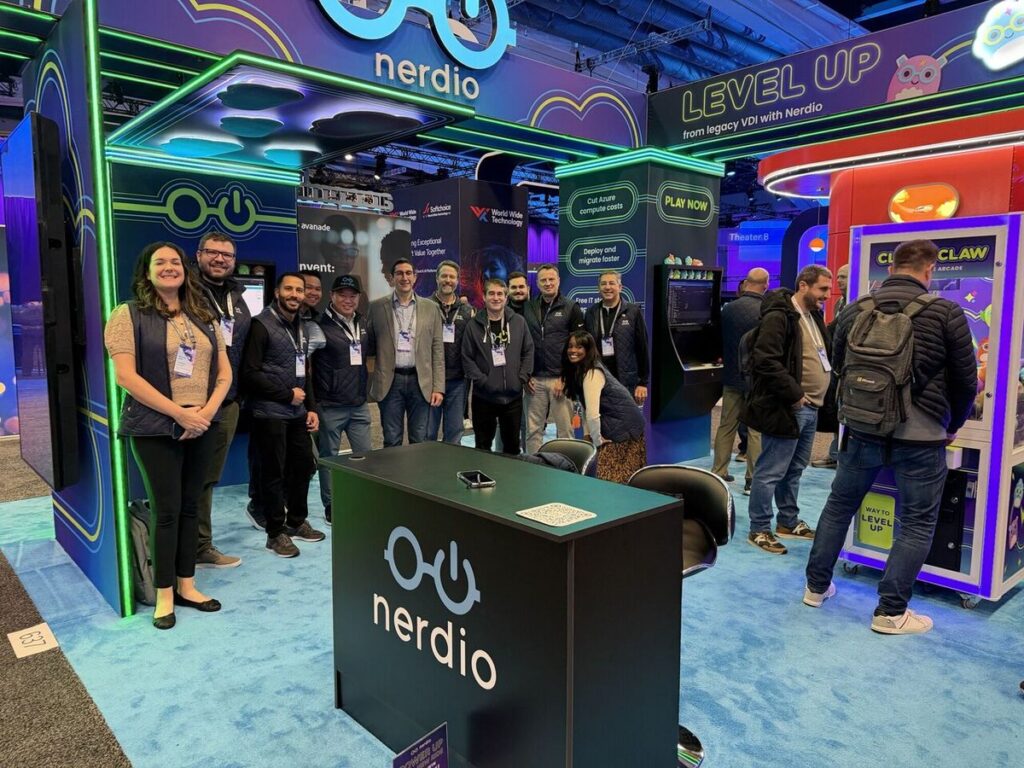
A Note Before You Read: I’ve been following Nerdio and Vadim’s work the past few weeks, paying close attention to the content, the conference, the community, and the story being built in public. What you see here comes from genuine curiosity, not criticism.
This analysis was assembled from publicly available sources: customer case studies, interviews, ESG reports, product documentation, conference recordings, and community conversations. I’ve tried to be accurate. If anything here is wrong, that’s a failure of information, not intent. I have no interest in misrepresenting what you’ve built.
The frame I’m working from is simple: no one can read their own label from inside the bottle. The people closest to a company are the last ones to see what the company actually is to the outside world. That’s not a flaw. It’s just proximity.
This entire article exists to answer one question: what business are you in?
Not what your product does. Not what problems it solves. What is the business, at the level of identity and transformation, that your decisions have been building all along?
I offer this with respect for the work you’ve done and the conviction that getting the answer right matters.
PS: Monopoly uncovered all the insights you’ll read in this perspective.
How to read this analysis
This article references my framework called the 4-Level Positioning Canvas. Here is a quick map so the Level 1 through Level 4 references make sense as you read.
The four levels, from weakest to strongest:
Level 1, FRAME (Articulate). The words a company uses to describe its positioning. I call this ‘framing.’ Easiest to develop, easiest to copy. Anyone can update a tagline.
Level 2, EXECUTE (Prove with Verbs). The measurable outcomes that validate what a company claims. Actions, metrics, results. A company can execute well and still be undifferentiated if there is no clear concept behind the effort.
Level 3, LIVE (Structural Embedding). When positioning stops being a messaging decision and becomes an organizational one. Resource allocation, hiring, partnerships, and structure all flow toward the same concept. The test: if a competitor had your P&L, what would surprise them?
Level 4, POSITION (Own the Noun). The concept that becomes synonymous with the company in customers’ minds. Volvo owns “safety.” Tesla owns “the future.” This level takes five to ten years to establish and cannot be claimed directly; it has to be earned through consistent decisions at every other level.
The sequence runs Level 4 down to Level 1: the concept comes first, then the language, then the proof, then the structure. Most companies operate at Level 1 while claiming Level 4. The gap between where a company actually operates and where it believes it operates is where this analysis lives.

Part 1: The Story They Tell
Vadim Vladimirskiy will tell you the Nerdio story as a series of good decisions made at the right time.
He will start with Adar IT, the managed services business he ran for years before Nerdio existed. He will describe how his team was drowning in the manual labour of managing cloud desktops for clients, how the repetitive scripting and configuration work was unsustainable, and how he began thinking about what it would look like to “take all of this technology enabled services that we were delivering and create technology that’s able to abstract all of the labour and remove all of the labour.” He built a tool for his own pain. The tool worked. He sold the MSP and went all-in on the software.
He will credit the outside-in methodology. “Being an outside-in company. Figuring out what customers’ real-world problems are and solving those problems as quickly as possible.” He will explain the five or six advisory boards, the thirty-plus structured feedback sessions per year, the practice of hiring customers as product managers, the two-week release cycles pushing twelve to twenty-four features at a time. He will tell you this is why Nerdio moves faster than everyone else.
He will credit discipline. The no-goal list. “If you’re not actively saying no, you’re not setting priorities, you’re just adding more things to do.” He will describe the decision to focus exclusively on Microsoft and end-user computing, and to refuse every request that falls outside the EUC domain. His VP of Product, Amol Dalvi, puts it bluntly: “We do not let ourselves get distracted by requests that are not related to the EUC domain.”
He will credit the Microsoft relationship. The board features Gavriella Schuster, former Microsoft Global Channel Chief, and Andy Lees, former Microsoft President. The hire of Scott Manchester, who ran Microsoft’s own AVD and Windows 365 division, as Chief Product and Technology Officer. The $350 million in influenced Azure revenue annually. Microsoft Americas Partner of the Year.
He will point to the metrics. Over $100 million in ARR, growing 85% year-over-year. More than 20,000 customers across 50 countries. 5 to 6.5 million users. A $500 million Series C that valued the company above a billion dollars. Profitability maintained during hyper-growth. The ESG Economic Validation study proving 55% average compute cost reduction and 50% admin time reduction.
He will describe the Citrix tailwind. His CRO, Joseph Landes, will say, “Citrix has been a tremendous tailwind to our business. I don’t think we’ve run into a Citrix customer who wants to stay.” Broadcom’s acquisition of Citrix and VMware triggered a wave of migrations, and Nerdio was positioned to capitalize on it.
And if you ask him the big question, what is Nerdio, he will say something like: the Microsoft Cloud management platform. The all-in-one solution that simplifies, secures, and saves. He will describe the product categories, the feature set, the expansion from AVD into Intune, Defender, Purview, Entra, and the full Microsoft estate. He will tell you the vision is total control over the entire Microsoft Cloud estate.
This is the story Vadim tells. It’s impressive. It’s also not what’s actually happening.
Part 2: The Hidden Position
Nerdio doesn’t own “Microsoft Cloud management.” They own command.
Command, as in the transformation that occurs when an overwhelmed IT professional, drowning in Azure portal complexity and manual scripting, suddenly has the entire Microsoft Cloud estate responding to their decisions instead of the other way around. Not simplification. Not automation. Not cost savings. The felt experience of being in command of something that was previously in command of them.
Every piece of customer language points here, and none of it says “management platform.”
- “It is the only product I have ever used that shows you the ROI in real time.” (ESG customer)
- “I do not understand why an AVD customer would not use Nerdio.” (ESG customer)
- “Fire-and-forget system.” (Sage)
- “90 minutes to get users up and running.” (Ceeva)
- “We explored AVD for half a year and were overwhelmed by the amount of data flowing at us.” (ESG customer, describing life before command)
- “We work differently now that we have Nerdio. The relationship between IT and business is more of a partnership.” (ESG customer)
- “The engineers who used to manage and deploy are now automating, scaling, and growing other areas.” (Sage)
None of these quotes describes a management platform. Every single one describes what it feels like to have command. The Sage customer didn’t say “we manage our desktops better.” They said they scaled from 200 to 1,000 customers without adding headcount, saving $1.5 million annually. That is the language of someone who went from reactive to commanding. The ESG customer didn’t praise a feature set. They expressed genuine confusion about why anyone would choose not to have this level of command. That is the language of procedural knowledge, the automatic assumption that command is the only rational state.
Penn State didn’t evaluate Nerdio against a feature matrix. They cut 71% of their AVD spend. Decision Digital didn’t run a pilot program. They went from 32-hour deployments to 15-minute deployments. Make-A-Wish UK didn’t file an RFP. They reduced their Azure bill by 40%. These are not purchasing outcomes. They are command outcomes. The numbers are the evidence. The feeling is the position.
The noun resolves every structural decision Nerdio has made, including the ones that look confusing from the outside.
Microsoft-only scope because command requires depth, not breadth. You cannot command something you understand superficially. Nerdio chose to know one ecosystem so thoroughly that it could absorb all its complexity on the user’s behalf. Joseph Landes: “100% of MSPs in the world are involved in the Microsoft cloud in some way, shape, or form. We chose one option and we’re going super deep.” Going deep is how you deliver command. Going wide is how you deliver features.
EUC-only feature set. The no-goal list. Refusing adjacent requests because command over a defined territory is worth more than coverage across a vague one. Every feature request they refuse is a signal that command is precise, not sprawling.
Single-tenant architecture. Running inside the customer’s own Azure subscription, not as a SaaS overlay. This is the most expensive architectural decision Nerdio made, and it only makes sense if you understand the noun. A management platform might be multi-tenant for efficiency. A command layer must reside within the customer’s own environment because you cannot command something you don’t fully possess. Single-tenant is the costly signal that proves Nerdio is not borrowing your cloud; it is giving you back your cloud.
Advisory boards of hands-on-keyboard users, not executive buyers. Hiring customers as product managers. Two-week release cycles. These are not just good product development practices. They are the structural proof that command flows from understanding. Nerdio listens to the people who actually type the commands so that the product can give those people command back.
Scott Manchester, the man who built AVD at Microsoft, leaving to become Nerdio’s CPTO is the costliest possible signal that command of Microsoft’s own desktop infrastructure now routes through Nerdio. When the architect of the building joins the company that manages the building, the building management company becomes something else entirely.
Selling Adar IT, the profitable MSP, to focus entirely on the software. This is not a strategic pivot. It is burning the boats. You do not sell a working business to build a management tool. You sell a working business to build something you believe will change the relationship between IT professionals and the Microsoft Cloud permanently. This is the costly signal that cannot be faked, because it costs something real.
The in-product ROI dashboard showing cost savings in real time. No other tool in the category does this. It is not a feature. It is the visible proof of command. You do not watch your money being managed. You watch your decisions working. The dashboard is a mirror that shows the customer their own command in action.
Remove all words. Strip the marketing, the taglines, the website copy, the conference slides. What pattern of decisions remains? A company that chose one ecosystem over all others. That chose depth over breadth. That chose architectural expense over architectural efficiency. That chose to hire its own customers. That chose to bring the architect of the platform into its own walls. That built a real-time proof mechanism into its own product. That holds thirty-plus feedback sessions a year with the people who actually touch the keyboards.
The pattern, without a single word of marketing, reads: we exist so that you are in command of the Microsoft Cloud. Costly signals, not cheap talk. The decisions required real investment. The marketing only requires a copywriter.
Now look at the competitive territory through this noun.
Citrix DaaS owns “legacy VDI,” a noun in decay. Omnissa and VMware Horizon own “on-prem VDI control,” which is a smaller territory shrinking by the year. Microsoft’s native AVD tools own “Azure ecosystem,” the platform itself, but Microsoft deliberately does not own the management layer. NinjaOne, Kaseya, and ConnectWise own “MSP operations,” which are adjacent territories, not the same territory.
Nobody owns command.
The concept of command over the Microsoft Cloud is vacant. Nerdio is proving it with every structural decision but has not named it. The competitors cannot claim it because their structural decisions point elsewhere. Citrix’s decisions point toward legacy. Microsoft’s decisions point toward platform breadth, not management depth. The MSP operations platforms point toward breadth across vendors. Only Nerdio’s decisions consistently, relentlessly, and structurally point toward command of one ecosystem.
This is how category transcendence works. Nouns establish territory, verbs prove it. “Microsoft Cloud management” is a product category. Any company can enter it. “Command” is mental territory. It is the identity customers experience after using the product, not a feature they evaluate before buying it. A management platform is compared based on its features. A command layer gets compared to nothing, because there is nothing to compare it to. You either have command or you don’t. And right now, across more than 20,000 organizations in 50 countries, IT professionals have command and don’t have the word for it.
Part 3: The Identity Layer
The Nerdio customer is not a demographic. They are not “mid-market IT administrators” or “MSPs with 50-500 seats” or “enterprises migrating from Citrix.” Those are targeting categories. The Nerdio customer is a specific person in a specific emotional state.
They are the IT professional who was told to “move to the cloud” and then left alone to figure out how. They are competent, technical, and often understaffed. They are surrounded by a Microsoft ecosystem that is enormously powerful and almost perversely complicated. They are spending their days in the Azure portal doing manual work that feels beneath their capability, writing scripts they will have to rewrite when Microsoft changes something, and defending their budget to executives who see cloud spending as an unpredictable cost center. They are firefighters who wanted to be architects.
Choosing Nerdio says something about you. It says: I am not willing to be managed by my own infrastructure. It says: I would rather command the cloud than perform manual labour inside it. It says: I value my time and my strategic contribution enough to use a tool that gives me both back.
This is not a purchasing decision. It is an identity statement.
There is even a skeptical version that proves the point. On Reddit, someone wrote: “Nerdio is the tax one pays for not knowing how to administer Azure.” The intent is dismissive. The revelation is profound. Even the critic acknowledges a value exchange is occurring. The person choosing Nerdio is trading one identity, the Azure expert who does everything manually, for another, the efficient commander who uses the right tool. The skeptic sees this as weakness. The customer sees it as intelligence. Both see the identity transformation. They just disagree on its value.
Vadim built this identity without naming it, because he lived it. He was the MSP operator drowning in manual labour. He built the tool that gave himself command. The product is an autobiography. Every feature traces back to a moment when someone at Adar IT was doing something manually that they should not have had to do. The outside-in methodology, the advisory boards, the customer-turned-PM hiring, these are not just practices. They are Vadim’s way of ensuring the product stays autobiographical, stays connected to the lived experience of the people who use it.

The founder’s identity unconsciously shaped the position. Vadim did not design the customer identity and then build a product to match it. He built a product that solved his own problem, and the identity of the customer was a reflection of his own identity all along: the technical operator who refuses to accept that complexity is inevitable, who believes systems can be built to absorb labour, who sees the cloud not as a burden but as something that should bend to the will of the person running it.
The “Nerd” in Nerdio is doing more identity work than any tagline. The NerdioCon tagline, “Where innovators, problem-solvers, and rebels unite to fight back against complexity, cost, and downtime,” is the closest thing Nerdio has to real identity positioning, and it lives on a conference banner, not in the corporate messaging. Customers call themselves “Nerdios.” They identify as “a Nerdio shop.” The PartNERD program names the community with the brand embedded. This is tribal belonging forming in real time, and it happens because the name itself grants permission. Being a nerd is your superpower. It is okay to be deeply technical. It is okay to care about the infrastructure layer that everyone else considers boring. This identity signal attracts exactly the right people and repels exactly the right people, which is what good positioning does.
The procedural knowledge is forming, but unevenly. In the MSP community, Nerdio has approached System 1 operations. On Reddit, MSPs recommend Nerdio for AVD without conscious evaluation, the way you might recommend a particular brand of tool without thinking about it. “Fire-and-forget” is the language of procedural trust, the kind of trust that does not require re-evaluation. When someone says, “I do not understand why an AVD customer would not use Nerdio,” that is not a product review. That is an automatic assumption. Neurons have fired together enough times that the association is wired.
In enterprise, it is still System 2. Conscious evaluation. Demo required. ROI justification. Comparison shopping on G2 and Capterra. “Is Nerdio still worth it?” threads on Reddit. The enterprise buyer arrives through analysis, not recall. This is where the missing noun creates a real cost. If the concept were named, if “command” were as associated with Nerdio as “search” is with Google, enterprise buyers would arrive already knowing, not needing to be convinced.
The distinction matters commercially. A System 1 sale happens before the salesperson enters the room. A System 2 sale happens because the salesperson enters the room. Nerdio’s MSP business is approaching the former. Nerdio’s enterprise business still requires the latter. The difference between these two is not sales methodology or go-to-market motion. It is the difference between a named concept and an unnamed one. When the concept has a name, the name does the selling. When it doesn’t, humans must.
The moment you claim, you weaken.
Nerdio’s strongest positioning asset is that the structural proof is doing the work, not the language. But there are places where the explicit claims introduce friction.
The explicit claims are not triggering major defence mechanisms, largely because the product genuinely pays for itself through Azure savings. Traditional procurement skepticism is partially bypassed when the tool generates measurable ROI within days. But there are small friction points. The “all-in-one” claim creates mild cognitive dissonance when the product is still heavily EUC-focused. Product renaming has introduced instability signals, with G2 reviewers noting the company “seems to be constantly renaming their products.” The claim to be “THE Microsoft Cloud management platform” feels oversized relative to the current scope, which triggers the subtle skepticism of overclaim.
This is the gap between operating at Level 2 and claiming Level 4. The structural proof supports Level 2-3 positioning; the explicit language reaches for Level 4 without having earned it perceptually. The proof is real but the claim feels oversized, and the mismatch creates the subtle cognitive friction that slows enterprise adoption.
Hebbian learning is occurring, but it is wiring toward the brand name rather than an owned noun. Customers have consistent, repeated experiences, product, NerdioCon, advisory boards, ROI dashboard, two-week releases, that reinforce the same concept. But because the concept is never named, the neural pathway forms as “Nerdio = good” rather than “command = Nerdio.” The brand gets stronger. The conceptual territory remains unclaimed.
Part 4: The Success Mechanics
Vadim didn’t choose tactics that created the position. The position determined which tactics would work.
Every tactical decision Nerdio made succeeds because it aligns with the implicit concept of command. The tactics look like smart choices. They were. But they worked because the underlying position made them obvious, not because they were clever in isolation.
The outside-in methodology works because command can only be built by someone who understands what the person in the chair actually needs to command. Every other company in the space builds for IT buyers. Nerdio builds for IT operators. The advisory boards are not a feedback mechanism. They are the structural guarantee that the command layer matches the command reality. This is why hiring customers as product managers is not just a nice cultural touch. It is the only way to ensure the product delivers the felt experience of command rather than the theoretical experience of management.
The Microsoft exclusivity works because command requires total knowledge of the territory being commanded. A multi-cloud tool can manage. Only a single-cloud tool can deliver command. The depth of integration, the auto-scaling engine, the real-time cost visibility, the policy automation, none of these would be possible at their current depth if Nerdio were splitting attention across AWS and GCP. The position chose the distribution, not vice versa.
The Azure Marketplace billing model works because command must be frictionless to acquire. Billing through Microsoft means the procurement bypass is built into the purchase mechanism. No new vendor approval. No separate billing relationship. The tool shows up inside the ecosystem it commands, purchased through the ecosystem it commands. The distribution channel is the position made operational.
The pricing architecture works as proof. Per-user-per-month consumption pricing for enterprise mirrors how cloud costs actually work; it signals that Nerdio lives in the same economic reality as its customers. Per-tenant-per-month for MSPs mirrors how MSPs bill their clients. The pricing does not ask customers to adopt a foreign economic model. It operates within their existing model, which is what command feels like. You do not have to change how you think to use this. It already thinks the way you do.
The free product during COVID was not a growth hack. It was a costly signal. When the world needed cloud desktops overnight, and Nerdio gave away the tool that delivered them, the signal was: we believe in the product enough to give it away, because we know what happens after you use it. What happens is command. And command, once experienced, is not returned.
Profitability maintained during 85% year-over-year growth. This is not a financial metric. It is proof that discipline is structural, not aspirational. Most companies at Nerdio’s growth rate choose to burn capital. Nerdio chose to grow within its means. This decision only makes sense if the underlying philosophy is about command, not conquest. You do not conquer a market by burning money. You command a market by being the option that cannot be removed.
NerdioCon works because it is the physical manifestation of the tribe that forms around command. The conference is not a product showcase. It is a gathering of people who share an identity: IT professionals who have figured out the Microsoft Cloud. The tribal language, “Nerdios,” “PartNERDs,” “innovators, problem-solvers, and rebels,” this language works because it names the identity the product creates. The conference is Level 3 structural embedding happening in real time, building the community infrastructure around the concept without ever naming the concept.
The IQ/EQ alignment is currently strong.
The inside-out capability, deep single-tenant Azure-native architecture, MSP-born operational DNA, Microsoft insider relationships, advisory board feedback loops, event-driven auto-scaling, is precisely what the market emotionally needs: relief from the sensation of drowning in Microsoft complexity. The structural capability directly addresses the emotional need. This is rare. Most companies have capabilities that partially overlap with market needs. Nerdio’s overlap is nearly complete.
But there is a growing risk. As Nerdio expands from AVD into the full Microsoft estate, Intune, Defender, Purview, Entra, Microsoft 365, the product is managing more complexity rather than eliminating it. The emotional promise customers heard was liberation from complexity. The product trajectory is toward comprehensive complexity management. These are different things. An IT professional who commands their AVD environment and then is told “now you can also manage Intune, Defender, Purview, and Entra through us” might feel empowered, or they might feel that the complexity has multiplied. The language determines which.
If the noun is “simplification,” the expansion breaks the promise. You cannot simplify by adding more. If the noun is “command,” the expansion strengthens the promise. More scope means more to command, which means the command layer is more valuable. The noun determines whether the growth strategy is coherent or contradictory. Right now, because the noun is unnamed, both interpretations coexist.
What is working accidentally
The structural decisions prove command without anyone at Nerdio using the word. The position chose the distribution, not vice versa, and it chose the architecture, pricing, hiring, and refusals, too. Vadim’s conscious narrative, the story of discipline and customer-centricity and Microsoft partnership, is true. But it describes the tactics. The position underneath explains why those particular tactics, and not others equally valid, were the ones that felt right.
What is missing: the conceptual crystallization that would make the structural proof legible. The Level 2 execution is strong, among the strongest in B2B SaaS. The Level 3 structural embedding is real, 100% of R&D on Microsoft technologies, board composition from Microsoft executive ranks, profitability maintained during hyper-growth, and NerdioCon as tribal infrastructure. The gap is between Level 3 and Level 4. The structural commitment exists. The perceptual monopoly does not. Customers know what Nerdio does, but cannot state, in one noun, what Nerdio is.
The Citrix tailwind is real, but tailwinds do not create perceptual monopolies. When the migration wave subsides, the positioning must be strong enough to win on pull, not push. Right now, a meaningful portion of Nerdio’s growth is an artifact of competitor self-destruction. That is not positioning. That is timing. Positioning is what remains when the wind stops.
Part 5: The Coaching Moment
Vadim, you think you built a Microsoft Cloud management platform. What you actually own is command.
Your customers are not buying management software. They are buying the experience of being in command of something that was previously in command of them.
Why the outside-in methodology worked: because command requires knowing what the person in the chair actually faces, not what the buyer in the meeting claims to need.
Why Microsoft exclusivity worked: because command requires total knowledge of the territory, and total knowledge requires total commitment.
Why the single-tenant architecture worked: because command lives inside the customer’s own environment, not on a vendor’s platform they have to trust.
Why the ROI dashboard worked: because it is not a feature; it is a mirror that shows customers their own command in action, in real time, with no one else’s interpretation.
Why NerdioCon worked: because it is the gathering of people who share the identity that command creates, IT professionals who have figured out the Microsoft Cloud.
The specific opportunity you are missing is semantic, not structural. The structural work is done. The execution proof is the strongest in your category. The advisory boards, the release velocity, the Microsoft insider relationships, and the architectural decisions all prove command. But because the concept is unnamed, every new customer must rediscover it through experience rather than arriving with it already understood. You are requiring 20,000 organizations to independently have the same insight, rather than naming the insight once and letting it propagate.
This is the gap blocking growth. It is not operational. It is not financial. It is not a product gap. It is a naming gap. The gap between Level 3 and Level 4 is a single noun, crystallized and repeated until the market can say it without being told.
Every decision your company makes should be filtered through one question: Does this deepen command?
The expansion into Intune, Defender, Purview, and Entra is correct, but only if the language evolves to frame expansion as expanded command rather than expanded features. “Now you can manage more of your Microsoft estate” is a feature announcement. “Now you command more of your Microsoft estate” is a position deepened. The words seem similar. The cognitive effect is entirely different. One adds to the customer’s workload. The other extends their authority.
The gap, stated plainly:
Current implicit position (what you demonstrate): “We absorb the complexity of the Microsoft Cloud so IT professionals don’t have to fight it.”
Explicit ownership position (what you could own intentionally): “When IT professionals need command of the Microsoft Cloud, Nerdio is the automatic, unconsidered answer.”
The first is proven structurally by everything you’ve built. The second is what happens when you name it.
The functional benefit layer is clear: Azure costs cut 55% on average, admin time reduced 50%, deployment compressed from weeks to hours, and infrastructure scaled 5x without headcount. These are the verbs. They are strong verbs. They are doing real work in the market.
But the benefit is the proof. The transformation is the position. Positioning happens after the fact.
What do your customers become after experiencing these benefits? They become IT professionals who command the Microsoft Cloud. Not manage it. Not maintain it. Not survive it. Command it. The Sage customer did not just save $1.5 million. They became the team that scaled 5x without adding a person. The ESG customer did not just cut costs. They became the department whose “relationship with the business is more of a partnership.” The engineers who “used to manage and deploy” became engineers who are “automating, scaling, and growing other areas.”
Not what they received. What they became.
This matters because benefits can be competed away. A competitor can build auto-scaling. A competitor can offer cost optimization. A competitor can create dashboards. But a competitor cannot replicate the transformation from overwhelmed administrator to commanding strategist, because that transformation is not a feature. It is the accumulated result of every structural decision you have made over years, embedded in community belonging, reinforced by tribal identity, proven by costly signals that no new entrant can replicate on day one.
The benefit is the proof. The transformation is the position. You have been naming the proof and leaving the position silent.
You built the structural proof. You built the execution evidence. You built the community. You built the Microsoft relationship deeper than any competitor will ever replicate. The only thing you have not built is the word for what all of it means. And that word is the difference between customers who choose you after evaluation and customers who choose you without it.
Three questions to sit with:
If you removed every mention of features, cost savings, and automation from your messaging, and instead described only what your customers become after using Nerdio, what would you say?
When a customer calls themselves “a Nerdio shop,” what are they actually claiming about their own identity, and how would your product decisions change if you optimized for that identity rather than for feature coverage?
Your expansion into the full Microsoft estate either deepens command or dilutes it; which framing does your current language support, and which framing would you choose if you were naming the noun explicitly?
If a competitor built every feature you have today, what would you still own that they couldn’t replicate, and can you say it in one word?
Here is the position, stated cleanly.
Nerdio does not simplify the Microsoft Cloud. Nerdio gives IT professionals command of it. The product is the mechanism. The savings are the proof. The community is the tribe. But the position, the thing that lives in the customer’s mind after the product has done its work, the thing that no competitor can copy because it was built by a decade of structural decisions and not by a marketing campaign, is command. It was always command. Now you can do it on purpose.
Uncover Your Position
Every company has a hidden position. The concept their decisions prove but their language hasn’t named. The noun that explains every success and every confusion. The identity transformation their customers experience but cannot articulate.
Nerdio’s was command. What’s yours?
The CEO Clarity Starter Kit is a focused engagement that reveals what concept your company actually owns, what level you operate at, whether you’re proving implicitly or claiming explicitly, and what single transition would unlock your next stage of growth.
For founders ready to go deeper, Monopoly is the full strategic engagement: crystallizing the noun, aligning every level of the business around it, and building the structural proof that makes your position unassailable.
Stop naming the benefit. Start naming the transformation.
Learn more about the CEO Clarity Starter Kit →
Explore Monopoly →
Leave a Reply
You must be logged in to post a comment.