
Note Before We Begin: This analysis exists because I’ve been watching Justin Welsh’s work for years and genuinely admire what he’s built. The consistency. The refusals. The quiet proof. It’s rare to see someone walk away from easy money because it doesn’t fit how they want to live.
I wrote this because I love looking deeper into what makes a business connect to identity, not just what a company or person sells, but what it actually means to the people who choose it.
I’ve done my best to gather accurate information from public sources, interviews, newsletters, and published content. If I’ve gotten something wrong, it’s not intentional. My goal isn’t to misrepresent anything; it’s to offer an outside perspective on something that’s genuinely difficult to see from the inside.
There’s a phrase I come back to often: no one can read their own label. The person running the business experiences it from inside the jar. They see every decision, every tradeoff, every late night. But customers experience something different. They see patterns that the founder might not even notice. They use language the founder never chose. They feel something the founder never explicitly said.
This analysis is an attempt to read the label.
Justin, if you ever read this, you may disagree with parts of it. You have data I don’t have. You have context I can’t access. You’ve lived this for six years while I’ve only observed from a distance. Your perspective is valid, and this isn’t meant to override it.
But sometimes an outside read can surface something useful. A pattern you hadn’t named. A strength you’d undervalued. A gap between what you do and what you say you do.
The entire premise of this article is to answer only one question:
What business are you actually in?
Not what you sell. Not what your website says. Not what your tagline claims.
What do your decisions, over the years, prove you believe?
That’s what this tries to uncover.
PS: Monopoly uncovered all the insights you’ll read in this perspective.
Part 1: The Story Justin Tells
If you only listened to Welsh’s explicit narrative, you’d hear something like this:
He’s “The $10M Solopreneur,” building a portfolio of one-person businesses with zero employees. He helps “100,000+ burned-out corporate professionals” build six-figure, one-person online businesses. He sells operating systems: LinkedIn OS, Content OS, Creator MBA, along with templates, newsletters, and community access that teach audience growth and solopreneurship.
His proof headlines are strong: $0 to $10M+ as a one-person business with 86-94% profit margins. 47,000+ students in LinkedIn OS alone. #1 global LinkedIn thought leader. The origin story is clean: high-performing startup exec, burnout and panic attack, walks away, designs a one-person business that now makes millions.
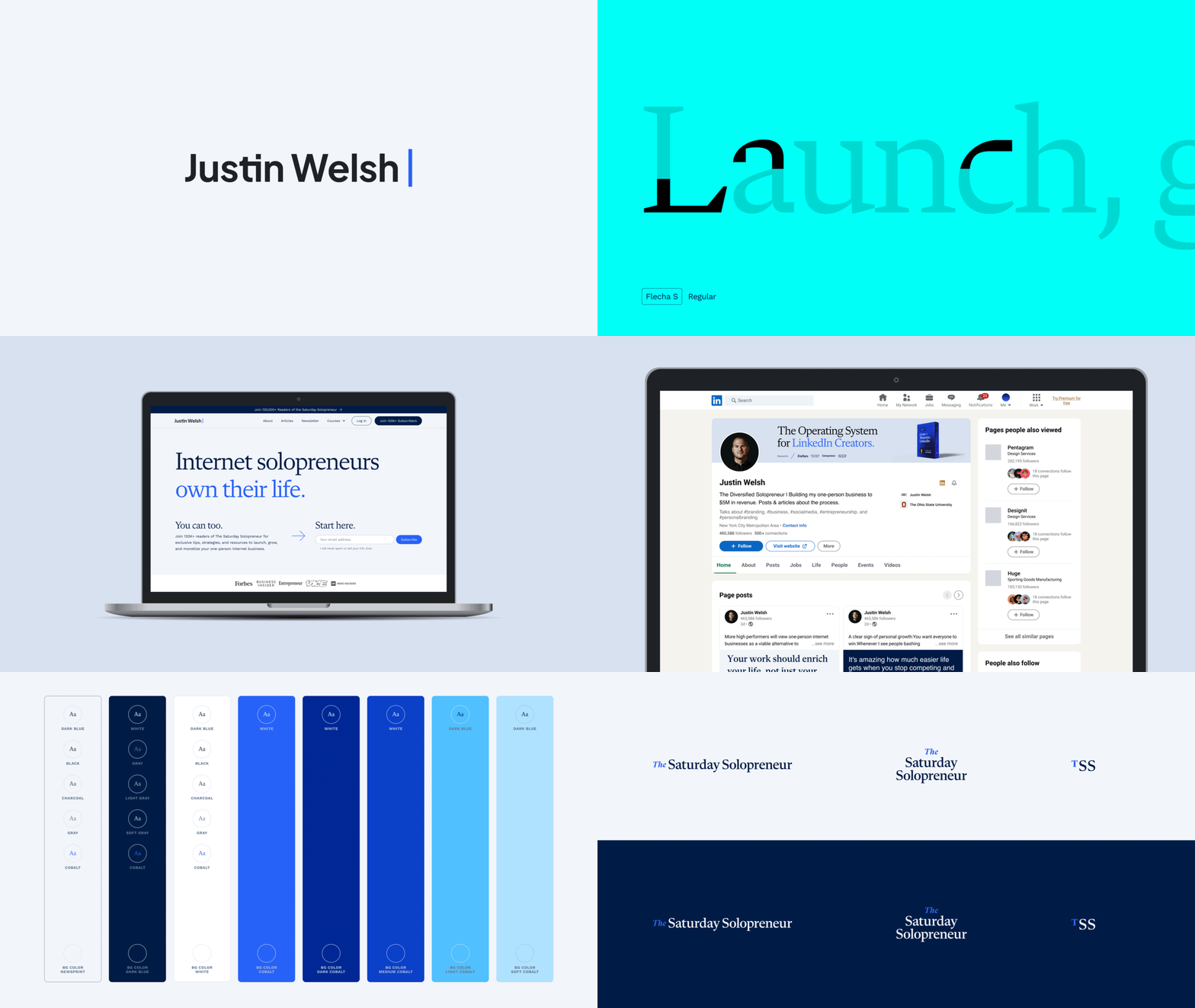
In 2023, Welsh worked with Ceremony, a branding agency, to articulate his brand promise. They landed on something elegant: “Freedom from. Freedom to.” The framing positions him as “an advocate for and an example of pursuing an authentic life. A life with more impact, more richness and more fire. A life with freedom from the 9-5. A life with freedom to live on purpose.”
This is excellent brand work. It captures the emotional destination his customers are seeking. By his own account, he’s “converting at an all-time high” since the rebrand.
But branding and positioning operate at different levels.
Branding is how you express your position: the language, visuals, and emotional promise. Positioning is what you own in minds: the concept that becomes synonymous with you through consistent proof.
Ceremony gave Welsh a strong Level 1 frame. The question this analysis asks operates deeper: What concept do his decisions prove, regardless of language?
The Linguistic Architecture
Examining Welsh’s language through the lens of nouns, verbs, and adjectives reveals a pattern.
Nouns he uses frequently: solopreneur, one-person business, operating system, portfolio, leverage, freedom. These establish territory.
Verbs he leans on: build, escape, productize, simplify, automate, leverage. These prove capability.
Adjectives he uses sparingly: diversified, profitable, high-leverage, anti-hustle. Welsh avoids superlatives. He substitutes quantitative proof, “$5M,” “175,000 subscribers,” “94% margin.”
But there’s a word in his own bio that he doesn’t fully claim: ‘own’.
“I help internet solopreneurs own their work and life.”
He says it. He doesn’t position around it. He retreats to verbs: “I help.” “I teach.” “I build.”
The concept is hiding in plain sight.
Part 2: The Hidden Position
Apply the “Remove All Words” test.
Delete the taglines, bios, website copy, and social posts. Strip away “Freedom from. Freedom to.” Strip away “The $10M Solopreneur.” What pattern of decisions remains?
The Decisions That Prove Ownership
Zero full-time employees at $10M+ revenue. Welsh has the capital to hire. He refuses. This isn’t a resource constraint; it’s a structural commitment to owning every aspect of his business without dependency on others.
No investors, ever. Full ownership of decisions. No board to please. No returns to chase. No exit pressure. No one else’s timeline.
Rejected a $100,000 consulting offer because it required weekly commitments and travel. He chose ownership of his time over significant income.
Shut down a $180,000/year recurring community after 15 months because it required “24/7 Slack presence.” He took back ownership of his attention.
Closed his $750K+/year consulting practice when course sales hit $2K/day. He chose ownership through leverage over rental through services.
Priced courses at $99-150 when the market supports $997-2,997. This isn’t charity, it’s democratizing access to ownership tools.
Zero paid advertising on a $10M business. He built and owned a distribution channel (email list, organic social) rather than renting attention from ad platforms.
Built “Operating Systems” instead of courses. The framing matters: once you have the system, you own the capability. It transfers. It’s yours.
Testing “Ownership” as the Organizing Concept
The focal-point test asks: remove the proposed concept, and do the decisions still cohere?
Remove “ownership” from Welsh’s business. Do his decisions make sense?
- Zero employees at $10M? Irrational without ownership as priority.
- Rejecting $100K consulting? Irrational without ownership of time as a priority.
- Shutting down $180K/year community? Irrational without ownership of attention as priority.
- No investors ever? Irrational without ownership of decisions as a priority.
- $99 pricing in a $997 market? Irrational without democratizing ownership as a priority.
Every decision points to ownership. Remove the concept, and the pattern dissolves into irrationality.
This is how you know it’s the real position.
What Noun Do Customers Actually Use?
In customer testimonials, revealing language emerges:
“I own my mornings now.”
“I finally built something that’s mine.”
“I own the process.”
“This is mine.”
Customers don’t say “I’m free” as often as they say “I own.” They describe the result in ownership terms, even when the marketing uses freedom language.
This is the signal. The market is telling Welsh what he actually sells, in their words, through their experience.
The Transformation Arc
Before Justin, customers described themselves withthe language of dependency:
“I was stuck in back-to-back meetings.”
“I was renting my time to someone else’s dream.”
“I had a title but no control.”
“I was successful on paper but felt trapped.”
After Justin, the language shifts to ownership:
“I built something mine.”
“I own my time.”
“I control my calendar.”
“I designed my business around my life.”
The transformation isn’t about making money online. It isn’t about LinkedIn growth. It isn’t even about solopreneurship.
The transformation is from renting to owning.
Renting your time to employers. Renting your identity from job titles. Renting your security from companies that could fire you tomorrow. Renting your creative output to organizations that own the IP. Renting your attention to whoever demanded it next.
Welsh’s customers have spent their careers renting. They didn’t own anything. Not really. Even high salaries were just higher rent.
Ownership is the antidote to dependency. That’s the emotional resonance. That’s why the position works.
Part 3: The Level Diagnostic
Where does Welsh actually operate versus where his language suggests?
Level 4 – POSITION (Own the Noun): Achieved Through Decisions
Welsh has achieved procedural knowledge status in his category. When creators think “grow on LinkedIn” or “build a solopreneur business,” Welsh comes to mind automatically — not through conscious evaluation, but through pattern recognition built over six years.
The evidence: “Who is the Justin Welsh in Spanish?” treats his name as a category descriptor. Competitors like Dan Koe deliberately use “one-person business” to avoid Welsh’s claimed territory. When people discuss solopreneurship in the creator economy, the term ‘Welsh’ comes to mind almost automatically.
The association is procedural, not declarative. People don’t consciously think “Justin Welsh is good at solopreneurship”; they think “solopreneur,” and his face appears. This is the strongest form of positioning: unconscious categorization rather than evaluated comparison.
But the noun he owns through decisions (ownership) differs from the noun he claims through language (solopreneur/freedom). This creates a gap.
Level 1 – FRAME (Articulate): Strong But Misaligned
Ceremony’s “Freedom from. Freedom to.” is excellent Level 1 work, emotionally resonant, linguistically clean, and clearly articulated.
But there’s a subtle misalignment. The brand promise is freedom. The proof mechanism is ownership. These work together, but they’re not identical.
Freedom is what customers feel.
Ownership is what Welsh’s decisions demonstrate.
The framing captures the emotional destination. It doesn’t fully name the structural proof that makes the destination credible.
Welsh’s website bio says, “I help internet solopreneurs own their work and life.” The word “own” appears but is buried mid-sentence, subordinated to the verb “help.”
Here’s how to think about this internally (not to be explicitly stated in your marketing or website). Strong noun-ownership language would lead with the concept:
“I am ownership for solopreneurs. My business proves that one person can own their time, their work, and their life, and I give you the systems to do the same.”
Or integrated with the freedom framing:
“Freedom from. Freedom to. Freedom through ownership.”
Level 2 – EXECUTE (Prove with Verbs): Exceptional
This is Welsh’s strongest level. His offerings enable specific, measurable actions:
- “Plan and produce a month of content in 40 minutes”
- “Go from 0 to 400,000+ followers in 12 months”
- “Build a six-figure one-person business”
The execution proof is structural. His 75-minute courses achieve 45% completion, compared to the 13.8% industry average. He didn’t lengthen to justify higher prices; he shortened to improve outcomes. That’s Level 2 proof of his position: simplicity and ownership of the learning process.
Testing against the Five Execution Questions:
- What specific action? Build a one-person business you own. Clear.
- What baseline? Corporate dependency or freelance chaos. Clear.
- What measured improvement? Variable across students. Could be stronger.
- How do customers verify? Testimonials, visible outcomes. Moderate.
- What timeline to value? Implied months. Could be more specific.
Three of five answered strongly. Room for standardization, but the foundation is solid.
Level 3 – LIVE (Structural Embedding): Excellent
More than 70% of resources demonstrably flow to positioning-critical capabilities. His tech stack is entirely content-and-course focused. His 4 hours/week content creation uses a hub-and-spoke model. The “Operating System” branding embeds systems thinking into product names.
The refusal to hire is the ultimate structural embedding. It forces the business to live the reality of ownership. He cannot cheat and throw bodies at a problem; he must build a system, an ownership tool, to solve it.
The P&L test: If competitors had Welsh’s P&L, what would shock them? The combination of $10M+ revenue with zero employees, 86-94% margins, and zero ad spend. This is the financial signature of ownership.
The Gap Analysis
Welsh operates at Level 4 through decisions but articulates at Level 1 around freedom/solopreneurship rather than ownership. The blocking issue is linguistic alignment, the concept his actions prove isn’t the concept his words fully claim.
This isn’t a criticism of Ceremony’s work. “Freedom from. Freedom to.” is the emotional promise that resonates with customers. The question is whether adding “ownership” as the explicit proof mechanism would strengthen or dilute the position.
My analysis suggests it would strengthen it. Ownership is provable. Freedom is claimable. In a market full of freedom claims, ownership proof creates differentiation.
Part 4: The Identity & Cognitive Layer
What Identity Does Choosing Welsh Enable?
Before Welsh: “I’m a VP at Company X.” Identity rented from employer.
After Welsh: “I own my work and life.” Identity owned by self.
Choosing Welsh enables the identity of “owner, not renter.” It says: I stopped renting my time, my creativity, my identity, my life. I built something mine.
The tribe signal: Owners vs. Renters.
No one wants to be a renter. Renters are dependent, precarious, building someone else’s dream. Owners are autonomous, secure, and building their own.
Welsh’s redemption narrative powers this identity transformation. Fired multiple times. Panic attack as a VP. Walked away from a prestigious career. Set his own definition of success. That story tells every burned-out professional: “You’re not crazy for wanting out. Here’s proof it works.”
Procedural vs. Declarative Knowledge
Welsh has achieved procedural knowledge for “solopreneur” in the creator economy. The association is automatic.
But the deeper concept, ownership, remains more declarative. Customers can explain why they chose him: “systems,” “clarity,” “proof,” and “affordable.” That’s System 2 reasoning, slow, comparative, conscious.
The opportunity is to wire “ownership” as deeply as “solopreneur.” When someone thinks “I want to own my work and life,” Welsh should surface automatically. Currently, that pathway is forming but incomplete.
Defence Mechanisms
Welsh largely avoids triggering skepticism. His claims are proof-backed (“$10M at 86% margins”) rather than quality-based (“I’m successful”). He shows P&L statements. He admits failures. He demonstrates vulnerability through his burnout story.
The primary skepticism vector is income verification; critics question whether stated revenue is accurate. But this skepticism is contained by structural proof. The visible refusals (shutting down $180K/year, no team at $10M) make “he’s not actually successful” untenable as a position.
His implicit proof creates a defence against criticism. The skeptic pattern is “I’m not sure his exact numbers are real” rather than “I don’t believe he’s successful.” The structural proof has already won the larger argument.
Is Hebbian Learning Occurring?
Six years of consistent decisions: solo scale, organic growth, transparency, refusals. Neurons are wiring “Welsh = ownership through systems.”
But the messaging evolution, from “LinkedIn guy” to “solopreneur” to “freedom,” has created some noise in the signal. The decisions are consistent. The language has shifted.
For maximum Hebbian consolidation, the explicit framing needs to match the implicit proof. When language and decisions align perfectly, the neural pathway becomes unbreakable.
Part 5: Success Mechanics
What’s Actually Working
The refusal portfolio is the real positioning statement. Shutting down $180K/year. Closing $750K consulting. Rejecting $100K offers. Refusing employees. Each “no” proves the “yes” to ownership more powerfully than any claim could.
Competitors cannot copy these refusals by changing their messaging. They would have to actually walk away from money. That’s costly signalling. The kind that creates defensible positions.
Building in public became a moat accidentally. Welsh’s transparency about revenue, failures, and process started as experimentation. It became his competitive advantage. Radical transparency is a costly signal that proves the system works.
Brevity created completion unintentionally. Shorter courses (75 minutes vs. industry-standard 20 hours) hit 45% completion vs. 13.8% average. He didn’t theorize about optimal length; he discovered it through iteration. Now it’s a structural advantage competitors can’t easily copy without cannibalizing their premium pricing.
Accessible pricing signals abundance. At $99-150 when the market supports $997-2,997, Welsh signals: “I don’t need to charge a premium because my business model doesn’t require it. Volume through value.” The pricing proves the ownership model works at scale.
LinkedIn’s timing created a first-mover advantage. Welsh went all-in when LinkedIn was “uncool” for creators. The position (ownership for corporate escapees) chose the distribution (where corporate people live). By the time competitors arrived, he owned the territory.
IQ/EQ Alignment
Inside-Out (IQ): Welsh can structurally deliver systematic ownership transfer. His unfair advantages include executive-level operational thinking (VP of Sales managing 150+ people and building $70M in ARR), six years of compounded content assets, and platform-first-mover status on LinkedIn. His actual business validates the frameworks he teaches.
Outside-In (EQ): The unmet emotional need is ownership. His audience has spent careers renting time, identity, security, and creativity. They want to own something. They want proof it’s possible.
Intersection: Welsh’s capability (systematic ownership tools from a former corporate operator) meets unmet market need (burned-out professionals seeking proof of a viable ownership path) perfectly. His origin story for his panic attack authentically connects with his audience’s emotional state. His $10M solo proof validates the path they want to take.
Vulnerability: The “operating system” framework is increasingly replicable. Dan Koe targets identical psychographics with similar messaging and a larger YouTube reach. The intersection remains strong but is becoming contested.
What’s Missing
Explicit ownership framing. “Freedom from. Freedom to.” captures the emotional promise. Adding “through ownership” would complete the proof mechanism.
Standardized execution metrics. The Five Execution Questions aren’t consistently answered across products. More specific timelines and verification methods would strengthen Level 2.
Promotional alignment. Welsh teaches “Decision Simplifier,” fewer, clearer offers. But Black Friday promotions with multiple tiers create complexity that contradicts the teaching. The misalignment weakens implicit proof.
Part 6: The Coaching Moment
Welsh has built something rare: a business whose decisions prove a powerful concept that his words don’t fully name.
He’s doing things right, but often for unexplained reasons. Transparency was accidental; now it’s a moat. Brevity was experimental; now it’s a differentiator. Refusals were a preference; now they’re positioning proof.
The opportunity is to do it on purpose. To name what he owns. To let “ownership” become explicit.
The Integration of Freedom and Ownership
This isn’t about replacing “Freedom from. Freedom to.” It’s about completing it.
Freedom is the promise. Ownership is the proof.
You get freedom by owning:
- Own your time → Freedom from the calendar
- Own your income → Freedom from employers
- Own your distribution → Freedom from algorithms
- Own your decisions → Freedom to live on purpose
Ceremony captured the destination. Ownership is the road.
The complete articulation:
“Freedom from. Freedom to. Through ownership.“
Or in bio form:
“I help people stop renting and start owning their work and life.”
Or framing:
“Justin Welsh is ownership for solopreneurs. His business proves one person can own their time, work, and life, and he gives you the systems to do the same.”
Specific Recommendations
Name the noun explicitly.
Welsh’s decisions prove ownership. His language should claim it. Not replacing freedom, but grounding it:
Current: “I help internet solopreneurs own their work and life.” Shifted: “I help people take ownership of their work and life and prove it’s possible by owning mine.”
The word “ownership” moves from a buried verb to a featured noun.
Reorganize products as ownership tools.
Current product names describe methods:
- The LinkedIn Operating System
- The Content Operating System
- The Creator MBA
Ownership-centred framing describes results:
- Own Your Distribution (LinkedIn OS)
- Own Your Content (Content OS)
- Own Your Business (Creator MBA)
Each product becomes a component of the ownership stack, not a standalone tactic.
Add one or two more “Costco hotdog” decisions.
Welsh already has his signature move: zero employees at $10M.
Additional ownership-proving decisions could include:
Headcount cap pledge: Publicly commit to never having more than one full-time employee, ever. Make it constitutional.
Price stability commitment: Publicly cap core product prices for a defined period, demonstrating that the ownership model doesn’t require price escalation.
These decisions would make traditional growth consultants wince. That’s the point. The question “Why would you do that?” should have one answer: “Because ownership is non-negotiable.”
Align promotions with philosophy.
The “Decision Simplifier” framework says: fewer, clearer offers.
Promotional periods should demonstrate this:
- One offer at a time
- One decision (now or later)
- One landing page
“We never run more than one live offer at a time because confusion kills ownership of the learning process.”
The promotion becomes proof of the position.
Measure procedural, not just declarative.
Current success metrics measure awareness and conversion. These are valuable but incomplete.
Ownership-specific metrics:
- First-name recall: “Whose name came to mind first when you thought about owning your work and life?”
- Comparison set size: “Who else did you seriously consider?” (Goal: shrink this list)
- Category entry triggers: What words activate the pathway to Welsh?
These measure automatic association, procedural knowledge, not just conscious awareness.
The Level Transition
Welsh’s opportunity isn’t building more. It’s naming what exists.
Current state:
- Level 4: Operating (owns concept through decisions)
- Level 3: Strong (structure embeds position)
- Level 2: Moderate (execution proves, but could be standardized)
- Level 1: Strong but incomplete (freedom without explicit ownership proof)
Target state:
- Level 4: Operating and articulated (ownership explicitly named)
- Level 3: Strong (maintained)
- Level 2: Strong (standardized metrics across products)
- Level 1: Complete (freedom promise + ownership proof)
The transition is linguistic, not operational. The business already proves ownership. The language needs to name it.
The Position, Stated
What business is Justin Welsh actually in?
He’s not in the solopreneur education business. He’s not in the LinkedIn growth business. He’s not in the content systems business.
He’s in the ownership business.
He helps people transition from renting their work and their lives to owning them.
The products are ownership tools:
- LinkedIn OS = Own your distribution
- Content OS = Own your creative process
- Creator MBA = Own your business model
- The Saturday Solopreneur = Own your weekends (then your weeks, then your life)
The refusals are ownership proofs:
- No employees = Own your operations
- No investors = Own your decisions
- No consulting = Own your time
- No community = Own your attention
- No ads = Own your growth
The brand promise captures the feeling:
“Freedom from. Freedom to.”
The positioning proof provides the mechanism:
Through ownership.
The lifestyle is the advertisement:
- Catskills = Owns his location
- Subaru = Owns his definition of enough
- Target = Owns his anti-status status
- 4-hour weeks = Owns his calendar
Every piece points at the same noun.
Closing: The Position That Chose Him
Justin Welsh didn’t set out to build “the ownership business.” He set out to escape burnout, build something sustainable, and help others do the same. But positioning doesn’t require intent. It emerges from consistent decisions. It reveals itself through patterns that the founder often can’t see.
Welsh’s decisions (over six years, through millions in revenue, across hundreds of refusals) prove one concept: ownership.
The strongest positions are never explicitly stated. They are implicitly proven through consistent decisions that create procedural knowledge in customers’ minds.
Welsh has done the hard part. He’s proven the position through costly signals that competitors cannot fake. He’s built a business that is the advertisement for what it teaches. He’s achieved procedural knowledge status where his name is synonymous with a category.
The remaining opportunity is significant but straightforward: name what he owns.
Not to replace “Freedom from. Freedom to.” That’s beautiful brand work that resonates deeply. But to complete it. To ground the emotional promise in structural proof. To make explicit what his decisions have already made true.
“Freedom from. Freedom to. Through ownership.”
The position chose him. Now he can choose to name it.
The One-Sentence Position
If distilled to a single sentence that captures what his decisions prove:
“I help people take ownership of their work and life, and I prove it’s possible by owning mine.”
That’s the business he’s in.
Everything else is distribution.
Find what you own in sixty minutes

Before you hire a messaging consultant to wordsmith your homepage, or an agency to “refresh your brand,” or someone to fix what they’ll call positioning (but is really just tactical framing), try this first.
The CEO Clarity Starter Kit
It does exactly what we just read. It helps you find and own your noun.
What you do:
- Run the Position Audit (reveals what noun you might already own without knowing it)
- Complete the 8-Question Advisor (the same questions that would surface “ownership” for Justin Welsh)
- Feed the output into ClarityGPT (included)
What you get:
- Your noun. The concept you can actually own, not just claim
- A 4-Level Positioning Canvas showing how to move from saying it to OWNING it
- ClarityGPT translates your position into landing pages, offers, and LinkedIn profiles (written in your buyer’s voice, not consultant-speak)
- A 30-day positioning course so you can apply this method without me
Time required: About an hour (less time than reading three more case studies about tactics that won’t work without position)
Who’s used it: 200+ CEOs and founders who were tired of pushing uphill
Investment: $249 USD
Most realize they don’t need the consultant or agency after this. Or they need far less than they thought. Because once you know your noun (your position), the tactics become obvious. The distribution chooses itself. The customers explain you better than you explain yourself.
And yes, if you buy the kit, it nudges me closer to that Porsche in the photo. Thanks in advance for supporting excellent positioning and questionable life choices.

Stop competing on features. Start owning concepts.
Leave a Reply
You must be logged in to post a comment.