
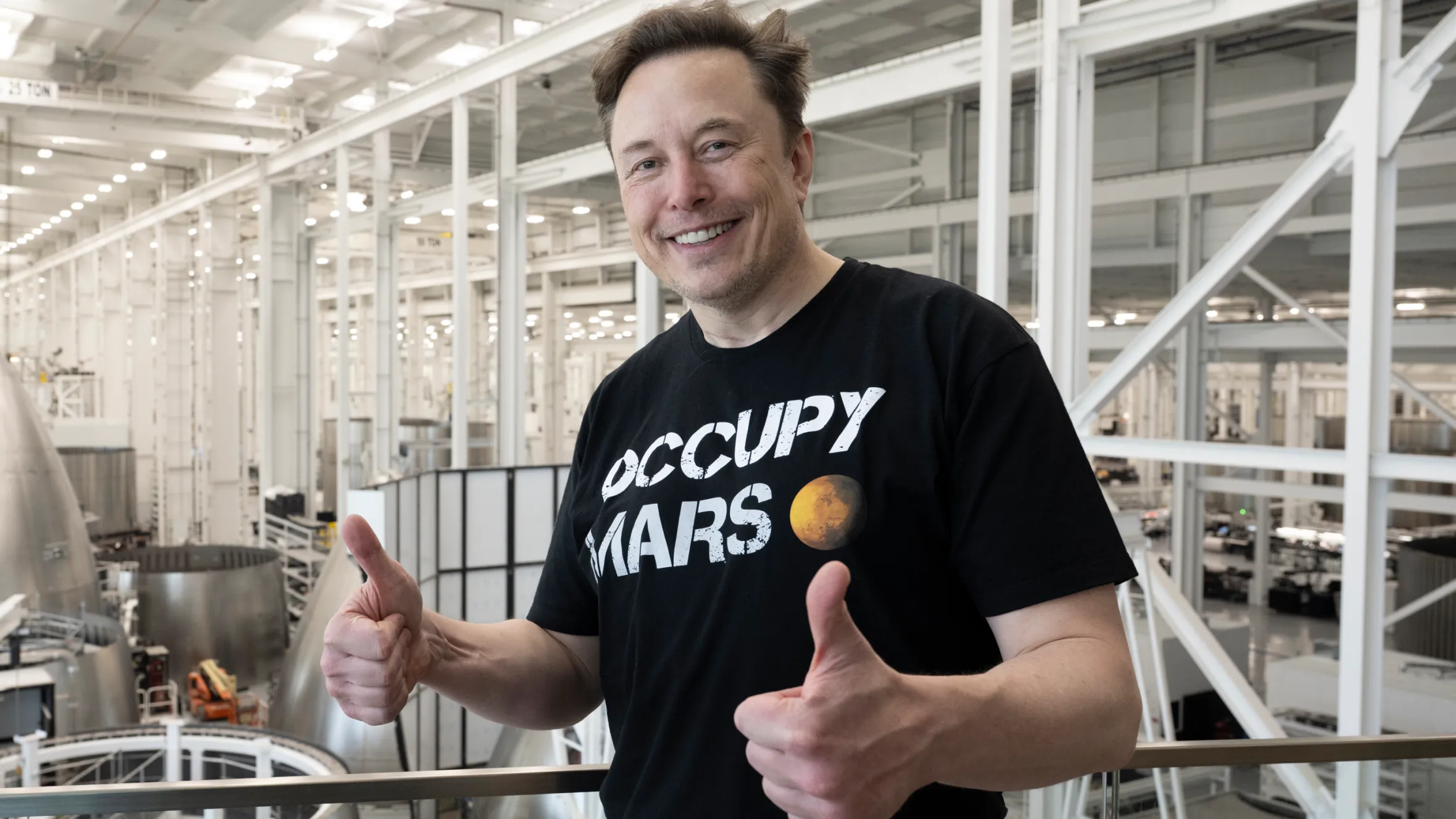

A note before you read this: SpaceX has been operating for 24 years, and the part of the company most worth respecting is the part the financial press does not write about: the engineering culture, the cadence, the tolerance for failure as a method, and the willingness to ship at scales nobody else attempts. This is not a company that coasted.
I am not a journalist, and this is not an investigation. I run a positioning practice. I look at companies the way a structural engineer looks at a building. Not to judge the architecture. To understand what is actually holding it up.
The premise of this analysis is one question. What business are you in? Not what you say you are in. Not what the S-1 says. What the capital flows, the contracts, the refusals, and the customer language say when the words are stripped away.
I have done my level best to get the facts right. If anything here is wrong, I want to know. My intention is not to misrepresent anything, and I have no stake in the outcome of the IPO or any adjacent position.
The reason I am doing this at all is a principle I have come to trust: no one can read their own label from inside the bottle. Founders are too close. The story a founder tells is the story they needed to believe to get this far, which is exactly why it deserves a second look from the outside.
If Elon reads this and disagrees with the diagnosis, that is fair. He has data I do not. I am reading what I can see and writing down what it says.
That is the whole point.
TL;DR — For Elon
You think you built a road to Mars. The customers describe what they became after buying from you, and the noun that contains every register of their description is one you have not named. A farmer in Wisconsin, a general at U.S. Space Force, a finance minister in Jakarta, an engineer at Anthropic, and a payload chief at Argotec each describe a line they could not cross before you and can cross now. They each use different words for it. The noun that contains every register is frontier. The work earned it. The label has not been used.
Frontier has been the operating filter the whole time. The word does not appear in the S-1 or in any shareholder letter, and the filter shows up in every decision the company has made under pressure. It is why Starship V3 chose deployment capacity over the iconic reusability demo six days before the IPO pricing window. It is why Starlink runs as a meter, not a product. It is why you wrote a $17B check for EchoStar spectrum, why Anthropic signed $15B a year for compute, why the European Commission funded a bridge it called dangerous. Every one of those decisions is coherent under one noun. None of them is coherent under any other.
The IPO is the one morning the entire investor class reads the same document, and the operating sections of that document either teach the analyst class the noun that has been running the company or teach them a feature word that contradicts the filter. If the document teaches the wrong noun, the wrong noun sticks for years, and subsequent capital allocation, customer acquisition, and talent compete against someone else’s word. If the document teaches the right noun, the inside of the company and the language the analyst class arrives at on its own run on the same line, and the compounding you have already been getting compounds in the same direction instead of against itself. This is the game across decades. The bell is leveraged on it.
The word is frontier. The work has two faces, and they are not symmetrical. Internally, frontier is explicit. It runs the operating model, capital allocation, hiring screens, refusal list, and the strategy section of the S-1. Externally, frontier is mostly silent. The brand expresses it. Customers describe what they became after buying. Nike does not say “we are an athletic-performance company.” They say “Just do it,” and the customer arrives at performance on their own. Volvo says safety sometimes, because 60 years of crash tests have filed the proof before the word was ever spoken. Stating the internal noun externally, before the proof is overwhelming and old, triggers a verification reflex in the customer that costs the brand more than it earns. The proof is real but recent. Customers are already describing the transformation in five different registers, each in their own words. That is the expression working. The decision is to make frontier explicit inside the company, and to keep expressing it outside, until the customer reaches for the noun on their own.
The rest of this document is the proof, in case you want to check the work.
How to read this analysis
This report uses a framework I call the 4-Level Positioning Canvas. A short map so the Level references make sense as you read.
The canvas has four levels, and the strength order is not the order you might expect.
Level 4 is POSITION (Own the Noun). The strongest level. A concept becomes so synonymous with a company that customers reach for that company’s name when they reach for the concept itself. Volvo owns safety. Tesla owns the future. Five to ten years to earn, never claimable outright, only proved through consistent decisions over time.
Level 1 is FRAME (Articulate). The language a company uses to express its positioning: taglines, messaging, the words in a pitch deck. Easiest level to reach, weakest barrier, because anyone can copy words.
Level 2 is EXECUTE (Prove with Verbs). The measurable outcomes that validate what the framing claims: actions, metrics, and results. A company that executes well without a clear concept can prove it is useful. It cannot prove it is different.
Level 3 is LIVE (Structural Embedding). When positioning is written into how a company actually operates: where resources go, who gets hired, and which partnerships get signed. A rough test: if a competitor had your P&L for a year, what would genuinely surprise them?
The sequence runs 4 → 1 → 2 → 3. Levels do not skip. Most companies operate at Level 1 while claiming Level 4. The gap between where a company actually sits and where it believes it sits is where the analysis lives, and it is what this report performs on SpaceX.
One more thing before you start. The noun is not a category, not a product, not a feature. It is the after-state a customer carries home once they have lived the experience.
Volvo does not own automotive safety engineering. It owns safety, because after the icy roads and the rear-end collision the kids walked away from, the owner has become a person whose family is protected. Tesla does not own battery-electric vehicle platforms. It owns the future, because after a year of charging at home and watching the software update overnight, the owner has become a person who is early to it. Apple does not own consumer electronics. It owns creativity, because after months of using the tools to record, edit, design, and ship, the user has become a person who makes things.
The noun is always the after-state.
Not after the purchase.
After the experience.
After the Volvo has carried the family through a winter. After the Tesla has been driven for a year. After the Falcon 9 has put the satellite in orbit and the operator has closed the contract. The transformation lives in what the customer has lived through, not in what they paid for.
The customer is the worst person to describe it. Ask them, and they will hand you what they bought: a car, a subscription, a launch. They will hand back the category, not the noun. The noun has to be read off them from the outside, by someone watching what they have become. That outside read is what this report performs on SpaceX.
A positioning analysis of the largest IPO in history, three weeks before the bell.
A methodology note before the analysis. The evidence base is everything in the public record I could verify by the second week of May 2026: the S-1 filing, Musk’s posts on X going back to 2002, NASA and Department of Defense press releases, NSSL acquisition reports, customer earnings calls and 8-Ks, the Anthropic compute announcement, the EchoStar spectrum sale documentation, Quilty Space and HDIN Research analyst notes, the Economist and Equity Research India coverage initiations, and a customer-language harvest from r/Starlink, Trustpilot, Hacker News, ministerial statements, and the broadband and satellite-operator trade press. What I do not have: any inside access to SpaceX, any NDA-protected material, any conversation with Musk or any current employee. The customer quotes in this report are verbatim from public sources and are the only sentences in the body I have kept in their original form.
On the absence of inside data. Position is what customers become. Customer language is public. Capital flows are public. Contracts and refusals are public. Inside access would reveal intent. Intent does not make a position. Decisions do. Decisions are visible from the outside. The implicit position is readable from public patterns because public patterns are the proof.
On falsification. The frontier read weakens if three things happen. The five customer registers stop converging on the same transformation pattern, splitting into incompatible registers that no single noun contains. SpaceX makes a sequence of decisions that does not extend a frontier: acquiring a legacy aerospace company at scale, returning compute capacity to a hyperscaler under hyperscaler terms, and accepting carrier-tier pricing on Starlink while exiting the spectrum acquisition path. Or a competitor opens a frontier first, in a category SpaceX should have opened, with customers naming the same transformation under the competitor’s roof. None of those three has happened. If any did, the noun would need to be retested.
On the noun (position). The synthesis runs from customer language to the transformation noun that contains every register. The five customer voices use different words for what they became: blessing, lifeline, sovereign, independent, secured, included, freedom, financial transformation, diversified, and monetized. Candidate nouns considered against the harvest: access, sovereignty, independence, crossing, threshold, breakthrough, opening, capability. Frontier carried the highest signal because it survives every register and every product line, it is a state rather than an event, and it is the only candidate that holds both the orbital and the terrestrial expressions of the same transformation.
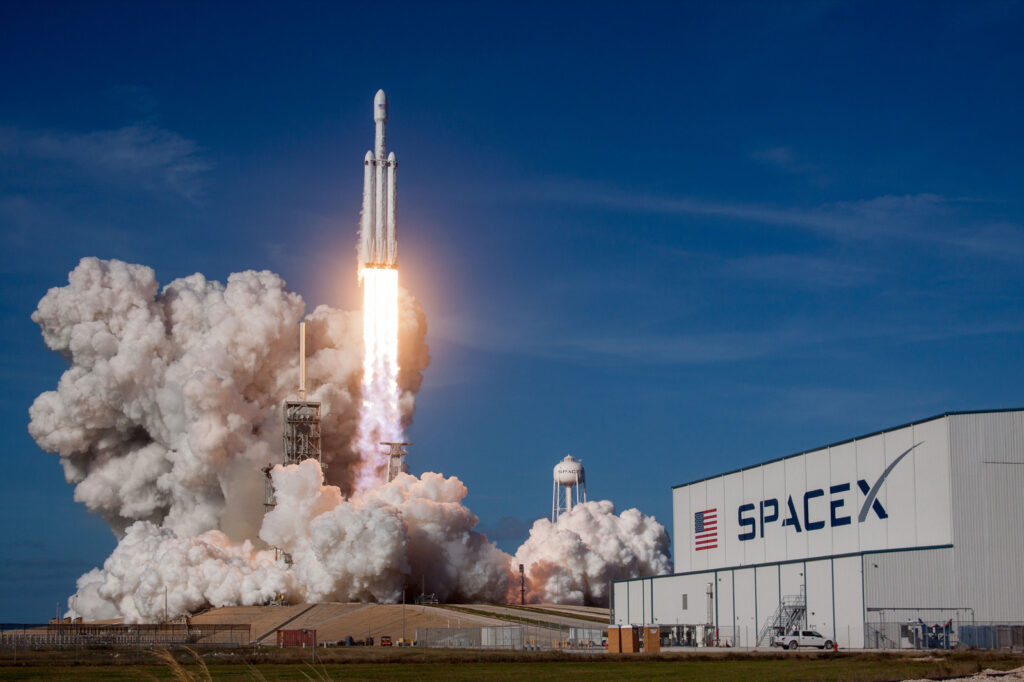
I. The Story They Tell
Ask Elon Musk what SpaceX is, and you get a sermon, not an answer.
The S-1 opens with this line: “You want to wake up in the morning and think the future is going to be great, and that’s what being a space-faring civilization is all about”. The mission statement that follows commits the company to “build the systems and technologies necessary to make life multiplanetary, to understand the true nature of the universe, and to extend the light of consciousness to the stars”.
There is not a single commercial noun in that sentence.
Musk’s public language stays at the same altitude. In October 2025, he called Starship “a planet-colonizer class rocket. The magnitude of that task makes every other space transport task trivial”. On May 20, 2026, the day after the S-1 dropped, he wrote: “I want to enable anyone to go to the Moon or Mars so that we secure the future of consciousness”. In March 2026, he committed SpaceX to send “millions of tons to the Moon to build a self-growing city there and the same for Mars”. In April, he framed Starship as a knowledge ark: “Keep books and historical media safe. SpaceX will put copies of knowledge in space and on the Moon and Mars”.
Then he describes the company itself as “the most vertically integrated innovation on (and off) Earth, featuring rockets, space-based internet, direct mobile communications, and the world’s leading real-time information and free speech platform”.
When asked what success looks like commercially, Musk reaches for cadence and capacity. Starship V3, launched six days before the IPO pricing window, “is designed to transport over a megaton of payload to space per year”. “Almost every part of Starship V3 is different from V2,” he wrote, then days later: “Congratulations SpaceX team on an epic first Starship V3 launch and landing. You scored a goal for humanity”.
When asked about Starlink, the story becomes subscriber growth: 10.3M subscribers across 164 countries, the largest single broadband expansion in human history. When asked about AI, the story shifts: “As the recently expanded partnership with Anthropic demonstrates, SpaceX is offering AI compute as a service at significant scale. Over time, especially with orbital data centers, we expect to serve AI at extremely high scale”. When asked about Starshield, Musk firewalls it: “There is a separate network called Starshield, which is operated by the US government. This is not under SpaceX control”.
Musk credits the success to engineering culture and vertical integration. His official title is not CEO; it is Chief Engineer. His top compensation tranche does not vest until SpaceX builds “a permanent human colony on Mars with at least one million inhabitants”. He retains 85% voting control after the IPO. When asked if he would sell shares into the bell, he answered on the record: “I’m not selling any shares.”
Mars. Multiplanetary civilization. Reusability. Cadence. Starship V3. The $1.75T IPO. 10.3M Starlink subscribers. Starshield. The Anthropic compute deal. The $28.5T total addressable market. The “light of consciousness.” This is the conscious narrative.
The story is internally consistent. It is the story of a 24-year-old company, founded in 2002, that survived three failed Falcon 1 launches, flew 134 times in 2024, filed for a $75B raise at a $1.75T valuation, then promised to send five uncrewed Starships to Mars in the 2026 transfer window before the vehicle had finished proving itself. It is the story Musk has told reporters, employees, investors, and his X audience for two decades. It is the story the S-1 commits to in print.
Notice what the story does not contain. Not a single sentence about what a customer becomes when they buy a Falcon 9 launch, sign a Starshield contract, plug into the Anthropic compute deal, or activate a Starlink kit in a Wisconsin farmhouse. The story is about what SpaceX will do, where it will go, and what it will enable. The verbs are everywhere: make multiplanetary, extend the light, deploy, deliver, secure, launch, and integrate. The adjectives are everywhere: planet-colonizer-class, vertically integrated, reusable, multiplanetary. The transformation noun, the word for what the customer becomes on the other side of the transaction, is absent.
The story is the one Musk tells. It is stirring. It is also not part of the story that the next era of SpaceX will be priced on.
II. The Hidden Position
The position is not in the S-1. It is in the customers, and they have been writing the transformation for years.
SpaceX has earned a noun no one has handed them. The noun is frontier. Not the place. Not the geography. The transformation. A frontier is what a customer enters when a boundary that used to be closed becomes crossable. Frontier is what every SpaceX customer becomes on the other side of the experience.
SpaceX has five customer bases. Each one crosses a different boundary. Each one speaks in a different register. The synthesis to one noun is mine, performed from outside, on the pattern that holds across all five.
Base 1: The United States government. NASA, the Department of Defence, the Space Force, and the National Reconnaissance Office. The register is institutional. They speak in administrator statements, congressional testimony, formal press releases, and acquisition reports.
“The fastest path to bringing these new systems online, launching from America, and ending our sole reliance on Russia is fully funding NASA’s Commercial Crew Program. It is my sincere hope that we all agree that the greatest nation on Earth should not be dependent on others to launch humans into space.” Charles Bolden, NASA Administrator, August 2015
Read Bolden’s 2015 statement as the pre-arrival policy argument that the entire Commercial Crew bet rested on. The line was a request to fund the bet before it had paid off. Now read the next quote as the post-arrival declaration five years later, the moment the boundary closed and reopened.
“Today, a new era in human spaceflight begins as we once again launch American astronauts on American rockets from American soil.” Jim Bridenstine, NASA Administrator, May 2020
The two NASA voices trace the arc. A closed boundary (foreign dependence for American crew launch) named in the political argument, then crossed in the operational declaration.
“This is a groundbreaking day. Today’s awards mark a new epoch of space launch that will finally transition the Department off Russian RD-180 engines.” Dr. William Roper, Assistant Secretary of the Air Force for Acquisition, August 2020
“Creating a more resilient space architecture through proliferation, disaggregation, and orbital diversity is a national security imperative.” Gen. Michael A. Guetlein, Vice Chief of Space Operations, Senate Armed Services Committee testimony, March 2025
“We’re making it harder for our adversaries to hide, while reducing time to insights for our customers from minutes to seconds. Today, we can see, hear, and sense better than any other nation on earth.” Chris Scolese, Director, National Reconnaissance Office, April 2025
What every one of these customers became after buying: independent. NASA became a customer of an American crew system again after nine years of dependence on foreign systems. The Department of Defence became capable of launching national-security payloads on competitively priced, domestically powered vehicles. The NRO became operationally capable of compressing intelligence delivery from minutes to seconds. The boundary that closed and reopened was sovereignty over the orbit overhead.
Base 2: Allied and sovereign governments outside the US. The European Space Agency, JAXA, Italian industrial contractors operating sovereign Earth-observation programs, South Korea, Taiwan, and several emerging-market national rollouts. The register is ministerial. They speak in agency press releases, ministerial statements, and treaty language.
“We have lost our independent access to space, putting at risk the sovereign deployment of the Union flagships, Galileo, Copernicus and soon IRIS². Regaining our sovereignty in terms of access to space is paramount.” Thierry Breton, European Commissioner for Internal Market, January 2024
“With this successful launch of the military satellite, our military has secured independent intelligence, surveillance and reconnaissance capabilities.” South Korean Ministry of National Defence, December 2023
“Our team has shown commitment to offering our country state-of-the-art tools to monitor our planet. If even one step counts, today we have taken seven.” David Avino, CEO, Argotec (Italian government IRIDE contractor), June 2025, after seven IRIDE satellites launched simultaneously on Falcon 9
“We have our own satellite that we can control. We can decide when and where to take images. In terms of national security, having the ability to capture images ourselves is a significant advantage.” Ho-Pen Chang, former Project Director, Taiwan National Space Organization
“The internet can facilitate better access to healthcare services by improving communication between regions, enabling real-time reporting from health facilities.” Budi Gunadi Sadikin, Minister of Health, Indonesia, May 2024, at the Bali Starlink launch
What every one of these customers became: sovereign in orbit, or operational on the ground where the grid did not previously reach. Korea became a country with its own reconnaissance layer. Italy became a country whose national Earth-observation programme moved from blueprint to deployed constellation in a single launch. Taiwan became a country with sovereign control over its own territory. Indonesia became a country whose Ministry of Health could receive real-time data from clinics in the outer islands. Europe became a region able to maintain access to its flagship navigation system through Ariane 6’s outage by accepting interim launches on Falcon 9. The boundary in each case was the line between sovereign and dependent, or between connected and absent.
Base 3: Commercial satellite operators. Iridium, SES, Telesat, Planet Labs, Eutelsat, OneWeb, Globalstar, AST SpaceMobile, and EchoStar. The register is operator. They speak in earnings calls, investor presentations, official IR press releases, and 8-K filings.
“In the end, we kind of took a chance — I’m glad we did that — the deal with SpaceX was about $450 million, a little bit more, for eight rockets. The next best deal I had was like $1.2 billion.” Matt Desch, CEO, Iridium Communications, June 2024
“We’ve come a long way, and we are particularly excited to see the financial transformation enabled by the completion of the Iridium NEXT system and the associated drop in capital expenditures.” Matt Desch, CEO, Iridium Communications, July 2018
“We thank SpaceX for their support, which reflects our shared vision for the boundless potential of space. With these launch plans in place, we’re on track to finish building out our full fleet of satellites and deliver robust, fast, secure connectivity around the globe.” Neil Masterson, CEO, OneWeb, March 2022, after Russia’s seizure of OneWeb satellites at Baikonur
“In SpaceX’s hands, it gives them a lot of flexibility in combining uplink and downlink, and it gives them a lot of flexibility for where spectrum might come in the future. They’re going to be able to make much better use of it than we can in today’s terms. And we’re pleased to get SpaceX stock.” Charlie Ergen, Chairman, EchoStar, November 2025, on the $17B spectrum sale
“We wouldn’t be having the conversations that we are about the capacity, the capabilities of the industry, without the drastically reduced cost of launch and then much more rapid cadence.” Tom Stroup, President, Satellite Industry Association, April 2026
What every one of these customers became: operationally viable. Iridium became a company that could refresh a 75-satellite constellation in under two years on a fixed-price contract for less than half the next-best bid. OneWeb became a company that could survive a geopolitical launch crisis without a constellation graveyard. Telesat became a company that could deploy Lightspeed on schedule when its preferred launchers were not flying. EchoStar became a company that monetized rather than operated its spectrum. The boundary in each case was the line between business plans that close and business plans that fail. Cadence is the mechanism. Surviving the next constellation refresh is the transformation.
Base 4: AI compute buyers. Anthropic is the confirmed customer. Stargate, xAI Colossus, CoreWeave, and Crusoe Energy are the competitive context that defines what the frontier means here. The register is deal structure, board letter, executive interview, and developer blog post.
“We are going to need to move a lot of atoms in order to keep up with AI demand, and there’s nobody better at quickly moving atoms — on or off planet Earth.” Tom Brown, Co-founder and Chief Compute Officer, Anthropic, May 2026
“We’ve signed an agreement with SpaceX to use all of the compute capacity at their Colossus 1 data center. This gives us access to more than 300 megawatts of new capacity (over 220,000 NVIDIA GPUs) within the month.” Anthropic official statement, May 2026
“As demonstrated today with the SpaceX compute deal, we are striving to enhance our computing capabilities at a rapid pace. Every day to secure even more computing resources.” Dario Amodei, CEO, Anthropic, May 2026, on the same day Anthropic disclosed 80x usage growth in the prior quarter
What Anthropic became: structurally diversified, with the lightest dependency in its compute stack. The SpaceX contract has a 90-day termination clause. Compare that to the multi-year, billions-of-dollars-of-engineering-debt lock-in of an Azure-style arrangement. Amodei is on the record that compute was Anthropic’s binding constraint at 80x quarter-on-quarter usage growth. As the legal analyst Richard Werner framed it in JD Supra in April 2026, the real negotiation in modern AI compute is not over price or IP but over “where dependence sits in the stack, and how difficult it will be to change course later.” Anthropic crossed from a state where compute was its binding constraint, named on the record by the CEO, to a state where it had five distinct providers and the freshest one was contractually the easiest to leave. The boundary was the line between a single-supplier dependency model and a competitive multi-supplier one.
Base 5: Retail Starlink users. The largest base by headcount, smallest by revenue concentration: 10.3M subscribers across 164 countries, ~$66 ARPU (Average Revenue Per User). The register is a forum post, a Trustpilot review, a journalist interview, and a ministerial statement in countries where Starlink underwrites national infrastructure.
“Truly a blessing for my family.” Texas rural user, r/Starlink “Lifeline.” A Wisconsin user during a 34.5-inch snowstorm said, “It gave me freedom and reliability again.” “We can stream and watch TV like normal people.” “Reliable internet in the middle of the ocean changes everything, safety, navigation, and even life on board.” Japanese mariner “Once Nigerians understand how safe, fast, and reliable Starlink is, MTN and Airtel will only be useful on our phones for calls, not for data services.” “Starlink is indeed the blood of our entire communication infrastructure now.” Mykhailo Fedorov, Minister of Digital Transformation, Ukraine, July 2023: “Our remote regions stand to benefit significantly from Starlink’s expansion of high-speed internet services, especially in addressing challenges in the health, education, and maritime sectors.” Luhut Binsar Pandjaitan, Coordinating Minister, Indonesia, May 2024
What every one of these customers became: included. Included in the modern world. Included on the grid. Included in the institution. Included as a citizen with the same access as the urban norm. The boundary in each case was the line between connectivity and absence of connectivity, and the absence was geographic, infrastructural, or institutional.
Reading the five voices as one transformation.
Five customer bases. Five registers. Five different boundaries. The verb is identical in every base. Each customer crossed from a closed boundary to an open one. The boundary differs. The transformation pattern is the same. A boundary that used to hold becomes crossable. A frontier is what gets crossed.
The frontier the U.S. government crossed was procurement sovereignty. The frontier the allies crossed was the dependence-on-an-ally line. The frontier the commercial operator crossed was the next constellation refresh, paying for itself. The frontier Anthropic crossed was the structural conflict of buying compute from a company that also competes with you. The frontier the rural Starlink user crossed was the edge of the grid.
Different frontiers, same transformation. The product is different. The boundary is different. The register is different. The noun the customer carries home is identical because the structural transformation is identical.
The right noun is frontier. No entity has earned it as a position. It is the noun that contains every substitute the customers reach for: “blessing,” “lifeline,” “ending our sole reliance,” “secured independent ISR,” “state-of-the-art tools to monitor our planet,” “financial transformation,” “diversified hardware strategy.” It survives every product the company runs and every product it has not built yet.
It is what a 12-year-old in Wisconsin, a U.S. Space Force general, the NRO Director, Iridium’s CEO, and Anthropic’s Chief Compute Officer have in common when they each become SpaceX customers. They each crossed a line that used to hold.
Now apply the noun to every major decision SpaceX has made in the last 24 months. Each one stops looking like a separate bet and starts looking like the same bet. Each one makes a different frontier crossable.
Falcon 9 reusability made the orbital frontier crossable as a road, not as an artifact. SpaceX flew 134 launches in 2024 alone, at roughly 95% lower cost-per-kilogram to low Earth orbit than the 2010 baseline. The DoD’s NSSL program has returned $7B in procurement funds and $22B in lifecycle cost reduction since SpaceX’s entry. A frontier you can cross once is a stunt. A frontier you can cross twice a week, at a 95% cost drop, is a frontier that has been opened.
Starlink at 65% of all active satellites made the connectivity frontier crossable for anyone on the wrong side of a terrestrial wire. The wrong side of the wire is rural America, every ocean, every disaster zone, every active war zone, and most of the developing world. A frontier that used to belong to incumbent telcos became crossable on a $66-per-month plan.
The $17B EchoStar spectrum purchase, completing the FCC-greenlit $40B sale together with AT&T’s $23B, made the carrier frontier crossable. SpaceX wrote a check larger than the market cap of most pure-play space companies to buy AWS-4 and H-block spectrum, the same spectrum bands the three U.S. carriers use to connect phones. EchoStar abandoned its plan to be the fourth nationwide carrier and converted decades of spectrum accumulation into SpaceX equity. Charlie Ergen’s own framing concedes the structural point.
The $15B-per-year Anthropic compute contract, $1.25B per month through May 2029, with a 90-day termination clause, made the AI-compute frontier crossable without going through a hyperscaler that is also a competitor. Anthropic does not buy compute from Microsoft because Microsoft owns OpenAI. Anthropic buys from SpaceX because SpaceX is positioned as the line, not the rival.
The 183 Starshield satellites already deployed, the sole Space Force PLEO contract worth up to $900M over ten years, the NRO proliferated architecture now scaled to hundreds of satellites, and the Golden Dome inclusion made the sovereign-defence frontier crossable for a U.S. government that no longer wanted to depend on the legacy primes. SpaceX is the largest private defence satellite network operator in history, yet refuses the label “defence contractor.” Roughly 20% of 2025 revenue came from U.S. federal agencies. Governments are not buying products. They are crossing a frontier that the company opened first.
The T-Mobile Direct-to-Cell partnership, with the one-year T-Mobile exclusivity ending in July 2026, made the carrier-agnostic frontier crossable. After July, SpaceX is a network layer above every U.S. carrier. AT&T, T-Mobile, and Verizon announced a defensive joint venture on May 14, 2026, to pool spectrum for satellite-based direct-to-device. Three carriers merged their strategy to defend against a fourth thing they could not name. That thing is the frontier they did not open.
The launch cadence at roughly 95% lower cost per kilogram, the Iridium NEXT financial-transformation precedent, the Telesat Lightspeed 14-launch consolidation, the SES O3b mPOWER multi-orbit build, the Planet Labs and Capella Space rideshare programs, the OneWeb post-Baikonur survival, the Starshield-NRO architecture, the Anthropic compute deal, the EchoStar spectrum acquisition, the Mars compensation milestone, the 85% voting control, the IPO at a $1.75T target with up to $75B in proceeds. Every decision, traced one by one, reduces to the same noun. Frontier.
Three of those decisions are load-bearing. Each one fails under any framing other than frontier. The Anthropic $15B-per-year compute contract. A rocket company does not sell compute. An aerospace contractor does not operate data centers at hyperscaler scale. A defence supplier does not sign commercial AI customers on 90-day terminations. The deal is coherent only under one framing: SpaceX opens new frontiers, and AI compute is one of them. The EchoStar $17B spectrum acquisition. A satellite internet company does not write a $17B check for carrier-grade spectrum. A rocket company has no use for AWS-4 and H-block bands. An aerospace company does not acquire FCC spectrum at telecom scale. The deal is coherent only under one framing: a frontier opener absorbs the adjacent frontier when it is for sale. The Mars compensation milestone. A CEO compensation grant that vests only when SpaceX establishes a permanent human colony on Mars with at least one million inhabitants fails under any commercial framing. No public company ties top compensation to a goal that may take three decades and sits outside the company’s primary business. The grant is coherent only under one framing: frontier opening, at its most extreme expression, is the operating filter to which the founder binds himself.
Three decisions. One framing. The other framings cannot hold them.
Now apply the remove-all-words test
Delete the press releases, the S-1 cover page, every Musk X post, and every analyst note. Look only at where capital, people, and contracts flow. What pattern remains?
SpaceX writes telecom checks. SpaceX sells compute capacity to AI labs. SpaceX runs the country’s launch utility, with roughly 95% of U.S. launches and 60% of global commercial launches. SpaceX operates a sovereign defence satellite swarm. SpaceX is becoming the carrier above the carriers. SpaceX is the launch backbone for half of every other constellation operator on Earth, including most of its commercial competitors. Each line of business is a different frontier. The mechanism that makes them crossable, in every case, is off-Earth infrastructure. The noun the customer carries home, in every case, is frontier.
Off-Earth infrastructure is the proof.
Frontier is the position.
This distinction is the entire move. The mechanism is what SpaceX operates. The position is what the customer becomes. Most positioning analyses collapse these two layers because they describe what the company does. Customers do not buy what a company does. They buy who they become after they have experienced your product or service.
Now look at the competitive territory through the frontier lens.
Amazon Kuiper is framing itself on “affordable broadband.” A price noun. AST SpaceMobile is framing on “the cellular partnership,” a feature noun, while buying its launches on Falcon 9. Blue Origin is framing the dream that has not yet shipped, FAA-grounded since April 30, 2026, after the New Glenn upper-stage anomaly, a deferred noun. Rocket Lab is framing “the second affordable launcher,” a comparative noun. ULA is “the legacy Pentagon contractor,” a legacy noun. EchoStar is now “the company that sold itself to SpaceX,” a derivative noun. Eutelsat / OneWeb owns “European sovereign LEO,” a regional noun. LandSpace owns “sovereign Chinese constellations,” another regional noun. CoreWeave owns “the essential cloud for AI,” a feature-of-a-feature noun.
Not one of them is positioning on a transformation. None of them can. Each of them has a feature, a region, or a price. None of them can credibly say “we make a frontier crossable,” because none of them open frontiers. They follow.
This is the rarest condition in modern enterprise. A $1.75T company about to file the largest IPO in history with no shared noun across its founder, its analyst class, its five distinct customer bases, and its competitors. The Economist calls SpaceX an “aerospace company.” HDIN Research calls it “an artificial intelligence infrastructure conglomerate” in transition from “an aerospace contractor.” Quilty Space calls it “the satellite constellation arm” inside a launcher. Equity Research India requires three nouns at once: “launch company plus internet network plus AI and social media company.” Space Daily concedes the obvious: “The categories are out of date.”
SpaceX has been embedding the noun structurally for years. The capex, the voting, the compensation, the contracts, the OSHA tolerance, the reseller pause, the Anthropic landlord deal, the EchoStar spectrum acquisition, every material commitment proves the same word. The label has never used it. Musk talks at the far horizon (“multiplanetary civilization”) and at the near tool (“reusable rockets”), and the word that sits between them, the word the evidence has been writing the whole time, is the one he has not named.
When the analyst class writes its first coverage initiation after the bell on June 12, 2026, they will reach for the corrosive default: “satellite internet with rockets attached.” That is what The Economist already wrote. That is what HDIN wrote. The category is out of date, and yet there is no replacement, because SpaceX has not named one.
Aerospace and defence cannot hold this company. The IPO is going to force the analyst class to adopt a coverage taxonomy, and right now, they cannot agree on one.
Frontier is not aerospace. It is a category of one.
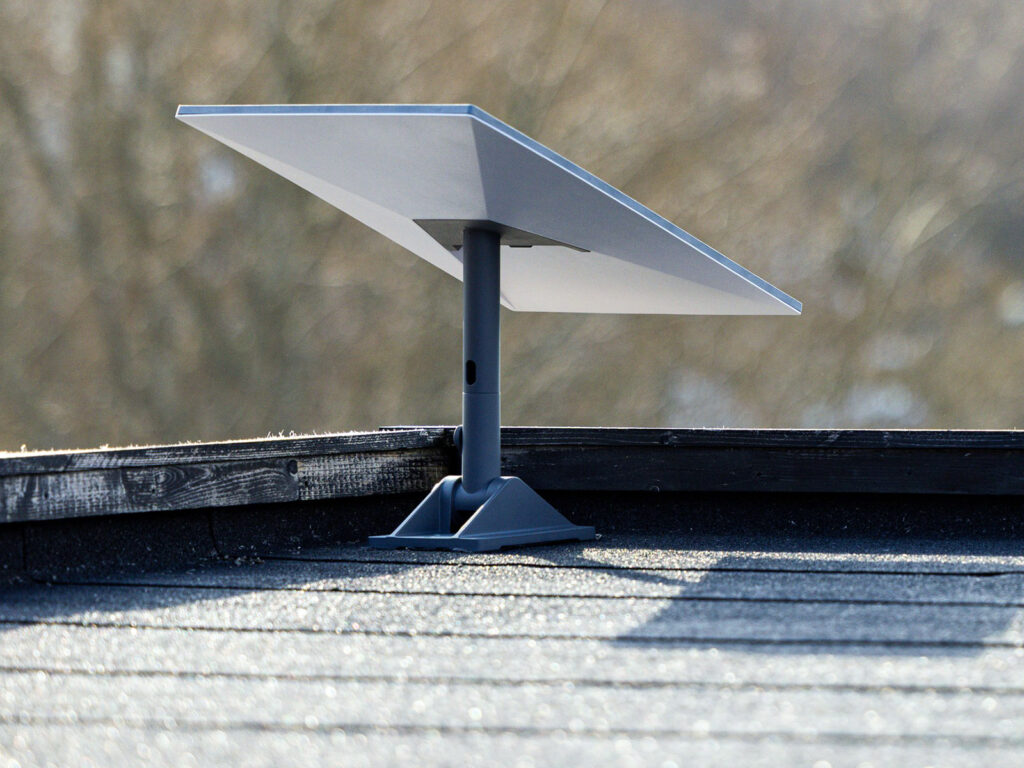
III. The Identity Layer
The SpaceX customer base is not demographic. It is identity-based, and it spans five altitudes.
A grandmother in rural Wisconsin, a NASA Administrator, a South Korean Defence Ministry spokesperson, Iridium’s CEO, and Anthropic’s Chief Compute Officer are not the same customer. They share the same transformation pattern at five different altitudes. The customer is different at every altitude. The pattern is identical: a boundary that used to hold no longer holds.
Read the language carefully across the five voices.
The Wisconsin user says “lifeline” after a 34.5-inch snowstorm. She is not describing bandwidth. She is describing what she became: safe, when geography would have made her isolated.
The Texas user says “blessing.” Theological language. He is not describing a product. He is describing a passage, from “left behind” to “chosen by the modern world.”
Bridenstine says, “We once again launched American astronauts on American rockets from American soil.” He is not describing a launch contract. He is describing what NASA became: sovereign in human spaceflight again, after nine years of being a passenger on someone else’s rocket. Bolden’s pre-arrival statement five years earlier said the United States should not be dependent on others to launch humans into space. Read the two together, and you see the closed-boundary argument, then the crossed-boundary declaration.
The NRO Director says, “Today, we can see, hear, and sense better than any other nation on earth.” He is not describing satellite specifications. He is describing what the United States became: the most operationally capable space-based intelligence apparatus in history, with revisit times measured in seconds instead of minutes.
The European Commissioner says, “We have lost our independent access to space.” He is using SpaceX while saying it. He is describing what Europe became, in the interim: a region whose flagship navigation system shipped on a foreign rocket because the alternative was an outage.
The South Korean Ministry of National Defence says “secured independent intelligence, surveillance and reconnaissance capabilities.” Compressed, declarative, complete. South Korea became a country with its own eyes overhead.
The Argotec CEO says, of seven IRIDE satellites launched simultaneously on Falcon 9, “if even one step counts, today we have taken seven.” Italy became a country whose national Earth-observation programme moved from blueprint to deployed constellation in a single launch.
The Taiwan project director says, “We can decide when and where to take images,” and “having the ability to capture images ourselves is a significant advantage.” Taiwan became a country with sovereign control over its own territory.
The Indonesian Minister of Health says “real-time reporting from health facilities.” Indonesia became a country where the Ministry of Health could see what its remote clinics were seeing the moment they saw it.
Matt Desch of Iridium says, “In the end, we kind of took a chance, I’m glad we did that,” and then quotes the dollar figures. He became a CEO who admitted on the record that the deal was a gamble that paid off. Iridium became a company that finished a refresh and walked into a long cash-generation window.
Neil Masterson of OneWeb says, “We thank SpaceX for their support, which reflects our shared vision for the boundless potential of space,” weeks after Russia confiscated his satellites at Baikonur. OneWeb became a company that survived a constellation-extinction event.
Charlie Ergen of EchoStar says, of SpaceX, “they’re going to be able to make much better use of it than we can in today’s terms.” EchoStar became a company that monetized its spectrum rather than operated it.
Tom Brown of Anthropic says, “There’s nobody better at quickly moving atoms — on or off planet Earth.” Dario Amodei says the same day, “We are striving to enhance our computing capabilities at a rapid pace, every day, to secure even more computing resources.” Anthropic became a company whose lightest compute dependency is the freshest one, with a 90-day exit and 300 megawatts of capacity, contracted in a quarter when usage grew 80 times.
@LiamJ2611 says it cleanly: “Starlink wasn’t just better internet. It gave me freedom and reliability again.” He became free.
The Japanese mariner writes: “Reliable internet in the middle of the ocean changes everything, safety, navigation, and even life on board.” He became connected at sea.
The Nigerian user writes that once people in his country understand Starlink, “MTN and Airtel will only be useful on our phones for calls, not for data services.” He became independent of the incumbent telecom monopoly.
The Hacker News engineer calls it “a cash cow” and “a cash machine.” He is not insulting Starlink. He is identifying himself. He becomes early in the next infrastructure monopoly.
Mars colonists, if and when they exist, will become the first people to leave Earth.
The compensation grant requires one million of them. Mars is the limit case of the same transformation. Rural Wisconsin is another limit case. NASA returning to American crewed launch is another. South Korea seeing its own territory from its own satellites is another. EchoStar walking out of the LEO race with SpaceX equity is another. Anthropic securing 300 megawatts of compute outside Microsoft and Amazon is another. All of them sit at the same noun. Mars is the most extreme line. Rural Wisconsin is the most ordinary line. The South Korean ISR satellite is the most sovereign line. The Anthropic compute deal is the most structural line. The transformation pattern is the same. The customers are different.
Musk’s own identity sits inside the same frame, even though he has not stated it. His title is Chief Engineer, not CEO. His salary tranche is a Mars city. His voting control is 85%. His public language rotates from “consciousness” to “compute” to “civilization,” each rotation a different attempt to gesture at a noun he has never named. He is the engineer who refused to let any boundary be load-bearing.
The charitable read on Musk here is straightforward. The reason he reaches for “civilization” and “consciousness” is that the work feels civilizational from the inside, and the people building it deserve a framing big enough to hold what they have done. That framing also leaves the analyst class with nothing to anchor on, because no customer, at any altitude, is actually paying for consciousness. They are paying to cross a line. The civilizational framing is true at the founder altitude and silent at the customer altitude. The customer altitude is the one that compounds.
This is identity-position-product alignment, even though the position is unnamed.
The position chose the distribution, not the other way around. Once the implicit answer was “make a frontier crossable,” the natural buyers were anyone whose limitation was a line. The surface of this planet. The edge of the grid. The edge of the friendly hyperscaler. The edge of the safe sovereign supplier. The edge of an affordable launch contract. The edge of a procurement system that locked in a single launch provider for a decade. Rural broadband, maritime, polar, disaster, war zone, emerging market, sovereign defence, AI compute, Mars logistics, and the entire commercial constellation refresh business all became downstream of the same transformation.
The customers operate in different registers, and the pattern is the same. The retail Starlink user talks about it the way you talk about the lights coming on: it works, it is “the system,” it is “it,” the subject so taken for granted the noun disappears into a pronoun. The NRO Director uses formal language, and reports the same kind of outcome: “today, we can see, hear, and sense” is present-tense, achieved-state language. The Iridium CEO reports it as arithmetic: capex dropped from $600M annually to $35M. The Anthropic Chief Compute Officer reports it as structure: dependency diversified, termination clause 90 days. In each register, the same thing has happened. The customer pressed a button, signed a contract, awarded a launch, or accepted an interim arrangement, and a line that used to hold no longer held.
Ask any Starlink user to explain SpaceX’s strategy and most cannot. Ask them whether their internet works in a snowstorm, on a boat, after a hurricane, on a frontline, and they will tell you instantly. Ask the NRO whether it can compress kill-chain latency from minutes to seconds and the public record shows the answer. Ask Iridium whether the NEXT refresh actually closed, and the 10-K shows the answer. Ask Anthropic whether 300 megawatts came online within one month, and the Claude Code rate-limit increase shows the answer. The asymmetry between what these customers can articulate about SpaceX-the-company and what they can demonstrate about themselves after buying is the signature of a line that has already been crossed.
The strongest market positions are the ones that have moved from deliberation (“should I trust this provider?”) into procedural reflex (“of course it works, I am already on the other side of the line”). SpaceX has achieved this across all five customer bases. The S-1 has not noticed.
Musk speaks in essays. He builds his rhetoric upward, into consciousness and civilization. That language is not a mismatch with the customer’s altitude. It is the destination layer correctly described. Mars and multiplanetary civilization are what SpaceX does and where it goes — Level 3 (Live) on the canvas, the structural commitment layer. Frontier is what humans become on the receiving end — Level 4 (Position), the transformation layer. Both are true. They sit at different levels. The Wisconsin grandmother is on a connectivity frontier. NRO is on an intelligence frontier. Anthropic is on a compute frontier. Future Mars settlers will be on a settlement frontier. Same noun. Different altitudes. The current S-1 makes the destination explicit and leaves the transformation silent. Without the transformation named, the destination reads as a private vision. It does not read as public infrastructure.
The benefit, what each customer received, varies by base. Rural Starlink users received bandwidth at $66 per month, 40-millisecond latency, sometimes 525 Mbps, where 18 Mbps used to be. NASA received commercial crew transportation at a fixed price. The NRO received satellites at a Falcon 9 cadence. Iridium received eight launches for ~$450M. Anthropic received 300 megawatts on a 90-day termination. The position, what each one became, is identical across the five bases: on the other side of a line that used to hold. The benefit is what they paid for. Position is who they became.
IV. The Success Mechanics
Musk did not pick tactics that created the position. The position picked the tactics that worked.
A frontier is something a customer crosses repeatedly, not once. That single fact wrote the engineering culture. Reusability was not a virtue. It was a structural requirement. The Saturn V crossed the line one time and stayed there. Falcon 9 had to be a road. The 134 launches in 2024 at roughly 95% lower cost per kilogram are not a triumph of engineering ambition alone. They are what opening a frontier looks like when you keep it open.
Vertical integration follows from the same logic. A crossing that depends on third parties is borrowed, not owned. SpaceX builds the rockets, the satellites, the ground terminals, the compute, and soon the cellular protocol. Musk calls this “the most vertically integrated innovation on (and off) Earth.” The description is correct. The reason is not love of integration. A frontier cannot have seams.
Starlink follows from the same logic. Rockets without payloads do not pay, and if the long-term goal is the lunar and Martian crossings, the first frontier has to pay for the next. Starlink is the meter on the first frontier that pays: 69% of quarterly revenue, $3.26B in Q1 2026, 10.3M subscribers across 164 countries. Quilty projects roughly $20B in 2026, around 79% of total revenue. The Hacker News engineer who called Starlink “a cash cow” was, accidentally, writing the most honest analyst note.
Starshield follows. No frontier stays purely commercial once a government can become a tenant on it. The 183 Starshield satellites, the NRO swarm, the Space Force PLEO contract, the Golden Dome bid, and roughly 20% of 2025 revenue from federal agencies all sit on the same constellation logic that put Starlink in a Wisconsin farmhouse. Musk fires the defence identity in language (“a violation of commercial Starlink terms of service to use the terminal for weapon systems”), and the same buses carry both payloads. The tenant on the frontier pays a different price. The frontier is the same.
The Anthropic contract follows. AI labs need compute that is not also a competitor. Microsoft owns OpenAI. SpaceX owns Grok, and the company’s posture is landlord, not lab. Anthropic chose the landlord: $15B a year, $1.25B a month through May 2029, 90-day termination, against $12.7B of AI capex in 2025 and a Colossus II data center build at roughly four times industry cost efficiency. The AI-compute frontier opened on the same operational logic that opened connectivity a decade earlier.
The EchoStar spectrum purchase follows. Frontier openers absorb the adjacent frontier when it is for sale. EchoStar tried to be the fourth nationwide carrier and could not. $17B from SpaceX, $23B from AT&T, EchoStar exits as an MVNO. A satellite-internet company does not write a $17B spectrum check. A frontier opener buying the carrier frontier does. The same logic explains the falling ARPU at growing scale ($99 to $81 to $66) and the selective price hike six days after IPO pricing: penetration across the territory, extraction at the choke points.
The IPO multiple follows. Aerospace companies trade at aerospace multiples.
Frontier openers trade at monopoly multiples. If SpaceX is in The Economist’s category, the comparables are Lockheed and Boeing and the valuation is a fraction of $1.75T. If SpaceX is the company that opens frontiers, the comparables are utilities, hyperscalers, telecoms, and global carriers, priced as monopolies of the lines they crossed first. The $1.75T number is already pricing the noun the label has not yet named.
Tesla and Toyota are the cleanest precedent. Same product category. A 30:1 P/E gap. A $755,000 perception premium per vehicle. Toyota owns reliability. Tesla owns the future. The noun moves the multiple. Cash flow does not. Full case study.
The 85% voting control, the Mars compensation milestone, the Chief Engineer title, all follow. A frontier business on a multi-decade horizon cannot be governed at quarterly cadence. Identity-defining founders bind themselves with identity-defining grants. Builders open frontiers. Managers run what builders have already opened.
The Starship V3 test on May 22, 2026, six days before the IPO pricing window, is consistent with the filter. The payload deployment succeeded. Twenty Starlink simulators reached orbit. The booster recovery failed. One of six Raptor engines was lost on ascent. Whether the manifest priority was set deliberately or whether the recovery failed for engineering reasons unrelated to manifest, the outcome is the same: deployment capacity stayed on track and the iconic reusability demo did not. Six days before the IPO pricing window, the part of the operation that compounds is the part that succeeded. The intent behind the manifest call is not in the public record. The outcome is consistent with the filter the rest of this report describes.
The financial pressure underneath sharpens the timing. SpaceX carries about $20B in debt with a $20B maturity wall in September 2027, plus another $9B in failed sale-leaseback financing. The IPO is not optional from a capital-structure standpoint. The multiple the company gets at the bell depends on which noun the market picks. “Aerospace and defence” refinances the debt at one multiple. Frontier refinances it at a much higher one. The noun is not a marketing decision. It is a balance-sheet decision.
What is working accidentally is the silence itself. While SpaceX has not named the noun, competitors cannot aim at it. Kuiper aims at affordable broadband. AST SpaceMobile aims at native cellular. The AT&T, T-Mobile, Verizon joint venture aims at American mobile sovereignty. Each of them fights for a feature word. None of them can fight for frontier, because none of them open one. The vacancy is option value as long as SpaceX is the only one able to claim the transformation. It becomes a vulnerability the moment the analyst class fills the silence with a corrosive default like “satellite internet with rockets attached.”
What is missing is the noun used explicitly inside the company. The structure has been writing it for 24 years. The strategy section of the S-1 has not.
V. The Coaching Moment
Most readers will close this report and file it under messaging. That filing has to be refused before anything else in this section is worth reading.
Positioning is not the marketing team’s job. It is not a word change. It is the prior commitment the operator makes about what kind of company this is, which decisions follow from that commitment, and which decisions are refused because they would dilute it. Marketing is downstream of that commitment. Allocation is downstream of that commitment. Hiring is downstream of that commitment. Pricing is downstream of that commitment. The outcomes the company calls financial performance are downstream of all of it. The chain is one chain.
This is the part most operators already feel, and most boards do not yet have language for. Musk has been operating frontier as a filter for 24 years without naming it. The compounding visible in the S-1 is the proof the filter has been doing the work. The question for the next chapter is whether the filter gets operated consciously inside the company, with the noun used explicitly in strategy decisions, capital allocation rationale, hiring screens, and the operating sections of the S-1, or whether it keeps running on intuition while the analyst class fills the silence with someone else’s word.
The rest of this section walks what frontier looks like when it is the deliberate operating filter, not a word on a campaign.
I. What the filter validates and refuses
A frontier is something a customer crosses repeatedly, not once. That sentence, taken seriously, decides things.
It decides what gets priority on the manifest. The next payload that opens a line a customer can cross repeatedly outranks the next payload that monetizes a line already open. Starship V3 on May 22 is the cleanest recent expression of this direction. Forced to choose, or by accident, deployment capacity stayed on track while booster recovery did not. Twenty Starlink simulators reached orbit. The booster failed. Reusability is the road. The meter on the road is what gets carried first. The decision (or the outcome the decision produced) was the filter, not a tradeoff.
It decides what customer concentration looks like. The DoD, NASA, Argotec, Anthropic, Sadikin’s ministry, the Korean Ministry of Defence, and the European Commission, as a reluctant tenant: each of these pays a price no substitute can offer, because no substitute opens the line they need crossed. That is not customer concentration risk in the conventional sense. It is rent on a road no one else built. The filter says protect the rent, decline the customers who would only pay a commodity rate, refuse the marginal launch contract that exists to fill manifest gaps with payloads that do not open a frontier. The commercial-launch backlog gets sorted into two piles. Frontier-relevant payloads stay. The rest are priced to decline. Rocket Lab Neutron and Blue Origin New Glenn can have the second pile. SpaceX keeps the first.
It decides what Starlink actually is inside the company. Not a consumer broadband product. Not a satellite internet business. The meter on the first frontier that pays for the next. 69% of quarterly revenue, $3.26B in Q1 2026, 10.3M subscribers across 164 countries, Quilty’s projected $20B in 2026 at around 79% of total revenue: that is the meter doing its job. The Hacker News engineer who called Starlink “a cash cow” wrote the most honest analyst note by accident. The decision the filter forces is what to do with the meter as the company moves through the IPO and what comes after. Treating Starlink as a consumer broadband product invites consumer broadband comparisons. Treating it as infrastructure rent on the frontier invites a different conversation entirely. Two framings, two different companies on the same revenue line. The filter picks the second.
It decides which adjacencies get refused in public. Tourism is the cleanest example. Inspiration4 was real. The filter says it does not get repeated as a product line, because tourism is the line crossed once, and a frontier is the line crossed repeatedly. Terrestrial broadband as a product is the second example. Starlink for Business is allowed as a billing wrapper on the meter. Starlink as a standalone consumer ISP brand, sold in retail channels against Comcast and Spectrum, is refused. The wrong adjacency dilutes the position before it strengthens the revenue. Cellular service through Starlink Direct-to-Cell is allowed because it extends the same meter to a place the customer cannot cross today. The refusals are the proof the filter is operating.
It decides what the defence relationship looks like. No frontier stays purely commercial once a government can become a tenant. The 183 Starshield satellites, the NRO swarm, the Space Force PLEO contract, the Golden Dome bid, and roughly 20% of 2025 revenue from federal agencies all sit on the same constellation logic that put a kit in a Wisconsin farmhouse. Musk fires the defence identity in language (“a violation of commercial Starlink terms of service to use the terminal for weapon systems”), and the same buses carry both payloads. Under the filter, the framing is settled. The defence customer is a tenant on the frontier. The pricing reflects that. The contract structure reflects that. The European Commission paying for the bridge it called dangerous is the tell that the filter is doing the work whether or not the customer enjoys the experience.
It decides what the next adjacent frontier acquisition costs. EchoStar tried to be the fourth nationwide carrier and could not. $17B from SpaceX, $23B from AT&T, EchoStar exits as an MVNO. A satellite-internet company does not write a $17B spectrum check. A frontier opener buying the carrier frontier does. The filter explains the falling ARPU at growing scale ($99 to $81 to $66) and the selective price hike six days after IPO pricing in the same breath. Penetration across the territory. Extraction at the choke points. Both moves are coherent under the filter. Under any other framing, one of them is overpriced and the other underpriced.
It decides who joins the company. Frontier as a hiring filter selects for engineers who would not exist anywhere else. Not the best rocket engineer the industry can produce. The engineer who would refuse to work on anything else. The Mars compensation milestone, the Chief Engineer title, and the 85% voting control all read as eccentric founder behaviour under a rocket-company framing. Under the frontier positioning, they read as the founder publicly binding himself to the only customer who matters at this horizon: the talent that joins for a multi-generational project. The compounding the company calls retention is the compounding the filter produces. The two are the same line.
II. The connection most readers miss
Everything in Section I is a decision. None of it is a campaign.
The point is not that frontier is the right word for marketing. The point is that frontier is the prior commitment that makes every one of these decisions coherent, and the absence of a deliberate commitment is the reason most companies make decisions that contradict each other quarter after quarter and call the result complexity.
The charitable read on the way positioning is normally treated runs like this: positioning is the messaging layer, and messaging is downstream of strategy, so the operator focuses on strategy and lets the marketing team handle the words. That treatment is true for the homepage and false for everything that compounds. The S-1 is not a marketing document. The compensation grant is not a marketing document. The manifest priority on May 22 was not a marketing decision. Each of these is a positioning, picked deliberately or arrived at by structural commitment, expressed as operating behaviour. The public language a brand uses on its homepage and in its campaigns is the smallest, last expression of a commitment that has already been made in capital, contracts, refusals, and hires. The customer is supposed to arrive at the noun on their own, by living the brand’s expression of it. The internal commitment is supposed to be unambiguous before the external expression begins.
This is why the gap between the implied position and the operator’s internal language carries cost. Every quarter the operating filter is doing one thing and the inside of the company is using a different word for it, the company pays in three places. Capital arrives sized for the wrong company, with the wrong patience horizon and the wrong expectations about quarterly disclosure. Customers self-select against the wrong promise and have to be re-sorted at the moment of value. Talent joins on the strength of the implied filter and leaves when the leadership’s stated story turns out to mean something different. The cost is real. It compounds in the wrong direction. The internal naming is the step most operators skip, because it feels like nothing changed on the outside. Nothing changed on the outside is the point. Everything that compounds on the outside is downstream of what is named clearly on the inside.
III. The IPO is not a marketing moment
The S-1 is the publication moment for a commitment that has already been made.
Twenty-four years of decisions are about to be summarized in a document that the entire investor class will read on the morning of June 12. The decisions are what they are. The capex is the proof. What is still open is which noun the operating sections of the document use to describe them.
The debt structure sharpens the timing. SpaceX carries about $20B in debt with a $20B maturity wall in September 2027, plus another $9B in failed sale-leaseback financing. The IPO is not optional. The capital arriving against it is not optional. The kind of capital that arrives is decided by the noun that the operating sections of the S-1 teach the market to use. “Aerospace and defence,” used explicitly in the strategy section, attracts one investor base, with one set of expectations about cash flow, capex discipline, and which adjacencies the company is allowed to pursue. “Frontier,” used explicitly in the same section, attracts a different investor base, with different patience, a different tolerance for the Mars timeline, and a different reaction to subsequent capex. The noun the inside of the document uses is the screen that decides which capital walks through the door.
Concrete consequences. Aerospace and defence multiples sit at 15-20x earnings. Utility, hyperscaler, telecom, and infrastructure blends sit at 25-100x depending on growth and infrastructure stake. At a $1.75T valuation, every multiple point sustained over the long term represents tens of billions in market value. The September 2027 maturity wall refinances at aerospace lender rates under one taxonomy and at infrastructure rates under the other. The compounded interest differential over the next decade exceeds the cost of the work that produces the noun. Engineers, executives, and operators who joined on the strength of an implicit frontier-opening mission stay longer when that mission is named explicitly. Anthropic-scale contracts are predictable when SpaceX is the company that opens new frontiers. They are surprise wins when SpaceX is a rocket company with a data center.
This is not a financial argument. It is the same operating filter, made legible in the public document where the operating logic becomes visible to everyone who has not been watching for 24 years. The S-1 is not one document. It is two registers stacked. The strategy section, the risk factors, the use-of-proceeds discussion, the compensation rationale: these are the internal register made public by disclosure law, and they are where frontier belongs explicitly. The cover, the prospectus summary, the roadshow language: these are the external register, where the noun is expressed and the analyst arrives at it on their own.
The asymmetry matters. Inside the company, frontier is the filter and the word. Outside the company, the noun has to be reached for by the customer, after living the experience long enough that no other word fits. The IPO is not the moment SpaceX starts saying frontier on the cover. It is the moment the inside language becomes legible to a wider audience for the first time, because disclosure law requires the operating sections to be written down. The right move is to let the operating sections read with one coherent noun behind every decision, and to let the cover, the prospectus summary, and the roadshow keep doing what the brand has been doing: expressing the transformation without claiming the noun, so the customer keeps reaching for it on their own.
The Economist has already written aerospace company. HDIN has already written AI infrastructure conglomerate. Quilty has already written satellite constellation arm. Equity Research India had to use three nouns at once. None of those is the position. All of them are descriptions of the methods. The analyst class will publish whichever word is closest to hand on the morning of the initiation. Once Wall Street picks a word, it sticks for years. The way the analyst class arrives at frontier on its own is the same way the customers did: by reading the operating filter off the operating sections of the S-1, in language coherent enough that no other noun fits.
What is working accidentally is the silence itself. While SpaceX has not named the noun, competitors cannot aim at it. Kuiper aims at affordable broadband. AST SpaceMobile aims at native cellular. The AT&T, T-Mobile, Verizon joint venture aims at American mobile sovereignty. Each of them fights for a feature word. None of them can fight for frontier, because none of them open one. The vacancy is option value as long as SpaceX is the only company able to claim what the customers already attribute. It becomes a vulnerability the moment the analyst class fills the silence with a corrosive default. The window is the gap between June 12 and the first coverage initiation. The decision is what gets named inside, in that window, in the operating sections.
IV. The diagnostic, handed back
The position is already operating. The compounding on the page is the evidence the filter is real.
The question is not whether to pick frontier. The pattern across all five customer registers points to it. The question is whether the operator runs the company under it consciously, on the operating sections of the S-1 where the strategy and the risk factors and the use-of-proceeds disclosure live, or whether the operator leaves the filter implicit and lets the analyst class fill the silence with a feature word that sticks.
Both paths produce a company. The two companies are different companies. One has its operating filter explicit inside, in the strategy section, the compensation rationale, the hiring screen, the refusal list, and expressed externally in language coherent enough that the analyst class arrives at the noun on its own. The other has an internal filter that drifts and an external register that contradicts itself, and pays the cost of the drift in capital, customers, and talent for as long as the drift continues. The decision belongs to the operator. It belongs to no one else. The S-1 has space for it. The compensation grant has language for it. The expression is already working in customer voices. The compounding has been waiting for the inside of the company to name what the operating filter has been writing for 24 years.
The word is frontier. The decision has two faces. Make it explicit inside, in the operating model, the capital allocation, the hiring screen, the strategy section of the S-1, the compensation rationale, the refusal list. Keep expressing it outside, in language the customer reaches for on their own, until the noun the inside is using is the noun the outside finds without being handed it.
Leave a Reply
You must be logged in to post a comment.